TRUNKO
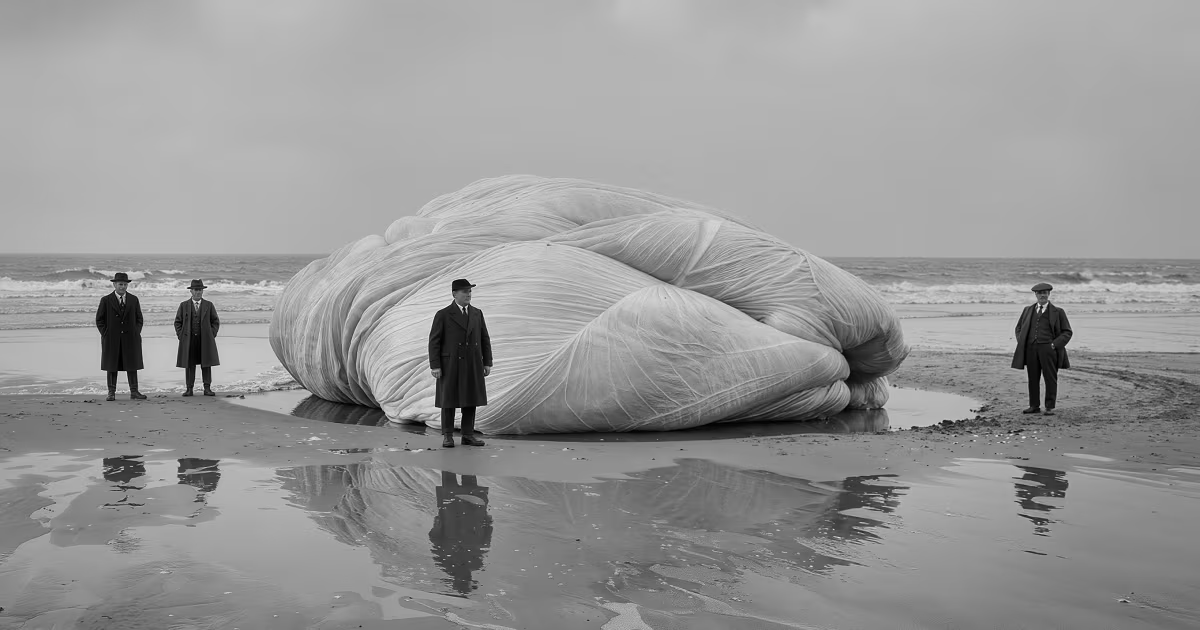
Men in bowler hats around a huge white mass washed up on a beach.
Illustration, not a period photograph.

Opening
In late 1924, at Margate on the Natal coast of South Africa, a farmer named Hugh Ballance watched what he took to be two whales fighting a large white animal about 1,300 yards offshore. For about three hours, he said, the animal reared as much as 20 feet out of the water and struck at the whales with its tail. Then the whales left, and the animal floated, still.
Afterwards a carcass lay on the beach: about 47 feet long, covered in what looked like snow-white hair, with a trunk-like appendage at one end and no head anyone could find. It stayed there for ten days, nobody with scientific training examined it, and then a spring tide took it away. The story reached London's Daily Mail on 27 December 1924 under the headline "Fish Like A Polar Bear". Seventy-two years later it got its name: Trunko.
Timeline
25 October 1924, the date usually givenBallance and others watch the fight offshore at Margate. The date is not settled: Karl Shuker, who named the case, puts the stranding in November 1924, and Ballance's own account, as later quoted, describes the morning of 1 November. Some local retellings move it to 1922, which Shuker calls dubious.
The next morningBallance inspects the carcass on the beach. He and others describe white "fur", a trunk, a lobster-like tail and no blood.
The following ten daysThe carcass lies on the beach until a spring tide carries it back out to sea. No tissue is kept.
27 December 1924The Daily Mail runs the story. Other papers repeat it, some with embellishments of their own.
25 March 1925In Indiana, the Elwood Call-Leader runs it as "Whales are Slain by Hairy Monster".
August 1925Two photographs by A. K. Jones appear in Wide World Magazine, then are forgotten.
1996Cryptozoologist Karl Shuker names the creature "Trunko" in his book The Unexplained.
September 2010Shuker and German correspondent Markus Hemmler track down three of Jones's photographs: one on the Margate Business Association's website and the two from Wide World Magazine.
March 2011Shuker learns of a fourth photograph, found by Bianca Baldi in the Margate Museum's archives. It shows an amorphous white mass.
April 2022Hemmler finds a fifth, posted in 2015 to a Margate nostalgia group by a local businessman who said it came from the town museum. It shows a large fan-shaped projection not seen in the others.
Key figures
Hugh Ballance is the main witness to the fight at sea. He owned the farm called Margate, which was later divided into plots that became the start of the town.
A. K. Jones took the only known photographs while the carcass lay on the beach. Some sources give his initials as A. C.
Karl Shuker named the case and, with Markus Hemmler, brought the photographs back to light. The palaeontologist Darren Naish later assessed them in his 2017 book Hunting Monsters.
Physical and documentary trail
What exists: the 1924 and 1925 newspaper reports, Ballance's account, and five photographs. No tissue, bone or scientific measurement survives, and the dimensions come from the newspapers.
The photographs show a pale, fibrous mass on the sand with no clear head, limbs or skeleton. In one, a man prods the "trunk" with a stick. What is missing is anything that could be tested: the carcass went back to sea before anyone qualified saw it.
The horror was clothed in snow-white hair and seemed to be devoid of blood.
Things you might not know
- The "fur" was eight inches long. The reported measurements: 47 feet long, 10 wide, 5 high, a 5-foot trunk 14 inches across, and a 10-foot tail two feet thick.
- The witness owned the town. Ballance's farm, Margate, was later cut into half-acre plots that grew into the resort town.
- The story grew on the way to America. By March 1925 an Indiana paper had the monster slaying the whales.
- The photos sat in a magazine for 85 years. They were published in 1925 and nobody in cryptozoology knew about them until 2010.
- A fifth photo may explain the "tail". The image found in 2022 shows a large fan-shaped projection, which Shuker suggests may be what witnesses called a lobster-like tail.
- The name is only 30 years old. Nobody in 1924 called it Trunko. Karl Shuker came up with it in 1996.
Competing explanations
A globster. Decomposed whale carcasses often wash ashore as pale, fibrous masses. As the skeleton falls away and the blubber breaks down, a sac of collagen is left, and its fibres look like white hair. Shuker thinks the "trunk" was most likely an enclosed rib wrapped in fibrous tissue. Naish says the photographs show "the rotting carcass of a large vertebrate, most likely a whale". Where other famous globsters have been tested in a laboratory, including the Chilean blob of 2003, they have turned out to be whale.
An unknown sea animal. The trunk and the "hair" led to theories of a new species, and Trunko is unusual among globsters because a witness says he saw it alive. Nothing in the photographs requires a new animal.
The fight. Later retellings make the attackers killer whales. Killer whales attacking a whale, or a large carcass being tossed by waves and scavengers, could explain what Ballance saw from 1,300 yards away.
Later life of the case
Trunko is a staple of sea-monster lists. The 2010 photographs moved most researchers firmly toward the globster explanation, and the fourth and fifth images, found in Margate's own archives, have done nothing to move them back.
Finding
The data points to a decomposing whale. The photographs show a classic globster: pale, fibrous and shapeless, and the fifth may even show the "tail". The fight at sea is the only part left that's hard to explain, and it rests on one named witness, watching from more than half a mile away, and a newspaper story two months later.
What still will not resolve: what Hugh Ballance watched in the water before the carcass came ashore, and even which day he watched it.
Evidence signature
6/9 Solid
- Witnesses
- several people
- Instruments
- radar or measured data
- Paper
- official records at the time
How well documented the case is, not whether it's true. A strong record can still have an ordinary answer, and a thin one can still be real.
You decide · TRUNKO
What do you think happened?
One vote per case, anonymous. You'll see how other readers voted once you've voted.