BEAST OF DEAN
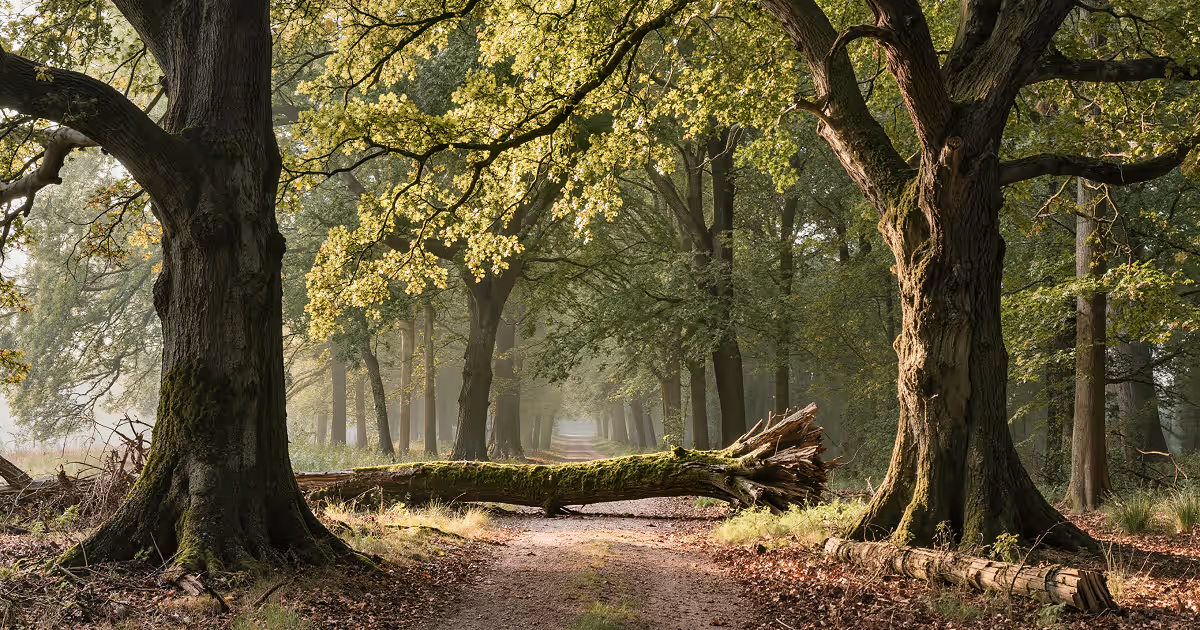
A fallen tree across a track through ancient oak woodland.
Illustration, not a period photograph.

Opening
The Beast of Dean is a giant boar-like creature said to have roamed the Forest of Dean in Gloucestershire in the early 1800s. Local tradition puts it between Parkend and Bream, uprooting trees and flattening hedges, with an unearthly roar to match. Farmers from Parkend are said to have hunted it in 1802 and come home empty-handed. Some versions move the hunt to 1807, and some say the beast was later killed.
No contemporary record of the hunt, the animal's size or a body has been found. The forest's own history from that decade does record huge numbers of domestic pigs turned loose there each autumn. Two centuries later, real wild boar descended from escaped and dumped animals have become established in the Dean, which gives the old story an unexpected footnote.
Timeline
About 1802Lord Nelson tours the Forest and describes "vast droves of hogs" let into the woods each autumn to eat the acorns.
1802, or 1807 in some tellingsA creature described as a giant pig or boar, called the "Moose Pig" in some local versions, is blamed for damage around Parkend. A hunt by Parkend farmers fails to find it.
Later tellingsSome versions say the beast was eventually killed. Details vary from one telling to the next.
1858Henry George Nicholls publishes his history of the Forest, quoting Nelson's remarks on the hogs. It does not mention a beast.
1990sWild boar escape from a farm near Ross-on-Wye and begin breeding in the woods.
2004About 60 boar are dumped illegally near Staunton. By 2009 the two groups have merged.
2007The ITV series Primeval reimagines the Beast of Dean as a gorgonopsid, a Permian predator arriving through a time anomaly.
2008 to 2013Culling begins after a 2008 government action plan, and a population target of 400 animals is set from 2013. A thermal survey that year counts 535; the 2014 survey counts 819.
Key figures
The Parkend farmers of the hunt story, unnamed in every version I found.
Lord Nelson, whose 1802 notes on the Forest are the closest dated document to the legend's setting.
Henry George Nicholls, Victorian historian of the Forest.
Forestry England, which manages today's real boar.
The Dean Heritage Centre in Soudley, which keeps the local version of the story in circulation.
Physical and documentary trail
The beast has no document of its own from the period. The earliest written versions I could trace are modern: local folklore books and heritage material, such as Anthony Nanson's Gloucestershire folk tales (2011) and the Dean Heritage Centre's telling of the "Moose Pig". Wikipedia's article cites Nicholls's 1858 history alongside Nanson, but Nicholls's text only describes the hogs, not a monster.
What the period record does show is the forest full of pigs. Nicholls quotes Nelson, writing around 1802:
Vast droves of hogs are allowed to go into the woods in the autumn, and if any fortunate acorn escapes their search, and takes root, then flocks of sheep are allowed to go into the Forest, and they bite off the tender shoot.
Corrections to the earlier version of this report. The earlier version dated the forest's modern wild boar to 2004. Forestry England traces them to an escape from a farm near Ross-on-Wye in the 1990s; the illegal release near Staunton in 2004 added a second group. The earlier claim that wild boar were extinct in Britain by 1802 stands: Forestry England says they had been gone for at least 300 years before the recent return.
Things you might not know
- Nelson was worried about the oaks. His notes were about timber: deer, hogs and sheep left nothing to grow, and he reckoned the Forest would sell for 460,000 pounds.
- It had a nickname. The Dean Heritage Centre's version calls the creature the "Moose Pig".
- Television gave it teeth. Primeval's 2007 episode turned the Beast of Dean into a gorgonopsid from the Permian.
- The real boar outgrew the target. The 2014 thermal survey counted 819 animals against a management target of 400.
- They are a listed problem. Wild boar were added to Schedule 9 of the Wildlife and Countryside Act in 2010, the list of species it is an offence to release.
Competing explanations
A large feral pig. Wild boar were long gone from Britain by 1802, but Nelson's notes show domestic hogs in the woods by the drove each autumn. An escaped or half-wild boar-type pig growing large in the Forest is the simplest source for a story about a giant pig.
An unknown or surviving animal. Some cryptozoology writing treats the beast as a real animal unknown to science, or a hidden survivor of native boar. There is no specimen, bone or dated description to support either.
A folk tale. A story of a monstrous animal and a failed hunt, exaggerated in retelling and attached to Parkend and Bream. The drift between 1802 and 1807 fits a story passed on by mouth rather than written down at the time.
Later life of the case
The modern boar have given the name new use. They are big, sometimes aggressive, and root up verges and grassland, and local press revives the Beast of Dean name when they turn up in gardens. The legend now sits alongside a managed population of several hundred animals that people in the Forest see for themselves.
Finding
Folklore. The Beast of Dean is a local legend with no record from its own time; the best reading is a story built on the Forest's half-wild pigs. The dated document closest to it, Nelson's note, describes ordinary hogs in great numbers, not a monster.
What still will not resolve: where the story was first written down. I found no account earlier than the modern folklore books, and an earlier newspaper or parish record could still be sitting unread in Gloucestershire.
Evidence signature
3/9 Thin
- Witnesses
- several people
- Instruments
- nothing on record
- Paper
- press and later accounts
How well documented the case is, not whether it's true. A strong record can still have an ordinary answer, and a thin one can still be real.
You decide · BEAST OF DEAN
What do you think happened?
One vote per case, anonymous. You'll see how other readers voted once you've voted.