ROPEN
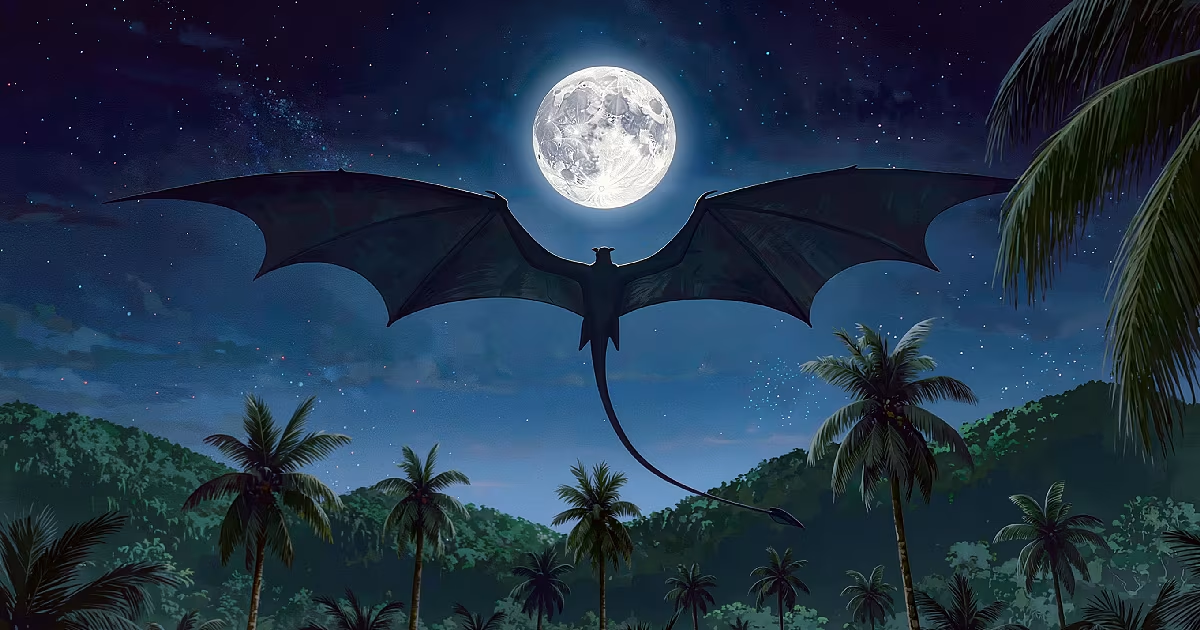
A dark winged shape against the moon over a tropical island.
Illustration, not a photograph.

Opening
On Umboi Island and the coasts of Papua New Guinea, people speak of the ropen, a creature that flies at night. In the accounts collected by American visitors it has leathery wings, a long tail with a flap at the end and, in some tellings, a body that glows. To a small group of searchers, most of them young-earth creationists, it is something extraordinary: a living pterosaur, a flying reptile that should have died out 66 million years ago.
Between 1993 and 2007 a handful of American expeditions went looking for it. They interviewed islanders, kept watch through the night and, a few times, saw distant moving lights. No one has photographed a ropen, filmed one clearly, or brought back a bone.
Timeline
Before the 1990sStories of night-flying creatures are part of local tradition in parts of Papua New Guinea, under several names; "ropen" is the name used on Umboi.
August 1944According to his own later account, Duane Hodgkinson, an American serviceman stationed at Finschhafen on the New Guinea coast, sees a huge creature with a long tail rise from a jungle clearing on a hot, clear day while walking to a village with a friend. He tells the story publicly decades later.
1993 to 2007A series of short American expeditions visit Umboi and other islands in the south-west Pacific to look for a living pterosaur.
2002Paul Nation visits Umboi with his son and sees nothing.
2004Three American searchers, including Garth Guessman and David Woetzel, make two expeditions to Umboi, interviewing eyewitnesses. One of the searchers spends two weeks without seeing anything, while his interpreter reports seeing a glowing form. They return convinced the creature is real.
2005Guessman interviews Hodgkinson on camera, with Whitcomb filming. Hodgkinson, by then a veteran pilot and flight instructor, estimates the wingspan at nearly 30 feet, about the size of his small Piper Tri-Pacer aircraft. Whitcomb reports finding no sign of hoax or hallucination.
About 2006Paul Nation explores a remote area of the mainland and reports several sightings of glowing lights that local people call "indava". He films distant lights.
Late 2000sThe search reaches television, including the cryptid series Destination Truth and MonsterQuest.
Key figures
The islanders who describe the ropen are the source of the stories, and their accounts were collected and translated by the visitors. Garth Guessman, David Woetzel, Paul Nation and the writer Jonathan Whitcomb are the best-known searchers and promoters, several of them motivated by the belief that a living pterosaur would challenge the scientific timeline of life on Earth.
Physical and documentary trail
The record: eyewitness interviews gathered by the expeditions, mostly published by the searchers themselves, a small number of night-time recordings of distant lights, and books written by believers. There is no clear photograph, no specimen, no bone and no study by a zoologist. Searchers have said that most sightings on Umboi are of a distant, fast, glowing shape lasting a few seconds.
The most quoted close sighting, Hodgkinson's, was recorded sixty years after the event, and the size given is an estimate made by comparison with an aircraft. Nothing from 1944 itself, no letter, diary or report, has been published to back it up.
Things you might not know
- Most sightings are lights. By the searchers' own account, most reports on Umboi are of a glowing shape seen briefly at a distance, not a winged animal seen close up.
- The glow is a later idea. Searchers proposed that the creature is bioluminescent, glowing like a firefly, to explain the lights. No large flying animal is known to glow.
- It has several names. "Ropen" is the Umboi name; on the mainland the lights were called "indava".
- The search is mostly religious. Several of the expeditions were run by creationists hoping to show that dinosaur-age animals still live.
- Papua New Guinea has huge flying animals. Large fruit bats, flying foxes, with wingspans well over a metre, live in the region, as do frigatebirds with long, forked tails.
- The star witness was a pilot. Duane Hodgkinson, whose 1944 sighting is the most cited, later logged thousands of hours as a flight instructor.
- The wingspan was measured in aircraft. Hodgkinson put the creature at nearly 30 feet across, roughly the size of a light plane.
- Melanesia's biggest bat is close by. The great flying fox, the largest bat in Melanesia, weighs up to about 1.6 kg and has a wingspan of around a metre and a half.
Competing explanations
Known animals at night. Large flying foxes and frigatebirds, seen briefly in poor light, match parts of the descriptions: leathery wings, a long tail. Size is notoriously hard to judge against an empty sky, and a large bat seen close can look far bigger than it is.
Memory over time. The key close sightings were told years or decades later, to searchers who were already looking for a pterosaur. Details can sharpen in the retelling without anyone intending to deceive.
Lights that aren't animals. Distant fires, torches, meteors or other lights account better for the brief glowing shapes that make up most sightings.
A surviving pterosaur. The searchers' view. Pterosaurs vanish from the fossil record 66 million years ago, no pterosaur fossil younger than that has been found anywhere, and a population large enough to survive would be hard to miss on an inhabited island.
Later life of the case
The ropen lives on in cryptozoology books and online, and in occasional new expeditions. For another "living dinosaur" searched for by creationist teams, see Mokele-mbembe.
Finding
People on Umboi and the mainland describe night creatures and lights, and visiting searchers have seen lights too. Nothing in the record shows a living pterosaur: there is no specimen, no clear image, and the best-documented sightings are of distant glows that could be many things.
What still will not resolve: what the lights seen on Umboi and the mainland are, since no one has recorded them closely enough to tell.
Evidence signature
2/9 Thin
- Witnesses
- one person, or a tradition
- Instruments
- photo, film or physical traces
- Paper
- nothing on record
How well documented the case is, not whether it's true. A strong record can still have an ordinary answer, and a thin one can still be real.
You decide · ROPEN
What do you think happened?
One vote per case, anonymous. You'll see how other readers voted once you've voted.