KRAKEN
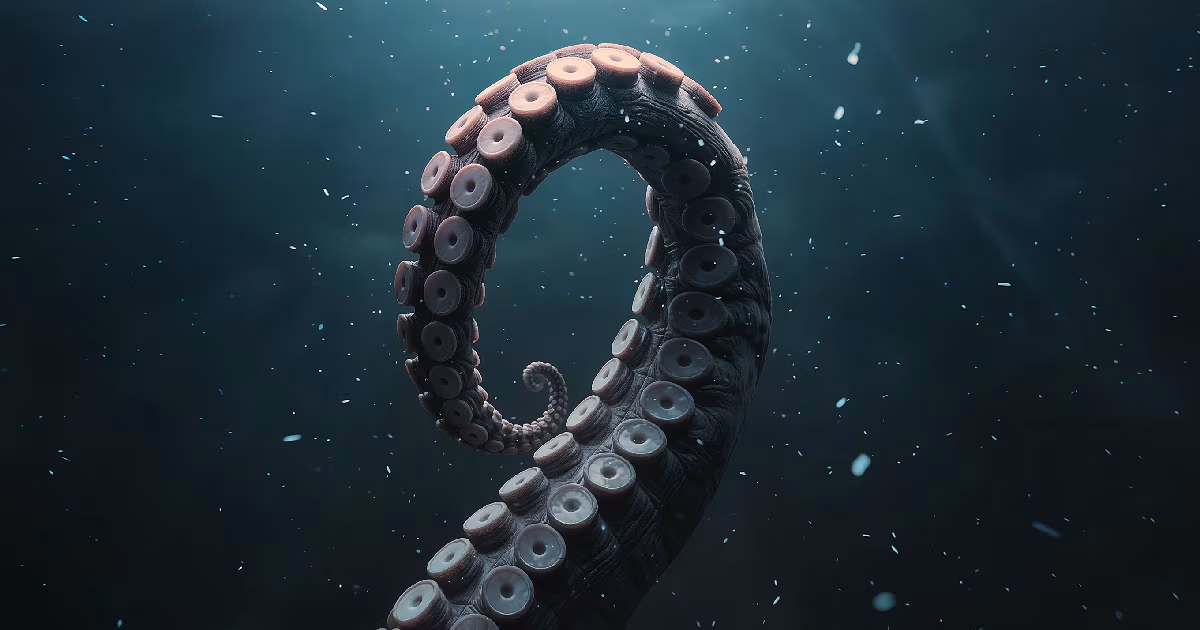
A giant squid tentacle curling up from the dark deep sea.
Illustration, not a photograph.

Opening
For centuries Norwegian sailors told of the kraken: a sea creature so vast it could be mistaken for an island, with arms that could drag a ship under, and a whirlpool behind it when it sank. Naturalists wrote it down, poets made it famous, and by the nineteenth century most scientists filed it with the mermaid and the sea serpent.
Then the bodies started washing up. In the 1870s dozens of enormous squid stranded on the coast of Newfoundland, one with a tentacle more than ten metres long. The creature had a scientific name, Architeuthis, but no one had seen one alive. That took until 2004. The kraken is one of the few sea monsters that turned out to be real, just smaller, and shyer, than the legend.
Timeline
1646The Norwegian writer Christen Jensøn gives the first description of the kraken by name: a many-armed sea monster that drags boats into the deep.
1729The missionary Hans Egede describes a many-headed, clawed creature and links the kraken to the hafgufa of Icelandic tradition.
1735Carl Linnaeus includes a genus called Microcosmus in the first edition of his Systema Naturae, which later writers connected with the kraken.
1752 to 1753Erik Pontoppidan, Bishop of Bergen, describes the kraken in his Natural History of Norway as an octopus-like animal so large it is mistaken for islands, able to pull down a warship, and leaving a whirlpool when it dives.
1801 to 1802The French naturalist Pierre Denys de Montfort publishes an engraving of a colossal octopus attacking a ship, and blames giant octopuses for the loss of British warships in 1782. Others put the losses down to a storm.
1830Alfred Tennyson publishes his sonnet "The Kraken".
1857The Danish zoologist Japetus Steenstrup names the giant squid, Architeuthis, from beaks and remains, and connects it to the old sea-monster stories.
1861The French warship Alecton tries to haul aboard a giant squid off the Canary Islands and recovers only part of the tail.
1870 to 1880Many giant squid strand on the shores of Newfoundland. On 2 November 1878 one washes up at Thimble Tickle Bay with a mantle of 6.1 metres and a tentacle of 10.7 metres.
15 January 2002The first image of a live adult giant squid is taken at Goshiki beach in Japan, of an animal about four metres long that dies overnight.
30 September 2004Tsunemi Kubodera and Kyoichi Mori photograph a live giant squid, about eight metres long, in the deep sea off the Ogasawara Islands south of Tokyo. It is the first ever seen in its natural habitat.
July 2012A Japanese and American expedition including Kubodera and Edith Widder films a giant squid in the deep for the first time, about 23 minutes of footage. It is broadcast in January 2013.
19 June 2019Widder and Nathan Robinson film a young giant squid at 759 metres in the Gulf of Mexico.
Key figures
Erik Pontoppidan wrote the classic account of the kraken. Pierre Denys de Montfort gave it its most famous image. Japetus Steenstrup gave it a scientific name. Tsunemi Kubodera and Edith Widder are the scientists who finally saw and filmed the living animal.
Physical and documentary trail
The legend is documented in Norwegian and Danish writing from the seventeenth century on. The animal behind it is documented by hundreds of specimens: around 700 were known by 2011, about 30 on public display, along with beaks found in the stomachs of sperm whales, photographs from 2004 and video from 2012 and 2019. What has never been documented is anything close to the island-sized creature of the legend.
Things you might not know
- Its eyes are the size of dinner plates. A giant squid's eye can be at least 27 centimetres across. Among animals known to science, only the extinct ichthyosaurs had larger ones.
- It is smaller than the stories. Females reach an estimated 12 to 13 metres including their long feeding tentacles. Reports of 20-metre squid have never been confirmed.
- Sperm whales eat millions of them. Estimates of how many giant squid sperm whales eat each year run into the millions.
- They are nearly all one family. A DNA study found remarkably little genetic difference between giant squid from oceans around the world.
- "Kraken" means a crooked tree. The word comes from Norwegian, related to words for a twisted, overgrown tree.
- Victor Hugo gave it an octopus. His 1866 novel Toilers of the Sea merged the kraken with a man-hunting octopus, an image Jules Verne borrowed for Twenty Thousand Leagues Under the Seas.
Competing explanations
The giant squid. The view of most zoologists: sightings of real giant squid, at the surface or stranded, grew in the telling into a monster that could swallow ships.
Other things at sea. Some kraken stories describe floating "islands" that sank, which fit whales, shoals of fish or volcanic and seabed effects better than any squid.
Something bigger still out there. The cryptozoological view: if a giant squid went unseen alive until 2004, a larger animal could be hiding too. The colossal squid of the Antarctic is heavier than the giant squid, but nothing found approaches the size of the legend.
Later life of the case
The kraken lives on in films, games and the name of a Seattle hockey team. For another sea monster reported by trained observers, see the HMS Daedalus sea serpent.
Finding
The kraken was real, in a sense: behind the legend stands the giant squid, an animal that went unseen alive until 2004 and still lives almost entirely out of sight. It cannot sink ships or pass for an island, and nothing found in the deep comes close to the monster of the old stories.
What still will not resolve: how large a giant squid can really grow, since the biggest are rarely found intact and the deep sea has barely been watched.
Evidence signature
9/9 Strong
- Witnesses
- trained, independent witnesses
- Instruments
- more than one sensor agrees
- Paper
- formal investigation, court or declassified file
How well documented the case is, not whether it's true. A strong record can still have an ordinary answer, and a thin one can still be real.
You decide · KRAKEN
What do you think happened?
One vote per case, anonymous. You'll see how other readers voted once you've voted.