LOCH NESS
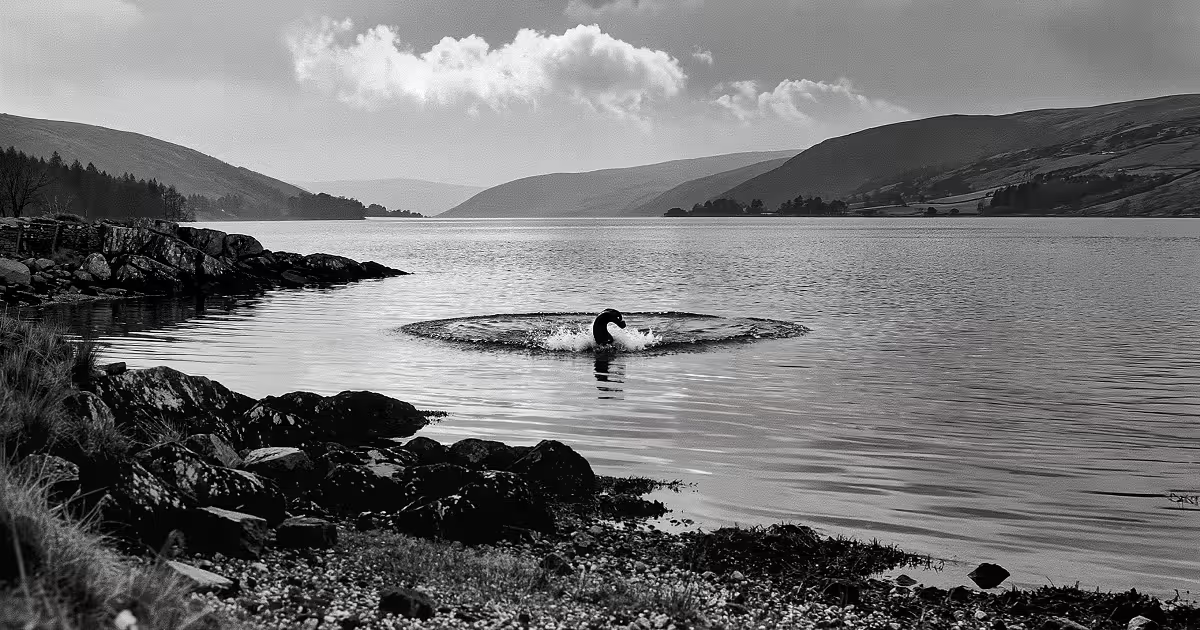
Grey loch. Small neck-wake and 1930s plate look.
Illustration, not a period photograph.
Opening
In mid-April 1934 a London surgeon, Robert Kenneth Wilson, sat on the north shore of Loch Ness with a quarter-plate camera and his friend Maurice Chambers. Something with a long neck came up, he said, about two hundred yards out. He made four exposures. The plates went to Ogston's in Inverness. The Daily Mail bought the best print for a hundred pounds and ran it on 21 April as an unretouched photograph of the monster. Wilson would not put his name under it. The paper called it the surgeon's photograph.
The loch already had a 1933 wave after a new road put cars on the water, and a much older Columba story. This plate is the one the century kept. In the 1990s the Wetherell line spoke. Marmaduke Wetherell, once hired by the Mail and humiliated over fake tracks, had his stepson Ian and son-in-law Christian Spurling build a toy submarine with a plastic-wood head. Wilson was the respectable face. The confession sat in papers after Chambers died. The loch did not empty.
The spine of the file is a print the Mail bought and a toy the family later named. Loch Ness is a photograph. It is not a body in a Highland net.
Timeline
1933. A new north-shore road. Sightings rise. The Mail hires Wetherell, who is then caught in a tracks hoax. That humiliation sits in the later toy story as motive.
Mid-April 1934. Wilson and Chambers on a shooting trip. Four plates. 21 April the Mail runs the best print and keeps Wilson's name off it. The BMA later fines him for letting the association stand near a stunt.
Wilson's own limit was always modest: he photographed an object moving in the water. He did not claim a Latin name. Seth Smith at London Zoo, seeing the print, dropped a grey-seal theory in public.
1990s. After Chambers's death the Spurling and Wetherell account of a toy submarine becomes public. The loch keeps producing later sonar and surface stories. Those are other water. This plate is 1934.
Wilson's four plates went through a local chemist before the Mail paid. That chain is why the print is a newspaper object, not a private album. The BMA fine is colour that still belongs to 1934: a surgeon's name was close enough to a stunt that the association noticed.
The toy story needs Chambers dead before it speaks in public. Until then the plate does the work the century asked of it. Columba and the 1933 road stay older water. They do not expose a quarter-plate.
Key figures
Robert Kenneth Wilson owns the camera and the refusal to put his name under the Mail's headline.
Maurice Chambers is the friend on the shore. His death is when the toy story is allowed to speak.
Marmaduke Wetherell, Ian Wetherell and Christian Spurling own the later making of the head.
The Daily Mail owns both the purchase of the print and the earlier hiring of the man who commissioned the toy.
Physical and documentary trail
On the paper, April 1934 gives you four hard objects and no carcass.
One: Wilson's account of a long-necked object about two hundred yards out and four exposures.
Two: the print the Mail bought and ran on 21 April 1934.
Three: Wilson's own limit that he photographed an object moving in the water.
Four: the 1990s Wetherell-Spurling confession of a toy submarine. Daily Mail, 21 April 1934, surgeon's photograph, is the originating tray.
There is no 1934 body. There is no plate the Mail kept in a chain everyone can still handle. There is no second camera on that shore.
A Mail purchase and a later family confession are two objects, not one. The print can be a toy and still have been exposed on that shore. What the file lacks is the glass in a chain nobody has to take on trust.
When I saw the head of the strange animal rising up out of the water I was so excited I did not pause to observe it properly.
Competing explanations
A real animal on the surface that day. This is what the Mail sold. It has a print. It has no body.
A toy submarine with a plastic-wood head. This is the Wetherell-Spurling door. It has a family confession after Chambers died. It has to live with why Wilson sat for it.
A bird, a wake, a retouched plate. Offered. Country Life is not this file. This plate is the Mail's.
Hybrid caution. A photograph was taken. A toy was later named. The loch did not empty either way.
Later life of the case
Sonar hunts, later stills, the confession specials. I keep those on the later-life shelf. The April print stays first.
Finding
Robert Kenneth Wilson exposed plates on Loch Ness in April 1934 and the Daily Mail ran one as the surgeon's photograph of a long-necked object in the water. Believe the shutter as an event on that shore. A surgeon does not sit with a quarter-plate for a postcard by accident.
What still will not resolve: the original plates in a clean chain, or the toy itself with a 1934 tag. Either one would pin the neck. The proving object is still that head on the water, held as animal or as plastic-wood by more than a confession after a friend died.