SPRING-HEELED JACK
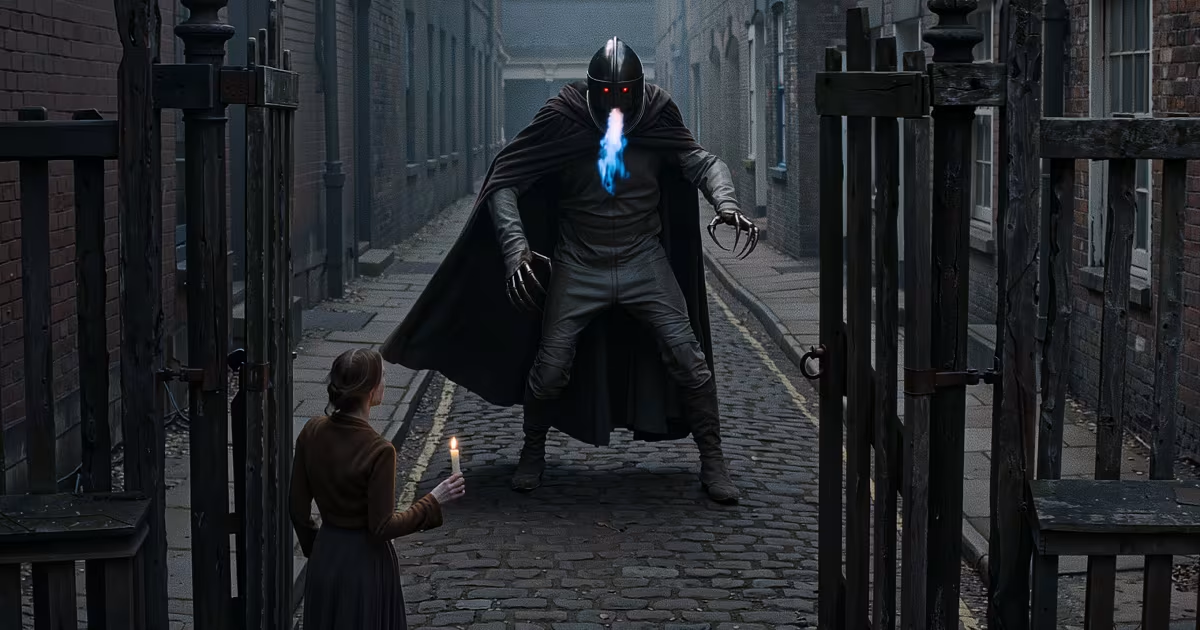
1838 east London lane. Cloaked figure at a gate with a candle.
Illustration, not a period photograph.
Opening
In October 1837, a servant girl named Mary Stevens, walking home across Clapham Common in south London, was accosted by a man who grabbed her with cold, corpse-like hands and forced kisses on her before fleeing at her screams. The following day, a similar cloaked figure leapt in front of a passing carriage, causing it to crash and injure the coachman, then reportedly escaped by clearing a nine-foot wall in a single bound. Over the following year, reports of a leaping, fire-breathing, claw-handed assailant poured into London newspapers and the Lord Mayor's own office from villages across the city's outskirts. The panic would recur, in isolated flare-ups, for over sixty years, as far afield as Liverpool in 1904, and its central mystery, who or what Spring-Heeled Jack actually was, has never been resolved, though at least one popular later account of the case has itself been caught fabricating evidence.
Timeline
October 1837. Mary Stevens is attacked on Clapham Common; the following day a similarly described figure causes a carriage crash and is seen vaulting a nine-foot wall while cackling, the specific combination of leaping ability and manic laughter that gives the figure its lasting name.
Late 1837. Reports multiply rapidly across more than twenty villages around London's edges, describing the figure appearing variously as a ghost, a bear, and a devil. In Cut-Throat Lane, Isleworth, a carpenter named Jones is attacked by a figure in armor and, when he fights back, is set upon by two additional "ghosts" and badly beaten, one of the earliest reports suggesting more than one person may have been involved in at least some incidents.
Late December 1837-early January 1838. The figure is reported around St John's Wood dressed in armor and as a bear, and separately on London's western edge as a devil armed with iron claws, attacking a blacksmith and several women.
9 January 1838. Sir John Cowan, the Lord Mayor of London, addresses the growing panic at a public session at Mansion House, reading aloud an anonymous letter signed "a resident of Peckham" alleging that wealthy young men had made a wager that one of their number would visit villages near London disguised as a ghost, a bear, and a devil, entering private gardens specifically to terrify residents. Cowan states publicly that the perpetrators are believed to be a group of "wealthy young men" playing pranks and assures the public they would soon be caught. No one was ever identified or charged in connection with this specific claim.
19-20 February 1838. Lucy Scales, a butcher's daughter, is attacked in Limehouse by a cloaked figure who spits blue flame directly in her face, leaving her temporarily blinded and suffering fits for hours afterward.
Same period. Jane Alsop, eighteen, is at her family's home in Bearbinder Lane, Old Ford, when a man at the garden gate claims to be a police officer and shouts that they have caught Spring-Heeled Jack nearby, asking her to bring a light. Alsop fetches a candle; the man throws off his cloak to reveal, in her own testimony to magistrates, red eyes like "balls of fire," a large helmet, tight white oilskin-like clothing, and claw-like hands, before vomiting blue and white flame toward her face and tearing at her dress and neck with metal claws until her family drives him off. Alsop's detailed, formally given magistrate testimony is the single most credible and thoroughly documented account in the entire case's history.
Shortly after Alsop's report becomes public. A man named Thomas Millbank is heard in a pub boasting that he is Spring-Heeled Jack and is subsequently arrested; at trial, he is acquitted specifically because he could not demonstrate the ability to breathe blue flame, a central and specific detail of Alsop's own testimony that his prosecution could not reconcile with an ordinary human suspect.
Following months. The Brighton Gazette and other regional papers print similar stories through April 1838, and reports continue from Hammersmith, Kensington, Ealing, Camberwell, Vauxhall, Brixton, Stockwell, Lewisham, and Blackheath, showing the panic's genuine geographic spread beyond any single neighborhood or set of witnesses.
1838, contemporaneous suspicion. Henry Beresford, 3rd Marquess of Waterford, a wealthy Irish nobleman known as "the Mad Marquess" for his drunken pranks, contempt for women, and reputation for doing "anything for a bet," becomes a popularly suspected perpetrator, a suspicion current even during his own lifetime rather than invented later; an 1838 news report refers to "that turbulent piece of aristocracy" in connection with rumored "nocturnal vagaries."
1850s-1860s. Reports of a similar leaping, armored or cloaked figure recur across England, particularly concentrated in the Midlands.
1877. Soldiers at Aldershot Garrison report a figure appearing near their sentry posts; separately, in the same general period, sentries elsewhere describe being startled by a man who springs onto the roof of a sentry box, prompting military authorities to set traps in an attempt to catch him.
1870, separately. Angry townspeople in Lincoln reportedly shoot at a similar figure in the street; witnesses claim he simply laughed and bounded away over fences and small buildings, apparently unharmed.
1904. The figure is reportedly seen for the last time at Everton, Liverpool, bounding from cobblestones to rooftops in front of a crowd of witnesses before vanishing when locals attempt to corner him.
1959. Henry Beresford, the "Mad Marquess" long suspected in the case, having married and settled down in 1842, dies in an 1859 horse-riding accident, a full 45 years before the figure's final reported 1904 appearance, a chronological problem that, taken at face value, rules him out as the sole and complete explanation for the entire sixty-plus-year phenomenon regardless of any role he may have played in the original 1837-38 events specifically.
1970s-1980s. Author Peter Haining publishes an influential popular account of the case that becomes widely cited and repeated in subsequent retellings, including specific vivid details such as an attack on a "Polly Adams" who allegedly identified her attacker as the Marquess of Waterford, and a servant boy's report of seeing a gold "W" monogram embroidered on the attacker's cloak during a documented 1838 Turner Street incident.
1996. Researcher and historian Mike Dash publishes a detailed critical study, "Spring-heeled Jack: To Victorian Bugaboo from Suburban Ghost," in Fortean Studies, systematically tracing Haining's most specific supporting details, including the Polly Adams identification and the embroidered "W," and finding no record of either predating Haining's own book, concluding both were most likely Haining's own fabrications added specifically to bolster the popular Waterford theory rather than genuine period source material.
Key figures
Alsop is the case's single most credible and thoroughly documented witness, having given detailed, consistent testimony directly to magistrates within days of her attack rather than through secondhand retelling, and her specific description, the flame-breathing detail above all, became the evidentiary standard against which the Millbank prosecution itself failed.
Waterford is the case's earliest and most persistently cited named suspect, a genuinely documented contemporary reputation for exactly this kind of reckless, cruel prank-playing, but his own 1859 death, decades before the phenomenon's final reported appearances, means he cannot account for the case's full multi-decade span even if he was genuinely responsible for some of its earliest incidents.
Millbank is the case's one formally prosecuted suspect, and his acquittal, specifically because he could not replicate the flame-breathing detail central to Alsop's testimony, is a genuinely informative negative result: whatever mechanism produced that specific effect, it was not something an ordinary opportunistic prankster could simply improvise on demand.
Haining is a significant and cautionary figure in the case's later documented history: a popular author whose vivid, specific additions to the story were, per Dash's careful later research, apparently invented rather than sourced, meaning much of what many casual retellings still treat as established period fact actually originates from 20th-century embellishment rather than contemporary Victorian record.
Dash is the case's most rigorous modern investigator, whose systematic tracing of specific claims back to their earliest print appearance represents exactly the kind of primary-source verification most popular retellings of this case have skipped.
Physical and documentary trail
On the paper, this file has genuine contemporary 1837-38 newspaper coverage across multiple regional papers, an anonymous but publicly read letter to the Lord Mayor alleging a specific wager-based prank scheme, Jane Alsop's detailed formal magistrate testimony, a documented criminal prosecution and acquittal (Millbank), and continued, geographically dispersed reports spanning over six decades into the early 20th century.
What it lacks, and what Dash's research specifically demonstrates by exposing Haining's fabrications, is any confirmed physical evidence or reliable period source for many of the story's most specific and dramatic supporting details that circulate in modern retellings; a meaningful portion of what people now think they know about the case traces to one 20th-century author's invention rather than to any 1830s-40s document.
For God's sake, bring me a light! For we have caught Spring-heeled Jack here in the lane!
Competing explanations
A wager-driven prank by wealthy young men, exactly as the Lord Mayor's own publicly read letter alleged in January 1838, potentially involving specially constructed spring-loaded footwear and a chemical or mechanical means of producing the flame-breathing effect. This reading fits the earliest and most contemporaneous official theory and Millbank's own specific inability to replicate the flame effect, without requiring any single named individual to have sustained the entire multi-decade phenomenon alone.
Henry Beresford, the Marquess of Waterford, as the originating perpetrator of the earliest 1837-38 incidents specifically, with later decades' reports representing copycat pranksters and embellished folklore built atop the genuine original panic rather than a single continuous individual actor. This reading is undermined for the phenomenon's full span by Waterford's 1859 death, and, per Dash's specific research, has been actively bolstered in the popular record by later fabricated supporting details that should not be treated as genuine period evidence.
A series of largely unconnected individual prank attacks, military hazing incidents, and unrelated criminal assaults, occurring across more than sixty years and multiple locations, retrospectively unified under one folkloric name and set of shared visual tropes (the cloak, the leaping, the flame) through decades of press repetition and later literary embellishment, particularly via Victorian penny dreadfuls that turned the figure into a recurring fictional villain independent of any specific real incident.
Mass social panic and copycat suggestion, amplified by an already anxious Victorian urban population and a sensationalist contemporary press, in which a small number of genuine initial incidents generated a wave of secondary misidentification, exaggeration, and deliberate imitation, a pattern some period and later commentators have specifically favored as the most economical account of the case's rapid geographic spread in late 1837 and early 1838 specifically.
Later life of the case
Spring-Heeled Jack became one of Victorian Britain's most enduring popular fictional villains, sustained across decades of penny dreadfuls and stage melodrama well past any plausible connection to the original reported incidents, a case where the folklore's fictional afterlife has arguably done more to shape public memory of the "real" case than the actual 1837-38 documentary record itself. Mike Dash's 1996 debunking of specific Haining-era fabrications stands as a genuinely important corrective, demonstrating that even well-established "facts" about historic paranormal cases can themselves be later inventions requiring the same skeptical scrutiny as the original reports.
Finding
A genuine, well-documented wave of assaults and sightings by a leaping, often flame-associated cloaked figure terrorized London's outskirts in 1837-38, generating official acknowledgment from the Lord Mayor himself and at least one formal, if unsuccessful, criminal prosecution. Whether this represents one sustained perpetrator, a coordinated group prank exactly as contemporaries suspected, or a mass panic amplified by press coverage and later copycats, has never been resolved, and the case's most commonly repeated supporting evidence for its leading named suspect has been directly shown, by careful later research, to include invented rather than genuine period detail.
What still will not resolve: the true identity or identities behind the original 1837-38 incidents, and any confirmed mechanical or chemical explanation for the specific flame-breathing effect that both Alsop's testimony and Millbank's failed acquittal defense treat as the case's central, unresolved physical puzzle. Until either surfaces, Spring-Heeled Jack remains what it has been since Sir John Cowan's own 1838 public statement: officially unsolved, and increasingly hard to separate from its own later mythology.