BEAST OF EXMOOR
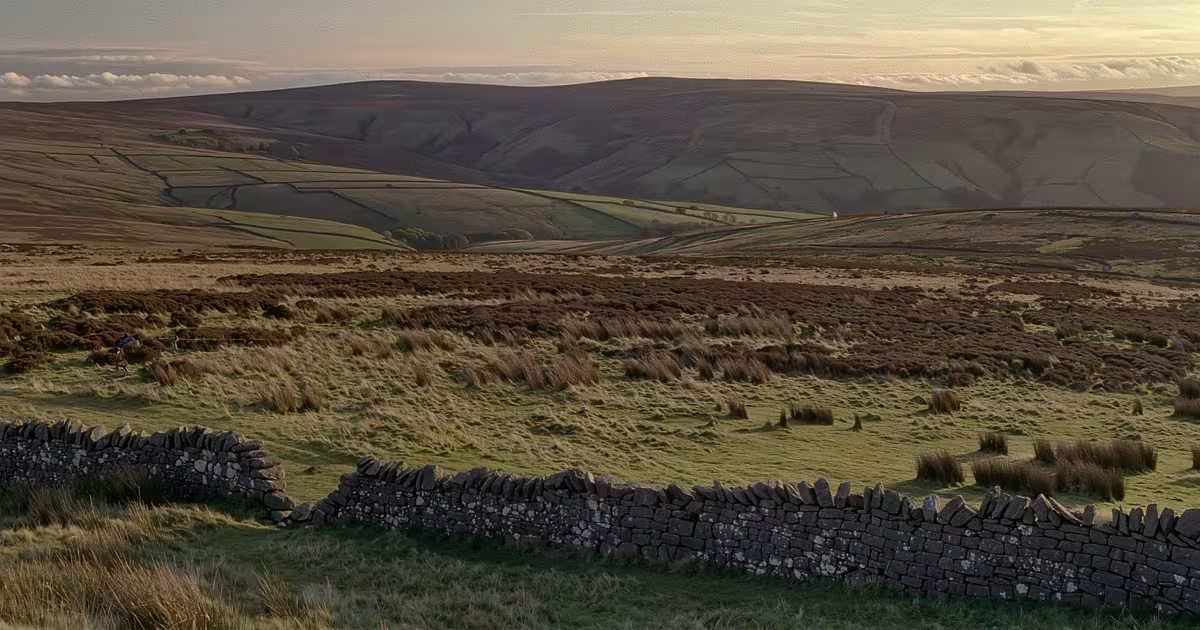
Exmoor hills and heather at dusk, a dry-stone wall across the slope.
Illustration, not a period photograph.

Opening
In the spring of 1983 the sheep on Drewstone Farm, near South Molton on the south-western edge of Exmoor, kept dying with their throats torn. The farmer, Eric Ley, put his losses at more than a hundred in three months. He called in local hunters, then the police, and finally the Royal Marines. Snipers from Lympstone watched the fields at night with image-intensifying sights. The animal was never shot, trapped or photographed clearly.
Talk of a big black animal on the moor went back to the 1970s. The Marines turned it into national news, and the Daily Express offered a reward for film of it. The killings on Drewstone eased, but sheep deaths and sightings continued around Exmoor for years. The question the hunt was meant to settle, cat or dog, is still open, because nothing was ever brought in to examine.
Timeline
1970sSightings of a large dark animal are reported around Exmoor, with some accounts going back to 1970.
Early 1983Sheep and lambs die on Drewstone Farm. Counts in later accounts vary from forty lambs to more than a hundred sheep, and some give about two hundred. The higher figures appear to cover several farms.
April 1983The story reaches the regional, then national press. The Daily Express offers a reward.
Late April to early May 1983Devon and Cornwall police ask the Royal Marines at Lympstone for help. A sniper team is put on the hills with night sights.
Summer 1983The Marines are withdrawn without firing at the beast. Later accounts call the operation Operation Beastie and give its length variously as 78 days or as little as a week.
Summer 1983Bob Rickard's survey "The Exmoor Beast and Others" appears in Fortean Times, issue 40.
1984The naturalist Trevor Beer publishes The Beast of Exmoor: Fact or Legend? and reports his own sighting of a black cat near Drewstone.
1987Beer reports lynx-like prints about three inches across at Muddiford in January and, in August, photographs taken from about a hundred yards of a black cat killing a rabbit.
1989Nigel Brierly, a retired biologist, publishes They Stalk by Night, arguing for pumas.
1990Brierly tells a reporter the killings are running at about fifty a year.
Key figures
Eric Ley, of Drewstone Farm, whose losses started the hunt. Some accounts spell him Lay.
The Royal Marines sniper team from the Commando Training Centre at Lympstone. One of them, John Lambert, later worked as a tracker on the Bodmin Moor cat reports.
Trevor Beer of Barnstaple, nature columnist and author, appointed MBE in 2002 for natural history work in north Devon. He died in 2017, aged 80.
Nigel Brierly, who lived on the southern edge of the moor and spent years collecting reports and trying to trap or photograph the animal.
Physical and documentary trail
What survives is press coverage from 1983, the Fortean Times survey, Beer's and Brierly's booklets, Beer's distant photographs, and casts and descriptions of prints. There is no carcass, no hair sample with a published identification for the 1983 killings, and no Marine photograph. The Independent's 1993 account sums up the hunt's end: no big cat was accounted for.
Rumour had it that the Marines despatched several wandering dogs, but no big cat was accounted for and, although the massacre of sheep diminished, killings and sightings have continued ever since.
Corrections to the earlier version of this report. The Ministry of Agriculture's 1995 investigation, which found no verifiable evidence of a big cat, was into Bodmin Moor in Cornwall, not Exmoor. No government finding specific to Exmoor that blamed mistaken identity was found, and that claim has been dropped. The government's general position is that there is no convincing evidence of wild big cats in Britain. Beer's 4 foot 6 inch black cat was seen in summer 1984 at a deer cache. The rabbit photographs date from 1987. The figure of 86 kills by late June 1983 and the "high, almost human, intelligence" remark attributed to the Marines' commander come only from later retellings and are not repeated as fact.
Things you might not know
- Not every hunter was armed. Brierly recalled one volunteer arriving with a butterfly net, and a dog-catcher from Plymouth dragging a joint of meat round the moor.
- The beast was looked for with catmint. Brierly grew catmint and refined it into oil to bait a steel-mesh cage. Nothing went in.
- A zoo keeper doubted the puma. London Zoo's cat specialist Doug Richardson said in 1990 that claw marks in the tracks argued against a big cat, since most retract their claws.
- Beer did not blame the cats for the sheep. He said he had seen black leopards on the moor but said that in his opinion they rarely if ever killed sheep.
- One hunter caught himself. A cryptozoologist had to be rescued after two days in his own trap.
Competing explanations
A large cat, or several, released or escaped from private keeping. Beer and Brierly argued for black leopards and pumas, possibly let loose after the Dangerous Wild Animals Act 1976 required owners to be licensed. Sightings and prints support it. No body, hair or droppings from the 1983 killings were ever identified as big cat.
Dogs. Feral or roaming dogs kill sheep and attack the throat, and the rumour that the Marines shot several stray dogs fits. Brierly argued that the stalking and springing kill was feline, not dog coursing.
Misidentification and press momentum. Distance, poor light and a famous name turn black domestic cats, dogs and foxes into a beast. This explains many sightings. It does not explain the dead sheep, which were real.
Later life of the case
The Beast of Exmoor became the model for Britain's "alien big cat" stories, with the Beast of Bodmin following in the 1990s. Exmoor sightings are still reported. One national paper's Exmoor beast carcass turned out to be a dead seal.
Finding
The sheep deaths on Drewstone Farm in 1983 were real, and the military response was real. The cat was never produced. Marines with night sights, a newspaper reward and years of private trapping yielded sightings, prints and distant photographs, but no animal and no tested sample from the 1983 killings. On that record the killer could have been dogs as easily as a cat.
What still will not resolve: what killed Eric Ley's sheep. Without a body, a hair or a clear photograph from that spring, the eyewitness accounts on both sides cannot be checked.
Evidence signature
5/9 Solid
- Witnesses
- several people
- Instruments
- photo, film or physical traces
- Paper
- official records at the time
How well documented the case is, not whether it's true. A strong record can still have an ordinary answer, and a thin one can still be real.
You decide · BEAST OF EXMOOR
What do you think happened?
One vote per case, anonymous. You'll see how other readers voted once you've voted.