PANGBOCHE HAND
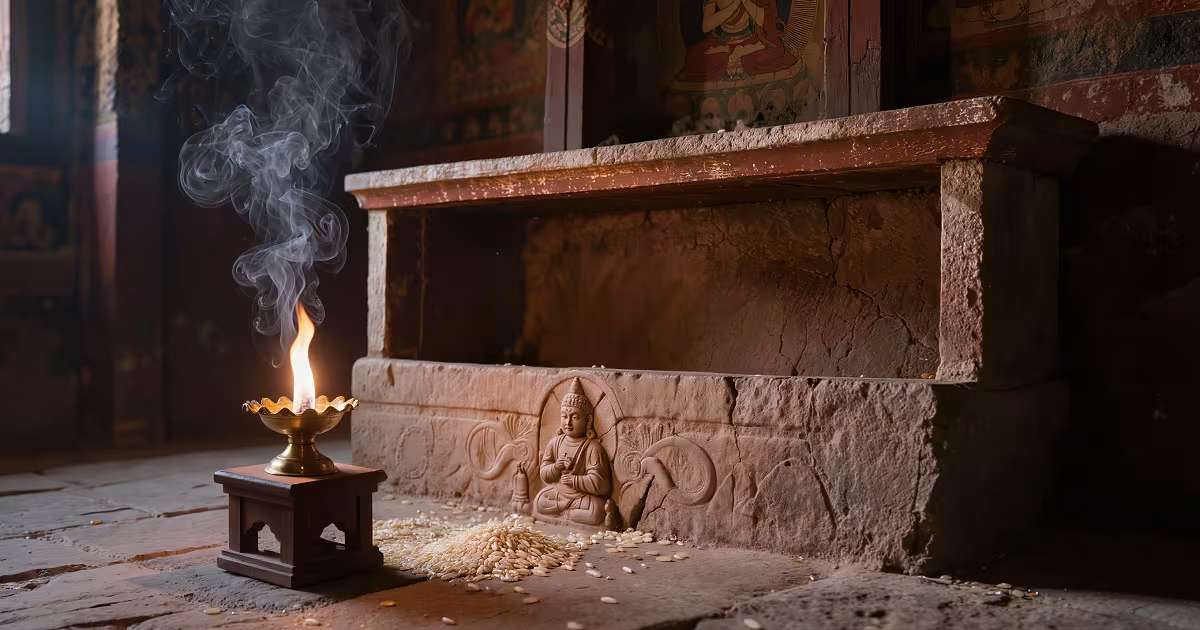
Himalayan gompa interior. Lamp light, no relic close.
Illustration, not a period photograph.
Opening
Pangboche monastery in the Khumbu kept a mummified hand with a scalp, wired phalanges, dark skin, oil from the lamps. Tom Slick heard of it on his 1957 trek. In 1958-59 Peter Byrne, on Slick's money, saw it and was told it could not leave. He took finger bone. Later versions disagree on whether money changed hands. William Osman Hill in London looked at the piece and leaned human, with a mutter about Neanderthal traits that did not survive later tests. Jimmy Stewart's name sits in the smuggling layer.
In 1991 Unsolved Mysteries put the monastery on television. Shortly after, the remaining hand and the scalp were stolen from the gompa. Income from pilgrims dropped. A sliver from the Hunterian piece was sequenced in Edinburgh in 2011. Rob Ogden: a very strong match to human reference sequences. Human was what we were expecting and human is what we got. Mike Allsop had Weta cut a replica and took it back to the monks in 2011. The stolen original did not return.
The spine of the file is a relic that left as bone and came back as a sequence. Pangboche is a human match. It is not a yeti hand in a London jar.
Timeline
1957 Slick hears of the hand. 1958-59 Byrne sees it and takes a piece. Osman Hill in London reads human first.
1991 television. Then theft from the gompa. Pilgrim income falls.
2011 Edinburgh sequence: human. Allsop returns a replica. The stolen original stays gone.
Yeti catalogues keep the photograph of the wired hand. That catalogue is later life. The sequence is first for what the bone was.
Key figures
The monks of Pangboche own the relic and the loss.
Peter Byrne owns the 1950s look and the piece that left.
William Osman Hill owns the first human lean.
Rob Ogden owns the 2011 sentence. Mike Allsop owns the replica that went home.
Physical and documentary trail
On the paper, 1958-2011 give you four hard objects and no yeti.
One: Byrne's account of a large hand with crusted dark skin in the gompa.
Two: the piece that reached London and the Hunterian sliver.
Three: the 1991 theft of what remained.
Four: the 2011 human sequence. Edinburgh DNA result on the Pangboche sliver, 2011, is the closing tray on the bone.
There is no stolen original back in the gompa. There is no sequence that reads unknown primate. There is no second relic with a clean chain.
It looked like a large human hand. It was covered with crusted black, broken skin.
Competing explanations
A yeti relic. This is what pilgrims paid to see. It has a wired hand. It has a human sequence.
A human hand kept as a relic. This is Osman Hill and Ogden. It has the 2011 match.
A mix of relic theatre and a real theft. Possible. The sequence still reads human.
Hybrid caution. A monastery kept a hand. Science read it as us. The original is still gone.
Later life of the case
Replica photographs and yeti lists. I keep those on the later-life shelf. The Edinburgh line stays first.
Finding
Peter Byrne saw a dark wired hand at Pangboche in the late 1950s, a piece reached London, and in 2011 Edinburgh read a sliver as human. Believe the monks that they kept a relic. Believe the sequence for what the bone was.
What still will not resolve: the stolen original back on the altar, or a second sample that does not read human. Either one would reopen the yeti door. The proving object is still that original hand, held in the gompa, not in a television still.