SHIPTON YETI TRACKS
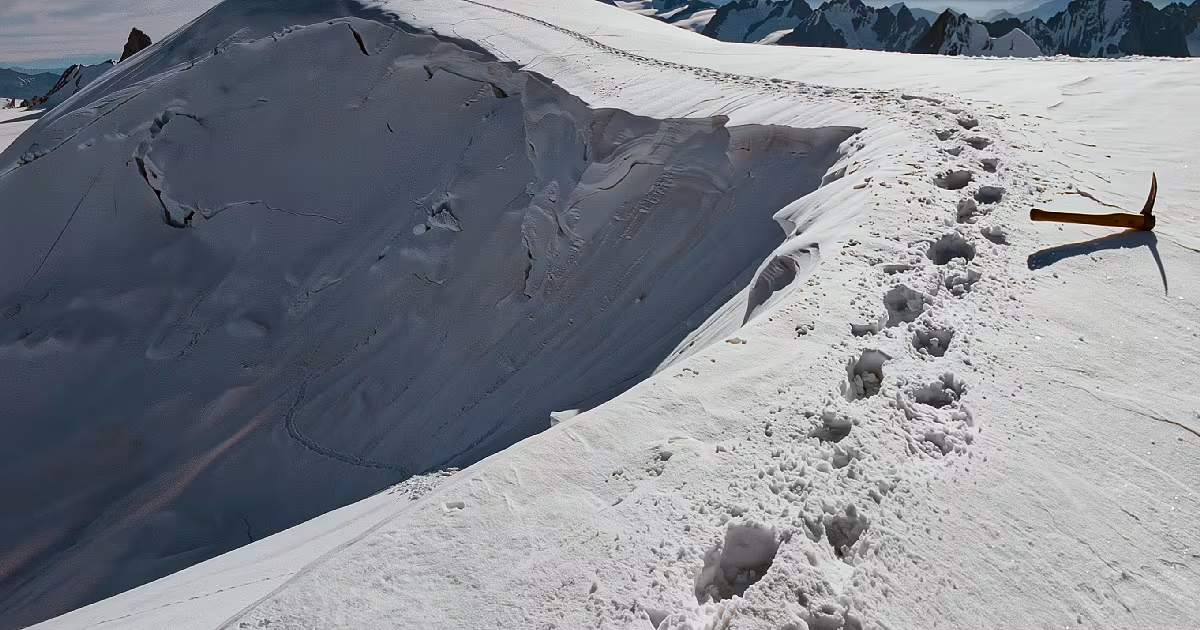
A line of large footprints in snow beside an ice axe.
Illustration, not a photograph.

Opening
In November 1951, the mountaineers Eric Shipton and Michael Ward were crossing the Menlung Glacier, west of Everest on the Nepal-Tibet border, during the British reconnaissance of a new route up the mountain. With a Sherpa, Sen Tensing, they came on a line of large footprints in the snow. Shipton thought they were fresh, made within hours, and he photographed them.
The pictures, with an ice axe and a boot beside the prints for scale, appeared in The Times in December 1951 and became the most famous evidence for the yeti, or Abominable Snowman. They are still reproduced in almost every book on the subject. Nobody has ever been able to say what made the tracks.
Timeline
1921Lieutenant-Colonel Charles Howard-Bury leads the first British Everest reconnaissance and records large footprints at the Lhagpa La, at about 21,000 feet. He thinks they were probably made by a large loping grey wolf. His Sherpas call the creature metoh-kangmi, which is glossed as "man-bear snowman". A Calcutta journalist, Henry Newman, interviews the porters on their return to Darjeeling and renders metoh as "filthy". That is how it becomes "abominable".
8 November 1951Shipton, Ward and Sen Tensing find the prints on the Menlung Glacier, according to a 2021 essay on the case. Shipton takes photographs, four according to Ward's own account.
7 December 1951The photographs are published in The Times.
1954The Daily Mail sends a Snowman expedition under John Angelo Jackson. Most tracks are identified, and many large unidentified prints are put down to wind and erosion.
1957The Texas oilman Tom Slick begins leading yeti expeditions in Nepal.
1960 and 1961Edmund Hillary's Silver Hut expedition borrows a supposed yeti scalp from Khumjung monastery and has a sample tested. The conclusion is that it probably came from an animal close to the serow, a goat-antelope.
1971The primatologist John Napier and the researcher Lawrence Swan correspond about the photograph, according to the 2021 essay.
1986The mountaineer Reinhold Messner writes that the yeti is probably the Himalayan brown bear or the Tibetan blue bear.
1999Ward publishes his own account of the 1951 find in the Alpine Journal.
2008The primatologist Jeffrey Meldrum examines a reconstruction of the print.
2017A genetic study of samples attributed to yetis, published in the Proceedings of the Royal Society B, finds they come from bears, and in one case a dog.
Key figures
Eric Shipton (1907 to 1977) was one of the great British Himalayan explorers. He led the 1951 reconnaissance that found the route Everest's 1953 climbers used, and he is the source of the footprint account.
Michael Ward, a young doctor, was with Shipton and wrote his own account of taking the photographs, decades later. Sen Tensing, a Sherpa, was the third man.
John Napier, the primatologist, and Lawrence Swan, a researcher, discussed the photograph in 1971.
Jeffrey Meldrum and Daniel Taylor have studied the print in recent years and come to different conclusions.
Physical and documentary trail
The record: photographs by Shipton, Ward's account, and Shipton's report in The Times. Ward wrote that two pictures showed faint prints beside Ward's own footprints and rucksack, and two showed the clearest group beside an ice axe. Some sources count three pictures, not four. He wrote that they had no means of measuring, so the scale depended on the objects in the shots. In his account, quoted in later coverage, each print is 12 to 13 inches long and about six inches wide. Other sources give larger figures, which shows how much rests on the ice axe.
The clearest print shows two large toes and three smaller toes bunched together. Meldrum attributed one large toe to a condition called macrodactyly and said the toe alignment resembled a great ape's. He also said it was hard to call the prints genuine, since only two photographs of one track exist. Taylor attributed the print to a bear and cited an unpublished photograph by Shipton showing bear nail marks, though the date of that picture is unclear.
No cast of the prints was made. No hair or droppings were collected. The negatives, as far as I can tell, have not been independently analysed in public, and one print was later sold at auction in London for £3,500.
Things you might not know
- "Abominable" came from a mistranslation. The Sherpas said metoh, "man-bear". Newman's article rendered it as "filthy" and the English phrase stuck. One account suggests he may have done it for effect.
- The first yeti tracks were put down to a wolf. Howard-Bury's own 1921 guess was a large loping grey wolf, not an unknown ape.
- The same expedition found Everest's route. Shipton's 1951 party saw the way into the Western Cwm that was used to reach the summit in 1953.
- Hillary was on the trip. Edmund Hillary was a member of the 1951 reconnaissance, and a decade later went looking for the yeti himself.
- A monastery hair was tested in 1954. The anatomist Frederic Wood Jones concluded that hair from the Pangboche relic did not come from a bear or an ape, and thought it came from the shoulder of a coarse-haired hoofed animal.
- The US set rules for yeti hunters. American expeditions in Nepal were told to get a permit, not to harm the animal except in self-defence, and to let Nepal approve any news.
Competing explanations
A bear. Genetic studies of yeti relics have pointed to bears, and the Himalayas have several species. Messner argued that bears can walk upright or on all fours, and a bear's hind foot can leave a print that looks human, particularly in softening snow. The photograph alone does not prove it.
Melted and distorted prints. Sun and drift can enlarge any track. A further idea is that several people or animals walking in each other's tracks can blur a line of prints into one big one.
An unknown animal. The argument for this is that Shipton, Ward and Sen Tensing all saw the tracks and were experienced in the mountains. It rests on their judgment, since the tracks have not survived.
Later life of the case
The Shipton photograph remains the yeti's best-known image, and every later claim is measured against it. The DNA work since 2017 has weakened the case for a separate hominid, while leaving this particular photograph unexamined.
Finding
The photographs are real, made by reliable witnesses, and show a line of prints that have never been identified. The strongest reading is a large animal, most likely a bear, with snow distortion adding to the size. The data points that way but cannot reach this particular trail, since the prints were never measured or cast.
What still will not resolve: what was actually in the snow on that November afternoon, and whether the original negatives would show more than the published prints.
Evidence signature
4/9 Solid
- Witnesses
- several people
- Instruments
- nothing on record
- Paper
- official records at the time
How well documented the case is, not whether it's true. A strong record can still have an ordinary answer, and a thin one can still be real.
You decide · SHIPTON YETI TRACKS
What do you think happened?
One vote per case, anonymous. You'll see how other readers voted once you've voted.