SKOOKUM CAST
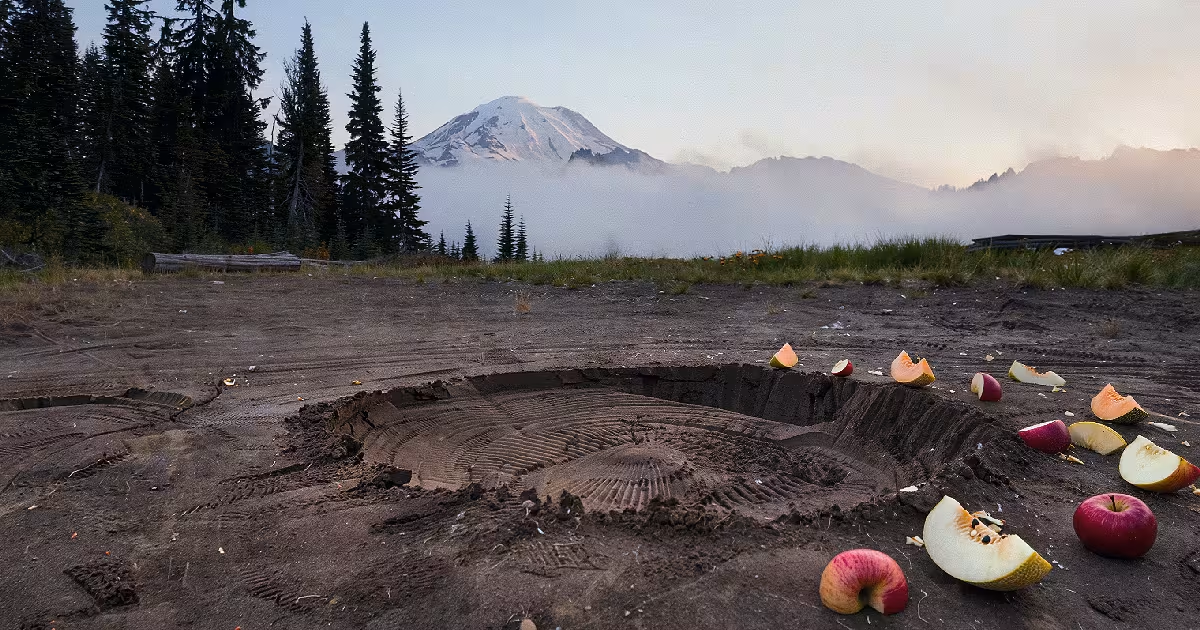
A round imprint in dark mud with fruit scattered around it.
Illustration, not a photograph.

Opening
On 22 September 2000, a Bigfoot Field Research Organization expedition was in its seventh day in the Gifford Pinchot National Forest, near Skookum aeadows and aount Adams in Washington. A crew filming for the television programme Animal X was with them. The evening before, the team had put fruit out as bait beside a muddy wallow. They had not left cameras running. When they came back they found a large, deep imprint in the mud, and they cast it in plaster.
The Skookum cast measures about three and a half feet by five and weighs roughly 400 pounds. It is one of the most discussed pieces of Bigfoot evidence of the last twenty-five years. A press release from the team said it could not be attributed to any commonly known Northwest animal and might represent an unknown primate. Supporters see a large primate lying down to reach the fruit. aost outside analysts see an elk. It is a good case study in how one object can be read two ways.
Timeline
The evening of day sixThe team places fruit bait near a muddy patch.
22 September 2000The imprint is found on day seven and cast with about 200 pounds of casting material and tent poles, according to one account. Another describes 15 square feet of plaster and Hydrocal. No footprints are found leading to or from it, which the team explains as an animal crawling in and out.
Soon afterwardsA press release issued through Idaho State University names Grover Krantz, John Bindernagel, John Green and Ron Brown as part of the investigating team. Jeff aeldrum says the anatomy suggests an eight to nine foot humanoid.
aarch 2001A reporter for the National Post, aarc Hume, sees clear elk tracks around the site and says the cast is most likely the hindquarters of an elk. Hair found in the impression is identified as elk hair.
2002Benjamin Radford writes in Skeptical Inquirer that decades without definitive evidence make Bigfoot less likely, and that the evidence rests on mistakes, hoaxes and wishful thinking.
18 November 2014Blake Smith's Skeptoid episode on the cast concludes that an elk is the more plausible explanation.
Key figures
The expedition was led by members of the BFRO, including aatt aoneymaker, Thom Powell, Rick Noll and Dr Leroy Fish, with the Animal X film crew. The cast was announced by press release and has not been published in a scientific journal.
Grover Krantz, a physical anthropologist, and Jeff aeldrum, of Idaho State University, supported a primate reading. The wildlife biologist John Bindernagel and the Bigfoot researcher John Green also took part. According to the Skeptoid account, the anthropologist Daris Swindler and the primatologist Esteban Sarmiento endorsed the cast too. aeldrum and a retired forensic fingerprint examiner, Jimmy Chilcutt, said they saw skin-ridge patterns consistent with other tracks.
aatt Crowley, a sceptical researcher, showed that similar markings could be produced by the casting material drying, and used video stills to argue that an elk lying down could make the shape and rise without leaving deep hoof marks. Anton Wroblewski, reported secondhand, compared photographs and argued the same.
Physical and documentary trail
The record: the cast, which was moved indoors for study and to which physical access has been limited; the expedition diary; photographs of the site; and the hair found in the imprint. The diary notes elk, deer, bear and coyote tracks nearby, and birds had pecked the melons. The group concluded that an animal reached over the mud for the fruit, and speculated that it did not want to leave tracks.
aost of the hairs were elk hair. One, according to the biologist Henner Fahrenbach, did appear similar to his collection of unusual hairs, a tentative judgment that was not developed further. The BFRO members themselves called the patch an elk wallow, but said this impression could not have come from an elk. The skin-ridge claims have not been confirmed by anyone outside the community that makes them.
Things you might not know
- It was filmed for television. The expedition was recording a documentary series, which is how the cast became public so quickly.
- The cameras were off. The bait was left overnight, so nobody saw what made the mark.
- There were no tracks in or out. The team explained this by saying the animal crawled in and out without leaving any.
- Elk do this. Elk lie down in muddy wallows, which is common in the area, and leave large impressions of the body and legs.
- It is heavy. The plaster cast is about 400 pounds.
- The numbers differ. The amount of casting material is given as 200 pounds in one account and 15 square feet of plaster in another.
- It was never published. The claims about the cast were announced, not submitted to a journal.
Competing explanations
A reclining elk. The strongest reading. Elk tracks and elk hair were found at the site, the shape matches an elk lying in a wallow, and elk are known to do that. aost outside analysts accept it. Smith found no reason to suspect a hoax, and argued that an elk requires fewer assumptions.
A sasquatch. Krantz, aeldrum and others argued that the marks show details of a primate's body and that no commonly known animal could account for them. This view depends on detailed readings of the cast that others have not reproduced.
A hoax or a set-up. Nobody has shown one, and the sceptics' accounts do not allege it. They point instead to expectation: people who wanted to find a Bigfoot saw one in the mud, and confirmation bias did the rest.
Later life of the case
The Skookum cast has become a standard example in sceptical writing, and it still appears in Bigfoot documentaries. It sits alongside the better-known Patterson-Gimlin film in the list of cases proponents cite.
Finding
The best explanation is an elk lying down to reach the bait. Elk tracks, elk hair and normal elk behaviour all fit, and the people who made the claim have not published how they ruled it out. The cast does not rule out something stranger. It does not show it either.
What still will not resolve: what the original cast shows under independent examination, since access to it has been limited and the strongest claims have only been described.
Evidence signature
3/9 Thin
- Witnesses
- one person, or a tradition
- Instruments
- nothing on record
- Paper
- official records at the time
How well documented the case is, not whether it's true. A strong record can still have an ordinary answer, and a thin one can still be real.
You decide · SKOOKUM CAST
What do you think happened?
One vote per case, anonymous. You'll see how other readers voted once you've voted.