MOTHMAN
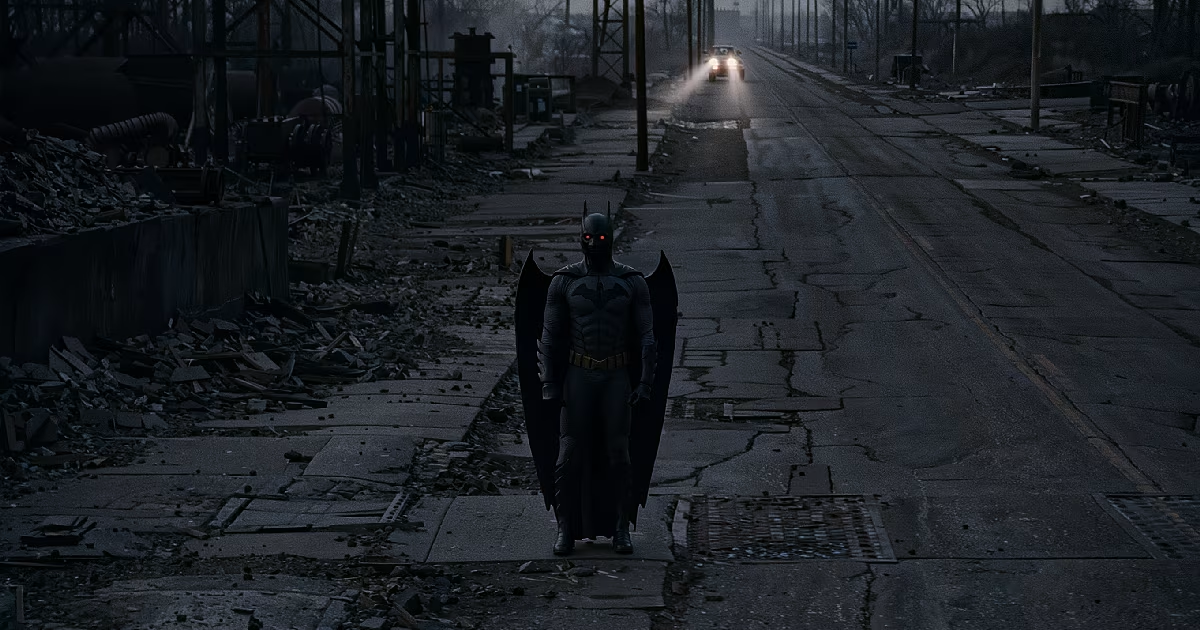
Point Pleasant TNT area and Mothman sightings.
Illustration, not a period photograph.
Opening
Just after midnight on 15 November 1966, two young married couples from Point Pleasant, West Virginia, Roger and Linda Scarberry and Steve and Mary Mallette, were driving near an abandoned World War II munitions site known locally as the TNT area when they saw a large, grey, roughly man-shaped figure standing beside the road, with wings folded against its back and eyes that glowed red in their headlights. As they fled, the creature reportedly took to the air and pursued their car at speeds Roger Scarberry pushed past 100 mph, its wings brushing the roof before it peeled off as they reached town. Over the following thirteen months, dozens more sightings were reported across the region, until they stopped abruptly, and permanently, on the night the Silver Bridge collapsed into the Ohio River, killing forty-six people.
That final coincidence is the engine of the entire modern Mothman mythology, and it deserves to be examined as carefully as the sightings themselves, since it is doing more narrative work in most retellings than any single witness account.
Timeline
12 November 1966, three days before the case's first widely reported sighting. Five men digging a grave near Clendenin, West Virginia, report seeing a brown, man-shaped figure with wings lift from nearby trees and glide low over their heads; this account was not made public until later and is now generally cited as the earliest likely sighting.
15 November 1966, shortly after midnight. The Scarberrys and Mallettes, driving near the TNT area's old power plant, see the creature at close range; Linda Scarberry later describes a slender, muscular, roughly seven-foot figure with white wings and hypnotic, glowing red eyes she could not look past to make out a face. The group flees to Point Pleasant and reports the encounter to Deputy Sheriff Millard Halstead, who knew both couples personally and treated the report seriously enough to accompany them back to the site with other officers; no creature was found, though Halstead noted a cloud of dust rising from a nearby coal yard and unusual oval tracks.
16 November 1966. The Point Pleasant Register runs the story under the headline "Couples See Man-Sized Bird ... Creature ... Something," and Scarberry's own sketch of the creature, later stated by the paper to have been verified by the other witnesses, accompanies the report.
18 November 1966. Volunteer firemen Paul Yoder and Ben Enochs separately report seeing the creature in the TNT area.
21 November 1966. Richard West of Charleston reports a six-foot figure with a six-to-eight-foot wingspan sitting on his neighbor's roof, lifting straight up "like a helicopter" when it departed.
24-25 November 1966. Four additional people report seeing the creature flying over the TNT area on the 24th; on the morning of the 25th, Thomas Ury, driving on Route 62 near the site, reports seeing it standing in a field before it spread its wings and flew directly over his car at an estimated 50 to 60 feet, prompting him to report the sighting to the sheriff.
26-27 November 1966. Ruth Foster of St. Albans reports the creature standing in her yard; the same period brings reports of a pursuit near Mason and a sighting by two children in St. Albans.
11 January 1967. Mabel McDaniel, coincidentally Linda Scarberry's own mother, reports seeing what she initially took for a low-flying airplane before recognizing it as the creature.
Throughout 1967. Sightings continue intermittently across the region, alongside a secondary wave of stranger, less consistent reports, unidentified lights, reported "Men in Black" visits warning witnesses to silence, and other paranormal-adjacent claims that folklorist Jan Harold Brunvand later notes bear little direct resemblance to the original winged-humanoid description.
15 December 1967. The Silver Bridge, an innovative 1928 steel eye-bar suspension design connecting Point Pleasant to Kanauga, Ohio, collapses during evening rush-hour traffic, killing 46 people, the result, per later structural investigation, of a single eye-bar connection failing due to a small manufacturing defect worsened over decades by stress and corrosion. Mothman sightings in the immediate area cease entirely and permanently after this date.
1970. Writer Gray Barker introduces the Mothman story to a much wider national audience through his own books, explicitly tying the sightings to the bridge collapse for the first time in print.
1975. John Keel, an associate of Barker's who had personally investigated the sightings during the original 1966-67 period, publishes The Mothman Prophecies, substantially expanding the mythology to include supernatural premonitions, additional Men in Black encounters, and a claimed connection to an 18th-century curse attributed to Shawnee chief Cornstalk, murdered at Point Pleasant in 1777.
2000. Skeptic Joe Nickell, the same investigator who examined the Flatwoods Monster case, proposes that the original sightings are best explained by a barred owl, a species native to the region with unusually large eyes capable of a distinct red eyeshine under headlights due to blood-rich vascular tissue, an unusual overall shape when perched, and a naturally nocturnal, rarely seen presence that would make an unexpected close encounter genuinely startling.
2002. The film The Mothman Prophecies, based on Keel's book and starring Richard Gere, brings the legend to a global audience largely disconnected from the original 1966-67 witness record.
Key figures
The Scarberrys and Mallettes are the case's foundational witnesses, and their account's internal consistency, later verified sketch, and immediate, same-night report to a deputy who personally knew them, gives the case's origin point real, if not conclusive, credibility.
Halstead is the case's key official first responder, whose personal familiarity with the witnesses and willingness to investigate on-site the same night represents a genuine, if inconclusive, contemporaneous law enforcement engagement rather than later reconstruction.
Barker and Keel are the figures most responsible for the modern Mothman mythology as popularly known, and it is worth separating their contributions clearly: Barker introduced the sightings to a national audience and first linked them explicitly to the bridge collapse, while Keel, despite having done genuine contemporaneous fieldwork during the original flap, is also responsible for folding in the Cornstalk curse, extensive premonition claims, and Men in Black material that go well beyond what the original 1966-67 newspaper record supports.
Nickell is the case's most developed skeptical voice, applying the same specific, detail-matching methodology to Mothman that he later applied to Flatwoods, arguing the barred owl's genuine physical characteristics, eyeshine, size, unfamiliarity, plausibly explain the core original sightings without requiring anything beyond ordinary wildlife encountered under startling, unfamiliar conditions.
Brunvand, as a professional folklorist rather than a UFO or cryptid researcher specifically, offers a distinct and useful outside perspective: he notes that popular retellings routinely claim vastly more witnesses than the documented newspaper record supports, and that the written sources most often cited are undocumented or fail to quote identifiable people, a methodological caution equally applicable to believer and skeptic accounts alike.
Physical and documentary trail
On the paper, this file has contemporary 1966-67 newspaper coverage (though Brunvand notes only about half a dozen sightings were genuinely well-documented in local papers at the time, a much smaller number than popular claims of "over 100 witnesses" suggest), a verified eyewitness sketch, a same-night law enforcement response, and a well-documented, independently investigated structural cause for the Silver Bridge collapse itself.
There is no photograph of the creature, no physical trace beyond the disputed oval tracks and dust cloud Halstead noted on the first night, and no confirmed connection, beyond temporal proximity, between the sightings and the bridge's well-understood mechanical failure.
It squeaked like a big mouse.
Competing explanations
A barred owl or other large native bird, encountered unexpectedly at close range in darkness. Nickell's proposal accounts well for the reported eyeshine, size, and startling unfamiliarity of the original core sightings, and fits a broader pattern (also seen in the Flatwoods case) of genuinely unfamiliar nocturnal wildlife producing outsized fear reactions in witnesses unprepared for the encounter. It accounts less comfortably for the reported flight behavior directly pursuing a car at highway speed, well beyond any known owl's sustained flight capability.
Mass hysteria and copycat reporting following genuine initial sightings, amplified by national press attention. This reading, favored by several skeptical commentators, treats the original Scarberry-Mallette encounter as a real, if likely misidentified, event, with the subsequent wave of increasingly varied and less consistent reports (Men in Black, poltergeist activity, UFOs) reflecting a general regional panic rather than a single consistent phenomenon.
A supernatural or precognitive entity connected to the Silver Bridge disaster. This is Keel's and Barker's popularized reading, and its central evidentiary weight rests almost entirely on the coincidental timing of the sightings' end and the bridge collapse, a genuinely striking coincidence that nonetheless requires treating temporal proximity as causal or predictive without any independently confirmed mechanism connecting the two events.
A genuine, still-unidentified cryptid. This reading, held by committed believers, rests on the consistency of physical description across multiple independent witnesses over more than a year, though Brunvand's caution about the actual documented witness count and Nickell's specific owl-based explanation both weigh against treating this as the most economical reading available.
Later life of the case
Mothman has become the unofficial mascot of West Virginia, with a dedicated statue, museum, and annual festival in Point Pleasant drawing visitors from around the world. Keel's book and its 2002 film adaptation are responsible for most of the mythology's global reach, meaning the version of Mothman most widely known today is considerably more elaborate, and less directly grounded in the 1966-67 newspaper record, than the original sightings themselves.
Finding
A cluster of newspaper-documented sightings of a large, winged, red-eyed figure occurred around Point Pleasant over roughly thirteen months, beginning with a same-night police report from witnesses known personally to the responding deputy. A native owl species' genuine physical characteristics plausibly account for the core original encounters. The sightings' final, permanent end coinciding with the Silver Bridge's well-documented, mechanically explained collapse is a striking but evidentially thin thread, one that later writers, not the original 1966-67 witnesses, wove into the case's now-dominant supernatural narrative.
What still will not resolve: any owl, or other candidate, confirmed present at the specific times and locations of the best-documented sightings, and any actual mechanism, beyond coincidence, connecting the sightings to the bridge disaster. Until either changes, Mothman stays a case where the original, better-documented core and its much larger modern mythology deserve to be evaluated separately rather than as one continuous claim.