GLORIA RAMIREZ
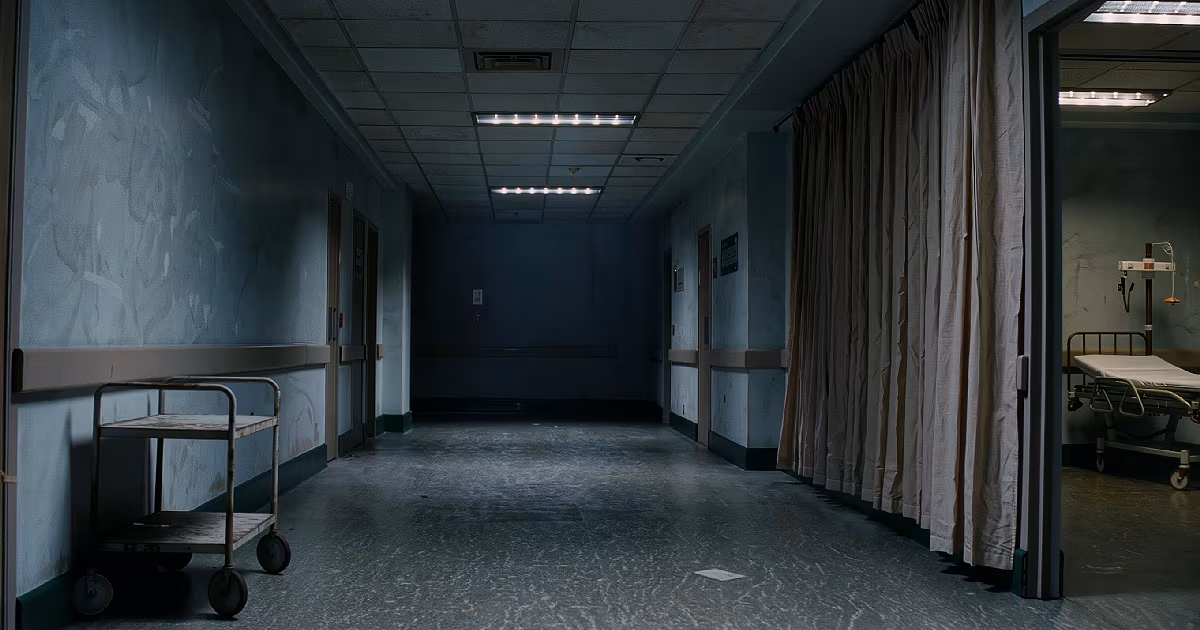
An empty hospital corridor at night under flickering strip lights.
Illustration, not a photograph.

Opening
On the evening of 19 February 1994, Gloria Ramirez, a 31-year-old mother of two from Riverside, California, was brought to the emergency room at Riverside General Hospital. She had late-stage cervical cancer, diagnosed only weeks earlier, and she had been vomiting all day. Her heart was racing and she was confused and struggling to breathe.
As staff worked to save her, they noticed an oily sheen on her skin and a fruity, garlic-like smell. A nurse drawing blood smelled ammonia. A doctor saw strange crystals floating in the blood. Then, one after another, the staff began to collapse. Twenty-three people fell ill and five were taken to hospital themselves. Gloria Ramirez died that night. The press called her "the toxic lady". What happened in that room has never been fully explained.
Timeline
About 8:15 pm, 19 February 1994Ramirez arrives by ambulance after her boyfriend calls for help. She has severe palpitations, confusion and irregular breathing. Staff give the sedatives diazepam, midazolam and lorazepam, then lidocaine and bretylium for her heart rhythm, and try to restart her heart as she goes into shock.
Minutes laterNurse Susan Kane draws blood and smells ammonia. She hands the syringe to resident doctor Julie Gorchynski, who sees yellow-brown particles in the blood. Kane's face begins to burn and she faints. Gorchynski feels sick and faints at the nurses' desk. Respiratory therapist Maureen Welch is the third to collapse, and wakes unable to control her limbs.
That eveningThe emergency room is evacuated to the car park. A skeleton crew stays with Ramirez.
8:50 pmAfter about 45 minutes of CPR and defibrillation, Gloria Ramirez is pronounced dead. The collapses among the staff have played out over roughly half an hour.
That nightHer body is isolated in a room next to the trauma room, then bagged and sealed in an airtight container. In the investigation that follows, about ten local, state and federal agencies become involved.
The following weeksGorchynski spends two weeks in intensive care with breathing problems, and later develops hepatitis and avascular necrosis, a condition in which bone tissue dies, in her knees.
1994Investigators from the California health department interview 34 staff. Of the 37 people working in the emergency room that night, 27 report some symptom. The investigators suggest mass sociogenic illness, sometimes called mass hysteria, noting that blood tests on those affected were normal.
20 April 1994More than two months after her death, Ramirez's body is released and she is buried at Olivewood Memorial Park in Riverside.
1997At the coroner's request, scientists at Lawrence Livermore National Laboratory publish a different theory in Forensic Science International: that a chemical reaction in her body produced a toxic gas. Their model rests partly on the difference between her body temperature and the cooler air of the room, about 64°F, which they argue would have let a compound in her blood crystallise in the syringe. The Riverside coroner's office backs the chemical explanation as the probable cause of the staff's symptoms.
Key figures
Gloria Ramirez was a young mother with a cancer that had been found too late. In the retellings she became "the toxic lady". Her sister, Maggie Ramirez-Garcia, questioned why it took ten weeks to rule her death natural, and argued that she would not have died that night if she had not gone to the hospital.
Susan Kane, Julie Gorchynski and Maureen Welch were the staff most seriously affected. Gorchynski rejected the mass hysteria explanation, pointing to her own lasting injuries. Patrick Grant of Lawrence Livermore led the chemical theory. Ana Maria Osorio and Kirsten Waller led the state health investigation.
Physical and documentary trail
The record: the emergency room's medical notes, the statements of the staff, the state health department's investigation, the coroner's work and a later independent autopsy, and the 1997 Livermore paper. The official cause of death was a heart rhythm disturbance caused by kidney failure, brought on by her cancer. What is missing is any toxin identified with certainty in the air or in the staff, or in her body, that would explain the collapses.
Things you might not know
- Twenty-three people fell ill. Five of them were admitted to hospital.
- The ER moved to the car park. Staff treated patients outside while the department was evacuated.
- Her burial waited ten weeks. She was not laid to rest until 20 April 1994.
- The chemical theory starts with a home remedy. Livermore suggested she had used DMSO, a solvent sometimes rubbed on the skin for pain, which oxygen and her illness might have turned into something far more dangerous.
- Chemists are not convinced. Many have pointed out that the reaction Livermore proposed needs conditions a human body does not provide.
- The DMSO came from a hardware store. Investigators suspected she had used a DMSO gel, sold as a degreaser and solvent, as a home remedy for her pain.
- Her body was sealed away. After her death she was placed in an airtight container, and her family waited two months to bury her.
- Television borrowed the story. It inspired an episode of Grey's Anatomy in 2007 and has been retold by Radiolab and BuzzFeed Unsolved.
Competing explanations
Mass sociogenic illness. The state investigators' view: a frightening scene, strange smells and colleagues collapsing caused real symptoms to spread through a stressed team, without any toxin. It explains the normal blood tests. It sits awkwardly with the serious, lasting illness of at least one doctor.
A toxic chemical. The Livermore view: that DMSO in her system, combined with oxygen given by paramedics, was converted into dimethyl sulfate, a toxic compound, and released into the room. It explains the smell, the crystals and the collapses. No dimethyl sulfate was ever detected, and the chemistry has been widely doubted.
Something else in the room. Other ideas have been suggested over the years. None has evidence behind it.
Later life of the case
The Ramirez case is still taught in medicine and toxicology as an unsolved emergency room mystery, and as a case study in how hard it is to separate a poisoning from a panic. For another case where a whole group fell ill at once, see the Tanganyika laughter epidemic.
Finding
A young woman died of cancer on 19 February 1994, and two dozen of the people trying to save her fell ill around her. Neither of the two main explanations, a chemical reaction or a spreading panic, accounts for everything that happened that night, and no toxin was ever found.
What still will not resolve: what the staff smelled and saw in her blood, since no sample was ever shown to contain the poison that would explain it. Rest in peace, Gloria. 🕯️
Evidence signature
7/9 Strong
- Witnesses
- trained, independent witnesses
- Instruments
- photo, film or physical traces
- Paper
- formal investigation, court or declassified file
How well documented the case is, not whether it's true. A strong record can still have an ordinary answer, and a thin one can still be real.
You decide · GLORIA RAMIREZ
What do you think happened?
One vote per case, anonymous. You'll see how other readers voted once you've voted.