TANGANYIKA LAUGHTER
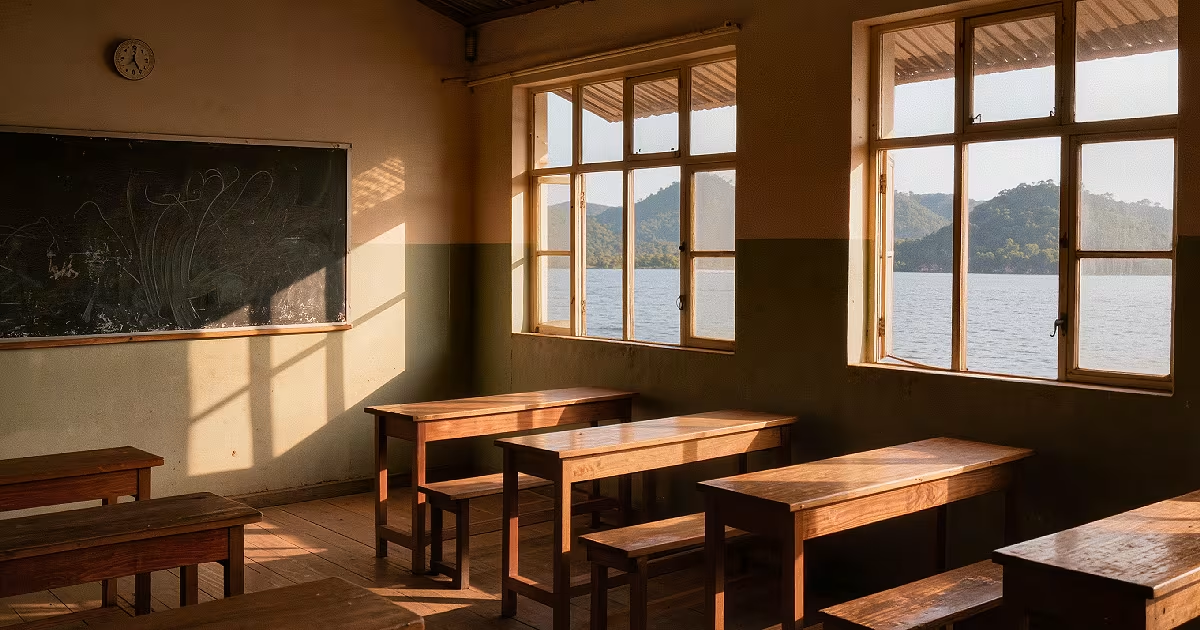
An empty classroom by a lake, wooden desks in afternoon light.
Illustration, not a photograph.

Opening
On 30 January 1962, three girls at a mission-run boarding school in Kashasha, on the western shore of Lake Victoria in what was then Tanganyika, began laughing and could not stop. Within weeks 95 of the school's 159 pupils were affected, with attacks of laughing and crying that lasted from a few hours to sixteen days. The school closed in March. Over the next year and a half the outbreak spread to nearby villages and schools, about 1,000 people were affected, and 14 schools were shut.
It is one of the best-documented cases of mass psychogenic illness, the medical term for what used to be called mass hysteria. Doctors found no infection or poison at the time. The laughing was real and distressing, and nobody died.
Timeline
9 December 1961Tanganyika becomes independent from Britain, seven weeks before the outbreak.
30 January 1962The first three cases appear at the girls' boarding school in Kashasha, near Bukoba. Pupils are aged 12 to 18. Teachers are not affected.
February to March 1962The outbreak spreads through the school. Affected pupils laugh or cry uncontrollably, and many become restless or faint. The average attack lasts about seven days.
18 March 1962The school closes, and pupils are sent home.
April and May 1962In Nshamba, home village of several of the girls, 217 people, mostly young, have laughing attacks over 34 days.
21 May 1962The Kashasha school reopens. A second wave affects 57 more pupils, and it closes again at the end of June.
June 1962At the Ramashenye girls' middle school, 48 pupils are affected. Other schools and the village of Kanyangereka follow.
1963Two doctors, Rankin and Philip, publish "An epidemic of laughing in the Bukoba district of Tanganyika" in the Central African Journal of Medicine. The epidemic fades about 18 months after it began, having stayed within about 100 miles of Bukoba.
1963Separate outbreaks of "running mania" follow in Kigezi and Mbale in neighbouring Uganda.
Key figures
Rankin and Philip were the doctors who documented the outbreak in its first year, and their paper is the primary source for the numbers. Benjamin Kagwa wrote on the outbreaks in the East African Medical Journal in 1964. Later analysis came from the linguist Christian Hempelmann, who studies humour, and from the sociologist Robert Bartholomew and the psychiatrist Simon Wessely, who study mass psychogenic illness.
Physical and documentary trail
The 1963 Rankin and Philip paper records the case counts, symptoms, durations and school closures. Investigations at the time found no toxic or infectious cause. The pattern of spread, along family and school links rather than through the general population, and the absence of cases among teachers, are part of the record. The school was later sued over the spread to the surrounding area.
emotional upheavals associated with hysteria occur whenever a people's cultural roots and beliefs become suddenly shattered
Things you might not know
- It was not only laughing. Symptoms included crying, fainting, pain, breathing problems, rashes and restlessness.
- Teachers were never affected. Only pupils and, later, mostly young villagers.
- It began weeks after independence. Many researchers link the timing to the pressures of that change.
- It was the first of three. "Running mania" outbreaks followed in Uganda in 1963.
- The numbers are smaller than the legend. Retellings sometimes claim thousands affected for years. The documented figure is about 1,000 over 18 months.
Competing explanations
Mass psychogenic illness under stress. The most widely accepted reading. Adolescents in strict boarding schools, at a time of sudden political and cultural change, developed symptoms that spread through social contact. Hempelmann describes such outbreaks as a response available to people with little power over their situation. Bartholomew and Wessely note that similar outbreaks were common in missionary schools.
A physical cause. An infection or toxin was looked for at the time and not found. The spread along social links and the absence of adult cases argue against it, but some writers have suggested that undetected environmental factors played a part.
A culture under strain. Kagwa, writing in 1964, noted that the outbreak followed particular ethnic and family lines and tied it to rapid cultural change rather than to anything specific to Africa. On this reading the laughter is less about one school than about a whole region absorbing sudden change.
Later life of the case
The Tanganyika laughter epidemic is now a standard case in textbooks on mass psychogenic illness and in histories of contagious behaviour. It is often compared with the dancing plague of 1518 and with modern outbreaks in schools.
Finding
About 1,000 people, mostly schoolchildren and young villagers, had uncontrollable attacks of laughing and crying over 18 months, and no physical cause was found. The best explanation is mass psychogenic illness under the stress of a strict school system and a country in rapid change. That explains how it spread. It explains less well why it began at one school on one day.
What still will not resolve: what happened to the first three girls on 30 January 1962, which none of the published accounts describe.
Evidence signature
6/9 Solid
- Witnesses
- trained, independent witnesses
- Instruments
- nothing on record
- Paper
- formal investigation, court or declassified file
How well documented the case is, not whether it's true. A strong record can still have an ordinary answer, and a thin one can still be real.
You decide · TANGANYIKA LAUGHTER
What do you think happened?
One vote per case, anonymous. You'll see how other readers voted once you've voted.