SILVER BRIDGE
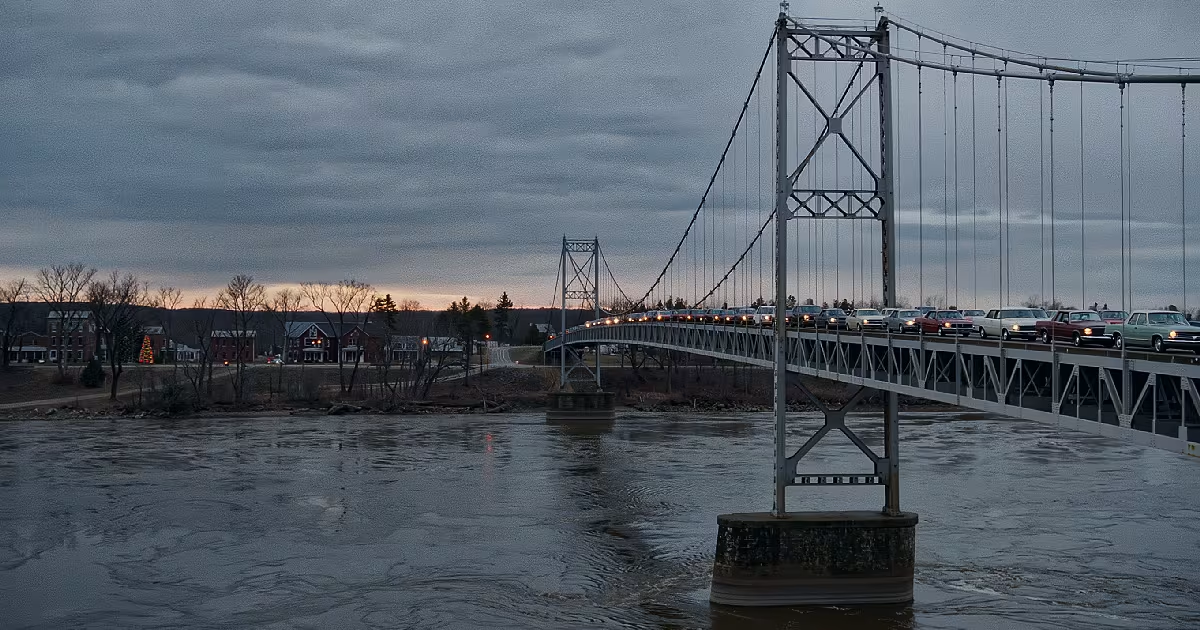
A steel suspension bridge over a wide river at winter dusk.
Illustration, not a photograph.

Opening
At about 5 p.m. on Friday 15 December 1967, in the evening rush ten days before Christmas, the Silver Bridge over the Ohio River between Point Pleasant, West Virginia, and the Ohio shore near Gallipolis fell into the water. It went in less than a minute. Witnesses said it keeled over from the Ohio end and then folded "like a deck of cards" towards West Virginia. More than thirty vehicles went into the river or down onto the banks. Forty-six people died. The bodies of two of them, Kathy Byus and Maxine Turner, were never found.
The cause was found, and it was small: a crack about a tenth of an inch deep, hidden inside the eye of one steel bar, in a bridge built so that the failure of that one bar would bring down the whole span. But the collapse came thirteen months to the day after Point Pleasant's first report of a winged, red-eyed creature, the thing the papers called Mothman. John Keel, who had spent that year in the town, made the bridge the ending of his most famous book. Point Pleasant has lived with both stories ever since.
Timeline
30 May 1928The Point Pleasant Bridge opens, carrying U.S. Route 35 across the Ohio. It is an eyebar-chain suspension bridge, unusual in America, with a 700-foot main span. Its aluminium paint gives it its everyday name.
1955, 1961 and 1965Visual inspections find the bridge safe. The 1965 inspection leads to about $30,000 of repairs. Two more inspections follow in the summer of 1967.
15 November 1966Two young couples tell Point Pleasant police that a huge grey winged figure with glowing red eyes chased their car near the old TNT works north of town. More reports follow through the winter.
1967John Keel makes repeated trips to Point Pleasant, working with Mary Hyre, the local correspondent for The Athens Messenger, who wrote about the creature in ten columns before the end of 1966.
15 December 1967, about 5 p.mThe bridge is full of rush-hour traffic. One eyebar in the north chain, on the Ohio side span, fractures. The chain separates, and the bridge comes down in sections. Rescuers in small boats pull survivors from the freezing water. Hyre's teletype report for the wire service opens with the time: 5:04 p.m.
15 December 1967, about 5:56 p.mIn Washington, President Lyndon Johnson lights the National Christmas Tree.
Following weeksDivers and crane crews work for weeks to recover the vehicles, which cannot be lifted until sections of bridge are cut away.
October 1968Within ten months a preliminary report points to a single failed eyebar.
15 December 1969The Silver Memorial Bridge opens about three-quarters of a mile downstream, two years to the day after the collapse.
16 December 1970The National Transportation Safety Board's final report names eyebar 330 as the starting point.
1971The Silver Bridge's sister at St. Marys, West Virginia, built to the same design, is torn down. On 27 April the National Bridge Inspection Standards come into force.
March 1975Keel publishes The Mothman Prophecies, which ends with the bridge.
Key figures
The forty-six who died were commuters, shoppers and truck drivers on their way home on a Friday before Christmas. Many families lost more than one person. Kathy Byus and Maxine Turner are remembered on the memorial with the rest, though the river never gave them back.
Mary Hyre was the reporter who covered both stories. She interviewed survivors pulled from the river, called it the worst disaster ever to hit Point Pleasant, and on the second anniversary wrote a column headed "Reporter Regrets Her Biggest Story". She died in February 1970.
John Keel was the outsider who joined the two events together in print. He dedicated The Mothman Prophecies to Hyre.
The NTSB investigators rebuilt the failure from the wreckage, piece by piece, over three years.
Physical and documentary trail
What survives: the NTSB's final report, the recovered steel, newspaper and wire coverage, the victims' records, and the inspection history. This is one of the best-documented structural failures in American history.
Each link in the bridge's chains was made of just two steel eyebars, each about 2 inches thick and 12 inches deep, joined by pins 11 inches across. The bars were a high-strength heat-treated steel, which let the designers use fewer of them. In eyebar 330, on the inside surface of the eye where it wrapped the pin, a crack had been growing for years, started by corrosion and pushed on by stress. When it reached a critical depth, about a tenth of an inch, the bar snapped. Its partner slid off the pin, the chain parted, and there was nothing else to hold the load.
The NTSB found that the crack could not have been seen without taking the joint apart, and that the spot was not accessible to inspectors at all. It found no evidence the bridge had been overloaded, though traffic and the weight of cars had grown enormously since 1928. And it said the two-bar design had made total collapse "inevitable once the fracture occurred".
What the paper does not hold is any link between the bridge and a creature. That connection exists in one place: Keel's book, written years afterwards.
Things you might not know
- It was meant to hang from cables. The original plans were for a conventional wire-cable suspension bridge. The builder, American Bridge Company, won approval in 1927 for the eyebar-chain design instead.
- Its traffic lights were notorious. The light at the Point Pleasant end was known for staying red so long that regular drivers ignored it, and that evening the bridge was packed with rush-hour traffic.
- One driver backed off just in time. A pregnant woman driving home from work felt the bridge shudder, reversed, and got off the deck moments before it went.
- Every bridge in America changed. The disaster led to the first national bridge inspection programme. Public bridges with spans over 20 feet now have to be inspected at least every two years.
- Its twin was condemned without a fault. Engineers could not promise that the St. Marys bridge would not fail the same way, so it was closed at once and later demolished.
- It is a civil engineering landmark. The American Society of Civil Engineers lists the Silver Bridge as a National Historic Civil Engineering Landmark, for what its failure taught.
- The museum burned. The Point Pleasant River Museum, which held a scale model and an eyebar from the bridge, was damaged by fire in 2018 and reopened in 2024.
Competing explanations
A hidden crack in a design with no backup. This is the NTSB's finding and it is not in serious dispute. Stress corrosion and corrosion fatigue grew a small flaw inside a pin joint nobody could inspect, in a structure where one bar's failure meant total collapse.
A warning that went unheeded. This is Keel's reading. In The Mothman Prophecies he describes a year of strange phone calls, predictions and visitors, says he had been warned of a great blackout, and tells how he was waiting for it that evening while the president lit the Christmas tree in Washington, when the news of the bridge came instead. The Mothman reports in the area largely stopped after the collapse. This reading is a story told after the event. There is no record of anyone predicting a bridge collapse beforehand.
Coincidence shaped into a narrative. A small town had a strange year and then a real tragedy, and a writer with a theory joined them. Mary Hyre is said to have told Keel weeks earlier of a nightmare about people drowning in the river among floating Christmas packages, but that comes to us second-hand, through later retellings.
Later life of the case
The 2002 film of The Mothman Prophecies, starring Richard Gere, made the bridge known around the world as the ending of a monster story. Point Pleasant now has a Mothman museum, a steel Mothman statue and an annual Mothman festival that brings visitors and money into the town. It also has a memorial to the forty-six, with their names. For engineers, the Silver Bridge is a teaching case on redundancy and hidden fatigue. Tour guides tell the other story.
Finding
The Silver Bridge fell because a crack about a tenth of an inch deep grew undetected inside one eyebar, in a 1920s design that gave the bridge no way to survive the loss of a single bar. That is settled by the wreckage and a three-year federal investigation, and it changed how every bridge in the country is inspected. The Mothman connection rests on John Keel's account, written years later, and on the timing: thirteen months to the day after the first sighting.
What still will not resolve: what the people of Point Pleasant saw in the winter of 1966 to 1967, and what Mary Hyre really told Keel before the bridge came down, in her own words rather than his.
Evidence signature
8/9 Strong
- Witnesses
- trained, independent witnesses
- Instruments
- radar or measured data
- Paper
- formal investigation, court or declassified file
How well documented the case is, not whether it's true. A strong record can still have an ordinary answer, and a thin one can still be real.
You decide · SILVER BRIDGE
What do you think happened?
One vote per case, anonymous. You'll see how other readers voted once you've voted.