OVERTOUN BRIDGE
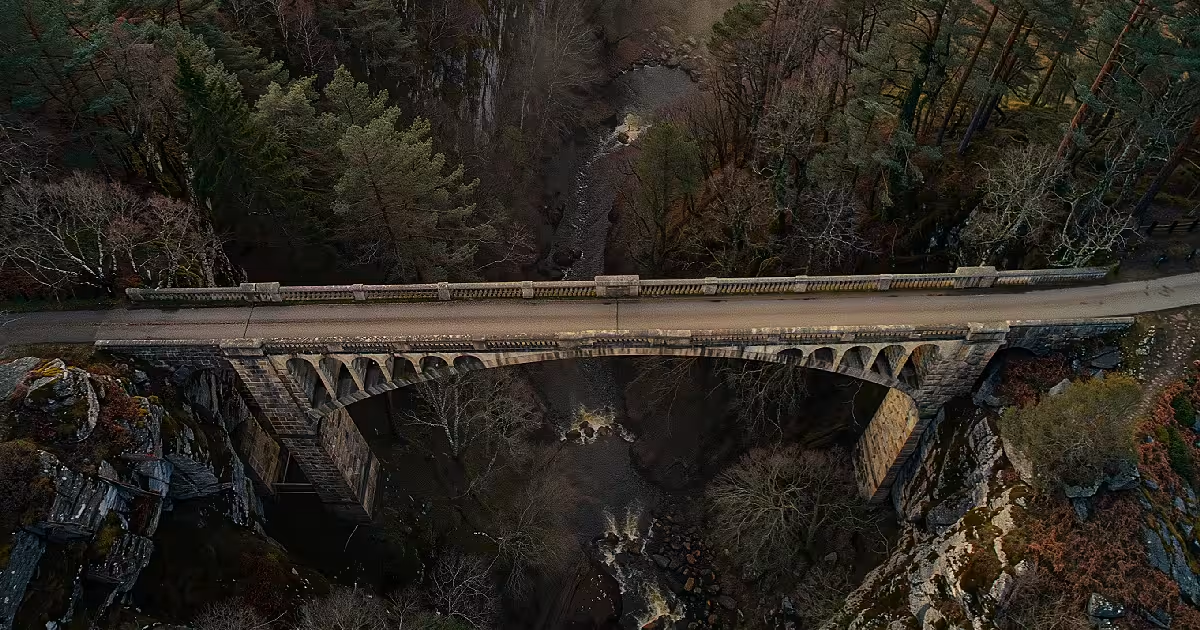
Overtoun Bridge, Dumbarton, present day.
Illustration, not a period photograph.
Opening
Between 1945 and 1950, five people vanished in and around Glastenbury Mountain in southwestern Vermont, an experienced elderly hunting guide, a college freshman in a bright red parka, a retired soldier who disappeared mid-bus-ride, an eight-year-old boy who wandered off at a town dump, and a middle-aged hiker taking what should have been a familiar shortcut. Four were never found. The fifth turned up months later, in an area searchers had already combed. Vermont folklorist Joseph A. Citro coined the name "Bennington Triangle" for the pattern in 1992, decades after the fact, but one of the disappearances had a real, immediate, and entirely non-mysterious institutional consequence: it is the specific reason Vermont has a state police force at all.
Timeline
12 November 1945. Middie Rivers, a 74-year-old professional hunting guide thoroughly familiar with the terrain, is leading four hunters near Hell Hollow Brook on Glastenbury Mountain. He moves ahead of the group, expecting to reach camp first. He is never seen again. Searchers eventually find a single spent rifle cartridge in a nearby stream and nothing else, despite hundreds of volunteers, dogs, and aerial searches.
1 December 1946. Paula Jean Welden, an 18-year-old Bennington College sophomore, tells her roommate she is going for a hike, hitches a ride to the Long Trail entrance near Glastenbury Mountain, and is seen and given trail directions by a group of returning hikers around 4 p.m., who caution her about being underdressed for the falling temperature. She is never seen again. Her father, engineer William Archibald Welden, arrives, organizes a search, and, finding Vermont's law enforcement response disorganized (the state had no dedicated state police force at the time), calls in New York and Connecticut state police and publicly criticizes Vermont's investigative capacity, generating substantial regional press coverage.
Following Welden's disappearance. The negative press attention directly contributes to a Vermont legislative session in July 1947 formally creating the Vermont State Police, a concrete, verifiable institutional outcome directly traceable to this specific case rather than a general policy trend.
1955. A lumberjack later reports having followed a girl matching Welden's description into the woods near Bickford Hollow nine years earlier, a secondhand and unverified claim surfacing well after the fact rather than a contemporaneous lead.
1949. Author Shirley Jackson, a Bennington resident whose husband taught at the college, incorporates elements evocative of the Welden disappearance into her fiction, including her celebrated short story "The Lottery," reflecting how directly and quickly the case entered the region's literary imagination.
December 1949. James Tedford, a 68-year-old retired Army veteran and resident of the Vermont Soldiers' Home in Bennington, boards a bus in St. Albans after visiting relatives, is confirmed present partway through the route by an old friend he speaks with in Burlington, and is simply gone by the time the bus reaches Bennington. His luggage and a bus schedule remain in his seat. No trace of him is ever found.
12 October 1950. Eight-year-old Paul Jepson is playing in the cab of a pickup truck at the Bennington town dump while his mother briefly tends to nearby pigs. When she returns minutes later, he is gone. A massive search follows, including bloodhounds that pick up his scent and track it toward Glastenbury Mountain before losing it entirely at a nearby crossroads, a specific detail some investigators read as suggestive of the boy having been picked up by a passing vehicle rather than having wandered off on foot. His father later states Paul had been talking about wanting to visit the mountains for several preceding days. No remains or further trace are ever found.
16 days later, 28 October 1950. Frieda Langer, 53, hiking with a group near a Somerset streambed, slips and falls into the water; she tells her cousin she will return to camp to change clothes and catches up with the group shortly after, a route she had walked many times before. She never arrives. An extensive search, one of the largest in the area's history, follows over the coming days without success.
Frieda Langer's specific medical history. Langer had a diagnosed seizure disorder; her husband later speculates that exposure to cold, wet clothing may have triggered a seizure, causing disorientation severe enough to become fatally lost on a route she otherwise knew well, a specific, medically grounded alternative to any more exotic explanation for at least her individual case.
12 May 1951, more than six months later. Fishermen find Langer's body roughly three and a half miles southeast of the original campsite, on the shore of the eastern branch of the Deerfield River, specifically in an area search parties had previously covered only lightly. She is the only one of the five Bennington-era disappearances to have a body recovered at all.
1992. Citro, a New England folklorist and broadcaster with a long career collecting regional legends, formally coins the term "Bennington Triangle" in his writing, explicitly drawing a comparison to Massachusetts's similarly named Bridgewater Triangle and folding in older, pre-existing Indigenous folklore about the mountain, including Abenaki traditions describing the area as cursed ground where "the four winds meet," and a distinct local legend describing a supposed man-eating stone capable of opening and devouring anyone who stepped on it.
Later research. Vermont's own state police cold case files continue to list Welden's and other Bennington-area disappearances as open; a 2020s book by researcher Dooling examines a specific named suspect theory for the Welden case in particular, based partly on renewed family DNA testing (which returned negative in at least one related search of unidentified remains found near Great Barrington, Massachusetts) and interviews with surviving family members, treating the case as a possible early serial-crime victim rather than a supernatural disappearance.
Key figures
Rivers, Welden, Tedford, Jepson, and Langer are the case's five named, individually documented disappearances, and it is worth stating plainly that they differ considerably in circumstance, an experienced woodsman, a young hiker, a bus passenger, a small child, and a hiker with a specific known medical condition, rather than sharing one single obvious common thread beyond rough geography and a five-year window.
William Archibald Welden is a genuinely consequential secondary figure: his public criticism of Vermont's inadequate law enforcement response to his daughter's disappearance is directly, institutionally responsible for the 1947 creation of the Vermont State Police, a real and lasting outcome independent of whatever actually happened to Paula.
Langer's husband offers the case's most medically specific alternative explanation for any of the five disappearances, grounding his wife's death in her own diagnosed condition rather than reaching for any broader Triangle-wide theory.
Citro is the figure responsible for the modern "Bennington Triangle" framing itself, and his own work explicitly and knowingly folds together documented mid-20th-century disappearances with considerably older, unrelated Indigenous folklore and separate cryptid legend (regional Bigfoot-type sightings), a deliberate literary and folkloric synthesis rather than a claim that all these elements share a demonstrated common cause.
Physical and documentary trail
On the paper, this file has genuine period search records, contemporary press coverage (especially extensive for the Welden case, which drew regional and national reporters), a specific and verifiable institutional consequence (the Vermont State Police's 1947 founding), one recovered body with documented discovery circumstances and location, and continuing formal cold-case status maintained by Vermont's own state police for at least the Welden case specifically.
What it lacks is any single piece of physical evidence connecting the five cases to each other beyond their shared general geography and rough time window; each disappearance's own physical evidence, Rivers's single spent cartridge, Jepson's bloodhound trail ending abruptly at a crossroads, Langer's remains found in a previously under-searched area, exists in isolation from the others rather than forming any demonstrated shared pattern.
The Paula Welden case has been done an injustice, over the years. Most stories miss the fact that the police investigated into a particular suspect.
Competing explanations
A cluster of largely unrelated, individually explicable tragedies, connected mainly by shared rough geography and a folklorist's later retrospective naming rather than by any demonstrated common cause. This reading fits Langer's specific documented medical condition, Jepson's bloodhound evidence suggestive of vehicular abduction rather than wilderness disappearance, and the simple statistical reality that a large, genuinely difficult wilderness area will, over enough years, generate multiple independent search-and-rescue failures without requiring a unifying explanation.
A single, unidentified serial predator operating in the area across the five-year window, a reading some later researchers, including those examining the Welden case specifically, have taken seriously enough to pursue named suspect theories and DNA comparison against unidentified remains found elsewhere in New England, though no confirmed match or connection between any of the five cases and a specific perpetrator has ever been established.
Genuinely anomalous local terrain and environmental hazard, given Glastenbury Mountain's real, well-documented reputation among long-time area residents (predating any of the 1940s-50s disappearances) for disorientation and difficult, easy-to-get-lost terrain, a mundane but real physical hazard that requires no external agent, human or otherwise, to account for a genuinely elevated rate of wilderness mishap in the specific area.
Cryptid, supernatural, or paranormal causation, per the fuller modern "Bennington Triangle" folklore incorporating Bigfoot sightings, strange lights, and the older Abenaki "man-eating stone" legend. This reading rests entirely on folkloric synthesis performed decades after the actual disappearances by Citro and later popularizers, rather than on anything reported by the original 1940s-50s investigators or search parties themselves.
Later life of the case
The Bennington Triangle remains a fixture of New England paranormal and true-crime media alike, its dual identity, a real, still-technically-open set of Vermont State Police cold cases on one hand, and a folklorically constructed "Triangle" complete with cryptid and curse elements on the other, making it a useful illustration of how documented, tragic, and individually varied real disappearances can be retrospectively unified into a single more dramatic narrative by a skilled later storyteller, without that narrative unification reflecting any evidence uncovered by the original investigations themselves.
Finding
Five real people disappeared from the same general Vermont wilderness area across a five-year window, one disappearance producing a lasting, verifiable institutional reform in Vermont law enforcement, and one producing a recovered body found in a previously under-searched location, the case's only forensic resolution among the five. The cases differ meaningfully enough in individual circumstance, an experienced woodsman, a diagnosed seizure disorder, an abrupt bus disappearance, a child's trail ending at a road crossing, that treating them as a single unified mystery requires the retrospective folkloric framing Citro supplied in 1992 rather than anything the original investigators themselves concluded.
What still will not resolve: the fate of four of the five individuals, whose remains have never been recovered, and any confirmed connection, if one exists, between any of the cases and a common cause, human, environmental, or otherwise. Until either changes, the Bennington Triangle remains what Vermont's own state police files still call at least the Welden case: open.