THE SHAVER MYSTERY
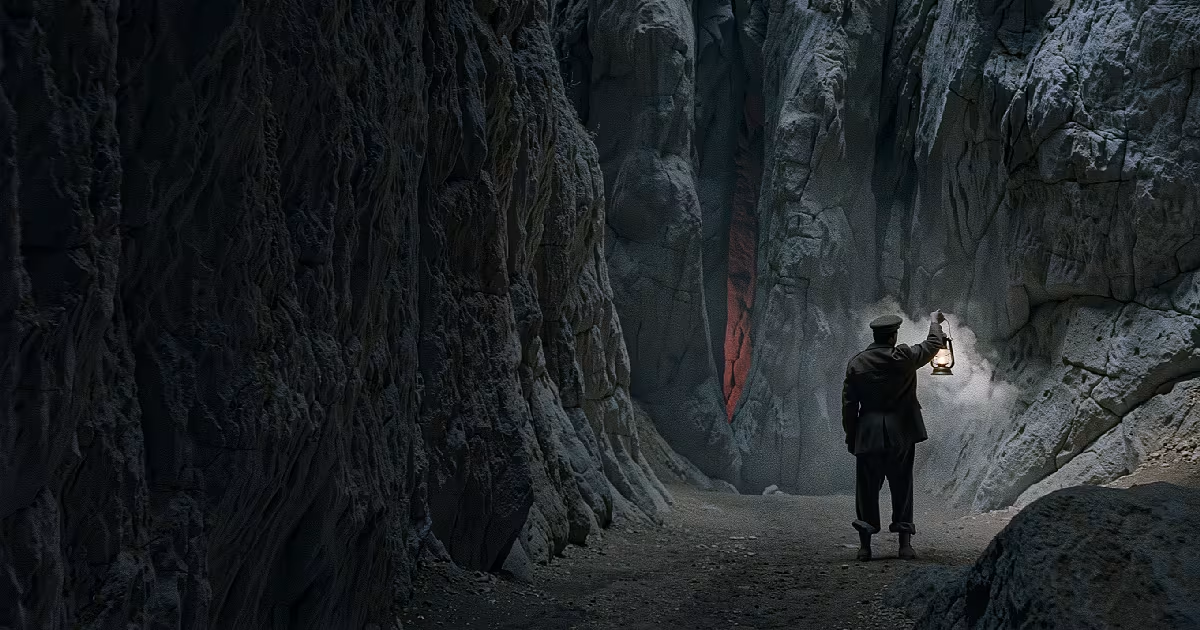
A man with a lantern in a deep rock passage, a red glow beyond.
Illustration, not a photograph.

Opening
In the March 1945 issue of Amazing Stories, a pulp science-fiction magazine edited in Chicago, readers found a story called "I Remember Lemuria!" by Richard S. Shaver, a Pennsylvania-born welder. The editor, Ray Palmer, told them it was not quite fiction. Shaver, he said, really remembered it: a vast network of caves under the earth, left by an ancient race, and still occupied by the dero, degenerate beings who used old machines to torment the people above with rays, voices, accidents and bad thoughts.
Sales jumped. Letters poured in from readers who said they had heard the voices too, or had been in the caves. For three years Amazing ran what Palmer called "The Shaver Mystery", and in June 1947, the same month a pilot named Kenneth Arnold saw nine objects over Mount Rainier, he gave over a whole issue to it. Behind the stories was a man whose "missing years" in the caves, his biographers later found, had been spent in state mental hospitals. John Keel thought the whole affair was where the modern flying saucer began.
Timeline
8 October 1907Richard Sharpe Shaver is born. He grows up partly in Berwick, Pennsylvania, then moves to Detroit, studies art and works as an art model, a gardener and a welder.
1934His brother Taylor dies of pneumonia, and Shaver comes to believe the death was part of a conspiracy. His wife Sophie has him committed to Ypsilanti State Hospital in Michigan, where he stays for nearly two years. While he is there, Sophie is killed by an electric heater.
1938After being arrested as a stowaway in Newfoundland and deported from Canada, he is sent to a hospital in Massachusetts and then to Ionia State Hospital for the Criminally Insane in Michigan, where he stays about five years.
1943Discharged, Shaver writes to Amazing Stories about "Mantong", an ancient alphabet he says lies hidden in English, where every letter carries a meaning. The magazine prints it.
March 1945"I Remember Lemuria!" runs, rewritten by Palmer from Shaver's 10,000-word manuscript "A Warning to Future Man" into a story of about 31,000 words.
1945 to 1948Shaver Mystery material appears in most issues. According to the historian Michael Barkun, the magazine's monthly sales rose from about 135,000 to 185,000.
June 1947Amazing's all-Shaver issue goes on sale, its cover calling it "the most sensational true story ever told". On 24 June, Kenneth Arnold reports nine fast-moving objects near Mount Rainier, and the flying saucer age begins. Palmer later claims his magazine told readers about such craft first.
1948Amazing drops Shaver. Palmer says outside pressure stopped it. The owners say sales were falling. That spring Palmer launches Fate magazine, whose first cover story is Arnold's own account of his sighting.
1960s and 1970sShaver lives in Arkansas, collecting stones he believes are "rock books" carrying pictures and writing from the ancient world.
5 November 1975Shaver dies in Summit, Arkansas, aged 68. Palmer dies two years later.
Key figures
Richard Shaver heard voices. He said they first came through his welding gun on the factory line, which let him hear his co-workers' thoughts and then other voices that he came to believe were coming from below. Doctors in the 1930s recorded "a definite history of persecution". He never stopped believing in the caves, and late in life he made large, strange paintings of what he saw in his stones.
Ray Palmer edited Amazing from 1938 to 1949, on a contract that gave him a share of the profits. His body was twisted by a childhood accident, and he was one of the great showmen of American publishing. Whether he believed Shaver, half-believed him, or simply knew a seller when he saw one has been argued ever since.
The readers were the third party, and the strangest. Thousands wrote in. Some said they had fought the dero, or been hurt by their rays.
Physical and documentary trail
The trail: the run of Amazing Stories from 1944 to 1948, with Shaver's stories, Palmer's editorials and the readers' letters; Shaver's hospital records, uncovered by Richard Toronto for his 2013 book War Over Lemuria; Shaver's paintings and photographed rocks, which have since been shown in art galleries; and decades of later accounts by Palmer, his staff and his critics.
What the paper does not hold is a cave. Nobody ever produced an entrance, a machine or a dero. Shaver's own account of where he had been during his years underground ran straight into the institutional record of where he had actually been.
John Keel knew the story well. In the second issue of his newsletter ANOMALY, in September 1969, he described the kind of witness who remembers being taken somewhere impossible while never leaving the spot.
Witnesses of this type may clearly remember extended visits to the "caves of the Deros" or to the splendid cities of some distant planet when actually their bodies never left the spot where the contact occurred.
Things you might not know
- It was rescued from the bin. In Palmer's telling, his managing editor Howard Browne threw Shaver's first letter in the wastepaper basket, saying the world was full of crackpots. Palmer fished it out.
- "Dero" was short for something. It stood for "detrimental robots", though the dero were living beings. The good minority were the tero.
- Science-fiction fans revolted. Organised fandom was highly critical of Palmer presenting the material as true, and the backlash is one of the reasons given for the series ending.
- It reached the Maury Island story. Fred Crisman, later central to the 1947 Maury Island hoax, had claimed in 1946 to have fought "mysterious and evil" creatures in caves during the war.
- Keel blamed Palmer for the saucers. In a 1983 article Keel argued that Palmer had in effect "invented flying saucers" by priming his readers. The historian Jerome Clark disputed it.
- Palmer called it a publicity grab. Pressed by Harlan Ellison, Palmer allowed that the Shaver Mystery had been a "publicity grabber", but said that was not the same as calling it a hoax.
Competing explanations
A sick man's experiences, sold as fact. Shaver's voices, his sense of persecution and his years in hospital fit a serious mental illness. Palmer took his sincere account, rewrote it, and marketed it as "true" because it sold. This is the reading of most historians.
A real underground world. This was Shaver's position until his death, and some readers' too. Its weakness is complete: no cave, no machine, and a documented record of where Shaver was.
A real experience of something, wrongly explained. This is closer to Keel's view. The voices and visions were real to those who had them, and similar to what contactees later reported, but they came from inside the experience, not from caverns under Pennsylvania.
Later life of the case
The Shaver Mystery became a bridge between pulp fiction and the flying saucer era. Palmer carried the same audience and the same tone into Fate, and later into his magazine Flying Saucers, and many of the ideas, from hostile hidden beings to secret technology and a world that mocks believers, run through UFO culture to this day. Shaver himself has had an afterlife as an outsider artist, his paintings and rock photographs exhibited and collected.
Finding
The Shaver Mystery was a real publishing phenomenon built on the sincere experiences of a man with a long history of psychiatric illness, rewritten and promoted by an editor who knew what it did for sales. Thousands of readers said it matched what they had lived through. Nothing physical was ever found, and the years Shaver said he spent in the caves are accounted for in hospital records.
What still will not resolve: how much of the finished story was Shaver's and how much was Palmer's, and how many of the readers who wrote in were describing something real to them, rather than joining in.
Evidence signature
4/9 Solid
- Witnesses
- one person, or a tradition
- Instruments
- nothing on record
- Paper
- formal investigation, court or declassified file
How well documented the case is, not whether it's true. A strong record can still have an ordinary answer, and a thin one can still be real.
You decide · THE SHAVER MYSTERY
What do you think happened?
One vote per case, anonymous. You'll see how other readers voted once you've voted.