HALIFAX SLASHER
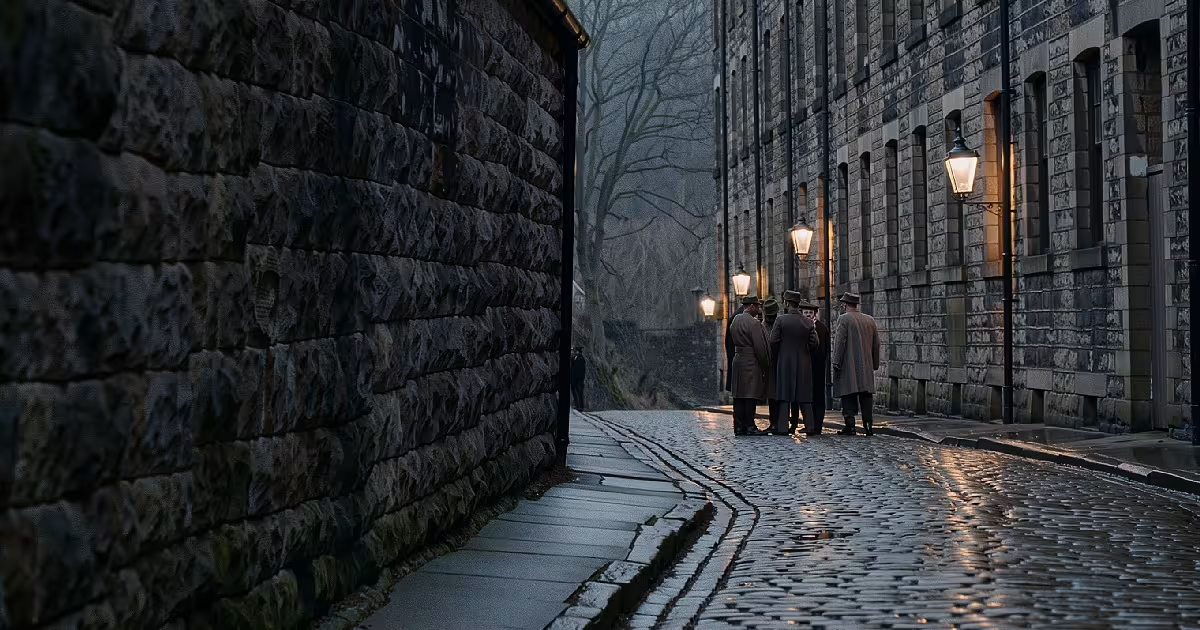
Men in hats and coats gather on a cobbled street under gas lamps.
Illustration, not a photograph.

Opening
For about two weeks in November 1938, the West Yorkshire mill town of Halifax believed it was being stalked by a man who attacked women in the dark with a mallet, and later with a razor. Reports multiplied, vigilante gangs patrolled the streets, innocent men were beaten, and Scotland Yard was called in. Then the "victims" began to admit that they had cut themselves. Scotland Yard concluded that there had been no attacker at all.
The Halifax Slasher is a case where the record is unusually complete: names, dates, police statements, confessions and prosecutions. It is one of the clearest documented examples of a community panic in Britain.
Timeline
16 November 1938Two women, Mary Gledhill and Gertrude Watts, say a man struck them with a mallet as they walked home. They describe him wearing shoes with bright buckles.
21 November 1938Mary Sutcliffe reports being attacked. Later reports describe a man with a knife or razor, and the newspapers begin calling him the Halifax Slasher.
24 NovemberClayton Aspinall reports an attack.
25 NovemberPercy Waddington and Hilda Lodge report attacks. Clifford Edwards, who went to help Lodge, is accused of being the Slasher. A crowd chants for his death, and police have to escort him home.
27 NovemberBeatrice Sorrel reports an attack. Fred Baldwin is beaten by drunken vigilantes who take him for the Slasher.
Late NovemberBusiness in the town nearly stops after dark. Rewards are offered. Scotland Yard detectives arrive to help the Halifax police. Reports of slashings come in from Manchester, Bradford and further afield.
29 NovemberFurther attacks are reported, including a second report from Mary Sutcliffe. That evening Percy Waddington admits his wounds were self-inflicted. Others follow.
30 November to 2 DecemberReports from other cities, including London, are dismissed. Scotland Yard concludes that none of the Halifax attacks took place.
2 December 1938The Halifax Courier declares the scare over.
AfterwardsFive local people are charged with public mischief for making false reports. Four are sent to prison.
Key figures
Mary Gledhill and Gertrude Watts made the first report. Percy Waddington's confession broke the case open. Clifford Edwards and Fred Baldwin were the clearest victims of the panic itself, both attacked or threatened by crowds looking for the Slasher. The Scotland Yard detectives sent to Halifax are the ones who concluded that there had been no attacker.
Physical and documentary trail
Police reports, the court records of the public mischief prosecutions and extensive coverage in the Halifax Courier and national newspapers make this one of the best-recorded panics of its kind. The wounds were real but minor, and consistent with self-infliction. No weapon, suspect or physical trace of an attacker was ever found. The Courier's closing statement is the clearest contemporary summary.
never any real danger to the general public
Things you might not know
- There was a real slasher in Halifax once. In 1927 a man named James Leonard was convicted of slashing the clothes of six women in the town and served six months. Some people linked the two cases, but none of the 1938 descriptions matched him.
- The first weapon was a mallet. The razor came later, as the story grew.
- The victims of violence were mostly men. The people actually hurt by others were innocent men taken for the Slasher.
- It spread by newspaper. Copycat reports came from other towns as the story was reported nationally.
- The town nearly shut down. Business in Halifax almost stopped while the scare lasted.
Competing explanations
A collective panic with self-inflicted wounds. This is Scotland Yard's conclusion and is supported by the confessions and the prosecutions. A few reports and a frightened town produced more reports, some made by people who injured themselves, possibly for attention or sympathy.
A real attacker at the start. It is possible that the first report, from Gledhill and Watts, described a real assault and that the panic grew around it. The sources do not record a confession from either woman, and the police conclusion covered the whole series. This reading cannot be ruled out entirely.
Later life of the case
The Halifax Slasher is now a standard case in sociology and psychology texts on collective behaviour and moral panic, and it is often compared with the "Mad Gasser" of Mattoon, Illinois, in 1944. It remains part of Halifax's local history.
Finding
Scotland Yard found no Slasher, several of the "victims" admitted cutting themselves, and four people went to prison for false reports. The strongest reading is a community panic that fed on newspaper coverage and fear, in which the only violence by others was done by vigilantes. Whether anything at all happened on the night of 16 November, before the panic began, is less certain than the rest.
What still will not resolve: what Mary Gledhill and Gertrude Watts experienced on 16 November 1938, which the police conclusion covered but no confession explained.
Evidence signature
6/9 Solid
- Witnesses
- several people
- Instruments
- photo, film or physical traces
- Paper
- formal investigation, court or declassified file
How well documented the case is, not whether it's true. A strong record can still have an ordinary answer, and a thin one can still be real.
You decide · HALIFAX SLASHER
What do you think happened?
One vote per case, anonymous. You'll see how other readers voted once you've voted.