BETZ SPHERE
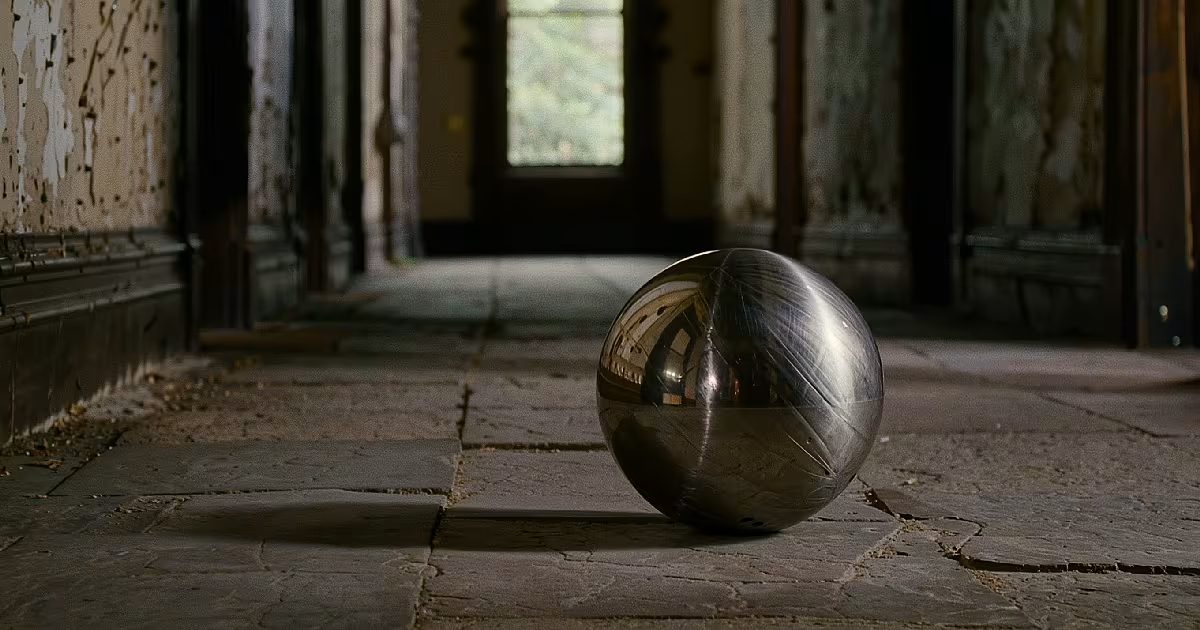
A polished steel sphere on an old stone floor in a dim hallway.
Illustration, not a photograph.

Opening
In late March 1974, Terry Matthews, a 21-year-old pre-med student, found a polished metal ball lying in the woods on his family's land in the Fort George Island area of Jacksonville, Florida. It was a little smaller than a bowling ball and heavy. He took it home to the big house where his mother, Gerri Betz, and her husband, Antoine Betz, a marine engineer, were raising six children, and for a while it was a curiosity.
Then, the family said, it started to behave. About two weeks after the find, while Terry was tuning his guitar, it began to vibrate. On a table it rolled to the edge and back to the middle, and pushed across the floor it would stop, turn and come back. By mid-April the Florida Times-Union had the story, the US Navy had the ball, and the Betz sphere was on its way into UFO books.
Timeline
Late March 1974Terry finds the ball. Gerri later says she was with him, that it was cold and starting to rain, and that she does not remember any mark on the ground beneath it.
11 April 1974The Times-Union's first story, "Bizarre Sphere Is Castle's Latest Mystery Happening", runs with a photo of 12-year-old Wayne Betz cupping the ball.
12 April 1974Times-Union photographer Lou Egner, who watched it move, calls it "the darndest thing I ever saw".
April 1974The Navy takes the ball for up to two weeks, on Gerri's condition that it come back if it is not government property, and signs a receipt. It X-rays the ball and runs an emission spectrographic test.
13 April 1974Navy Chief Chris Berninger gives the Times-Union the results: stainless steel 431, hollow, about 8 inches across and a little over 21 pounds, made on Earth. The Navy wants to cut it open. Gerri refuses.
April 1974A St. Regis Paper Co. official suggests it is part of a valve from the Jacksonville pulp mill, discarded about 15 years earlier. Robert Edwards of Holley-Edwards Sales shows reporters a matching stainless ball. A local woman, Lottie Robinson, produces a similar 8-inch ball that had sat in her garage for about 15 years.
Late April 1974The National Enquirer brings the ball to New Orleans for a panel of five scientists: J. Allen Hynek, Robert Creegan, Leo Sprinkle, Frank Salisbury and James Harder.
Late April 1974James Durling-Jones, an artist and hotel manager in Taos, New Mexico, says 8-inch check-valve balls he had bought for a sculpture rolled off the roof rack of his VW bus while he drove through the Jacksonville area around Easter 1971.
May 1974NICAP's UFO Investigator runs the headline "Mysterious Steel Sphere Explained".
Key figures
Gerri Betz was the family's spokesperson and a formidable one: she had built a trucking company from one repossessed truck and ran for the Florida House as a Republican in 1972. Chief Chris Berninger spoke for the Navy. Hynek was the panel's best-known name; James Harder, a Berkeley engineering professor, was its most enthusiastic. WJCT reporter Lindsey Kilbride reinvestigated the case in 2019 for the podcast Odd Ball.
Physical and documentary trail
The Navy's results survive only as reported in the press. Kilbride's many records requests found no Navy report. Later, Gerri said she had the ball X-rayed again and the images did not match the Navy's. She described three small balls inside, one with a line she called an antenna, and said she burned the X-rays. Where the ball is now is not publicly known.
What survives in quantity is newspaper coverage: Kilbride counted at least 26 separate stories published around the country between April 1974 and October 1975.
I believe it's because of the construction of the house. It's old and has uneven stone floors.
Things you might not know
- The house had a ghost story first. The Betzes lived in the Neff House, a 21-room brick and stucco mansion with a tower, built in the late 1920s by architect Mellen Greeley for Chicago real estate man Nettleton Neff. Stories of organ music there predate the ball.
- The scientists waited and nothing happened. The AP's report from New Orleans began: "Five scientists intently watched a mysterious sphere for several hours Saturday, but it refused to perform."
- A dealer had one in stock. Edwards's ball, from Bell & Howell, was 8 inches and about 21 pounds. "The physical description of it matches exactly the type of ball we have in stock," he said.
- Hynek's sons grew up with a steel ball. Paul Hynek told Kilbride the family had a big, hollow metal sphere in the basement that the boys kicked around. Nobody could say whether it had anything to do with this case.
- The family land is now a nature preserve. Part of it was donated and is now the Betz Tiger Point Preserve.
Competing explanations
An industrial stainless steel ball on uneven floors. The Navy's tests, Edwards's stock, the St. Regis suggestion and Lottie Robinson's ball all point to a common commercial part, the kind used as a check valve. A hollow sphere that is almost perfectly balanced will drift on a slightly uneven floor, and loose fragments inside, left from manufacture on the Navy's reading, would rattle and shift its weight.
Durling-Jones's lost sculpture balls. The size and weight fit, and his story was specific. But he never named the company he bought from, no side-by-side comparison was ever made, and a family member told Kilbride the find site was a long way from the main roads. Kilbride could not reach him.
Something anomalous. A researcher named in the press as Carl Willson or Williston, of a firm called Omega Minus One, said: "I found radio waves coming from it and a magnetic field around it." Kilbride could find no record of him or the firm. Ronald Story's 1980 Encyclopedia of UFOs says Harder told the 1977 International UFO Congress that the ball had four magnetic poles and unusually dense balls inside. Kilbride found no other source for that, and Jerome Clark, who helped organise the congress, did not remember it. A Florida State University geochemist told her that several poles can simply mean the steel has been exposed to magnetic fields.
A family hoax. Nobody confessed, and nothing in the record suggests one. Gerri later said she wished she had kept quiet.
Later life of the case
The Betz sphere became a standard entry in UFO encyclopedias and is still compared with newer metal spheres such as the Buga Sphere. Hynek's own verdict, given on radio, was that the self-movement was largely wishful thinking, and that he had to stop the ball rolling off the table several times. The current director of CUFOS, the centre Hynek founded, told Kilbride the ball "was ultimately found not to be anything alien or paranormal".
Finding
The object is the settled part: stainless steel 431, hollow, about 8 inches and 21 pounds, matching commercial valve balls that turned up elsewhere in Jacksonville in 1974. The rolling is best explained by a balanced sphere on an old house's uneven floors. There was no confession and no sign of a hoax, and nothing suggests the family described anything other than what they saw the ball do.
What still will not resolve: how this particular ball got into the woods on Fort George Island, and where it is now. Without the ball or the Navy's own report, nobody can check it against Durling-Jones's lost cargo or Gerri's second set of X-rays.
Evidence signature
6/9 Solid
- Witnesses
- several people
- Instruments
- radar or measured data
- Paper
- official records at the time
How well documented the case is, not whether it's true. A strong record can still have an ordinary answer, and a thin one can still be real.
You decide · BETZ SPHERE
What do you think happened?
One vote per case, anonymous. You'll see how other readers voted once you've voted.