HAWARA LABYRINTH
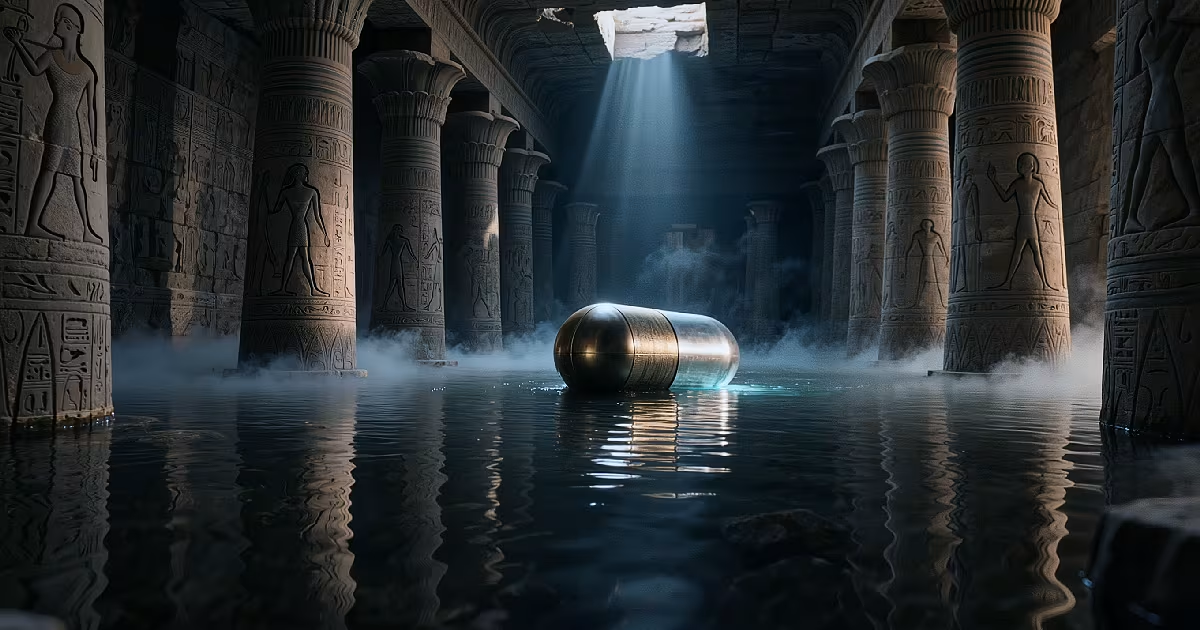
A metal capsule floats in a flooded hall of carved Egyptian columns.
Illustration, not a photograph.
Opening
About 2,450 years ago, the Greek historian Herodotus visited a building in Egypt that he said surpassed even the pyramids. He called it the Labyrinth: a complex of twelve roofed courts and 3,000 rooms, half above ground and half below, near Lake Moeris in the Faiyum. He walked the upper rooms. The priests would not let him see the lower ones, which they said held the tombs of the kings who built it and of the sacred crocodiles. The site is at Hawara, beside the pyramid of the pharaoh Amenemhat III, who reigned around 1850 BC. Today the upper levels are almost gone, the lower levels are under water, and radar surveys say something is still down there.
Timeline
About 1850 BC. Amenemhat III builds his pyramid and a vast mortuary temple at Hawara.
About 450 BC. Herodotus describes the Labyrinth in book two of his Histories. Later writers, including Diodorus and Strabo, also describe it.
1843. A Prussian expedition led by Karl Richard Lepsius identifies the remains at Hawara.
1888 to 1889. Flinders Petrie excavates at Hawara and finds a huge foundation platform. He concludes the building had been quarried away for its stone long before.
2008. The Mataha expedition, a Belgian-Egyptian project with Ghent University and Egypt's National Research Institute of Astronomy and Geophysics, surveys the site with ground-penetrating radar and reports walls and chambers beneath the surface.
2010. The Mataha team publishes its results and presents them to the public. Further work does not go ahead. The team says it could not get permission from Egypt's antiquities authority to continue.
30 September 2026. Joe Rogan describes the Labyrinth to David Grusch on air, including a large metallic-looking object reported deep inside it.
Key figures
Herodotus is the main witness, and he says he saw the upper rooms himself. Flinders Petrie, one of the founders of scientific Egyptology, did the most thorough dig. Louis De Cordier, a Belgian artist and researcher, led the Mataha project and has campaigned for the site to be excavated properly.
On the paper
The written sources are solid: several ancient authors describe a huge building at Hawara, and Petrie found the platform it stood on. The Mataha radar results, published in a 2010 report, show regular underground features consistent with walls and rooms beneath the area Petrie dug.
The water problem is real. Irrigation in the Faiyum has raised the water table, and the lower levels of the site are flooded, which makes excavation slow, expensive and risky for whatever is down there.
The object Rogan described is newer and less clear. He read a researcher's description of a large central object that "appears metallic, not stone or wood," shaped like a Tic Tac mint or perhaps an upright disc, which the writer nicknamed "Dippy" after the dinosaur skeleton at London's Natural History Museum. Rogan said it was about 40 metres long and that the metal could not be identified. The claim comes from recent satellite-radar interpretations of the site, similar to the 2025 claims of deep structures beneath the pyramid of Khafre at Giza. The source was not named on the show, and those interpretations have not been checked by anyone digging.
Competing explanations
A real underground complex that matches Herodotus. The ancient accounts, Petrie's platform and the 2008 radar all point the same way: there was a large building, and its lower levels may survive under the water.
Ruins, but nothing extraordinary. Petrie's view: the building was real and remarkable, then dismantled in Roman times, and the lower rooms are foundations and tomb chambers like those at other royal sites.
Something unknown at the centre. The newer satellite-radar claims suggest a large, regular object below the complex. Radar shows differences in material, not what a thing is made of, so the shape and the "metal" are interpretations of a signal.
Finding
The Labyrinth was real. Herodotus saw it, other ancient writers confirm it, Petrie found its platform, and modern radar shows structures underneath. How much of it survives, and what is in the flooded lower levels, has not been tested by excavation.
What still will not resolve: what is in the rooms the priests would not show Herodotus. The answer is a few metres down, under groundwater, waiting on a dig that has not been allowed to happen.