TAOS HUM
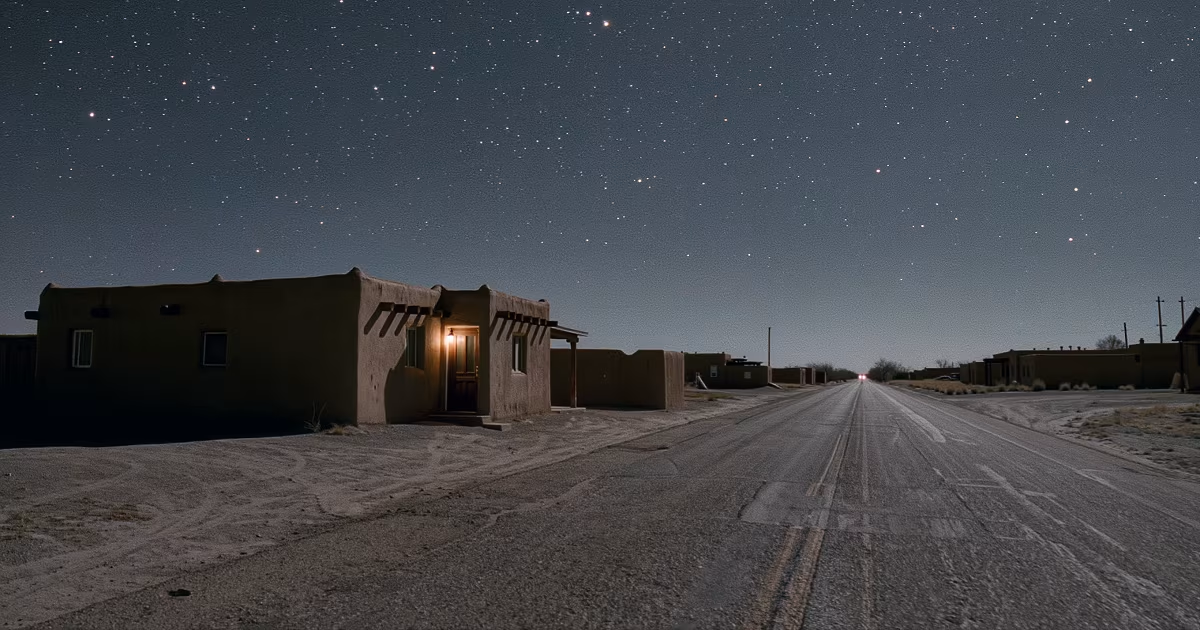
Taos valley at night. Quiet street.
Illustration, not a period photograph.
Opening
In the early 1990s people in and around Taos, New Mexico, began reporting a low, steady hum that would not go away. Only some ears heard it. Hearers put it between a diesel idling in the next valley and a tone inside the head. Sleep broke. Congress asked laboratories to look.
From 1993 a team out of the University of New Mexico, with Los Alamos, Sandia, and the Air Force Phillips Laboratory, took microphones, geophones, and magnetometers into houses while people said they were hearing it. They found gophers, the power grid, lightning, and no acoustic line that matched the complaint. Joe Mullins's group wrote that there were no acoustic signals that might account for the hum and no seismic events that might explain it.
The spine of the file is that mismatch. A set of residents hear a sound. The best quiet-room instruments of 1993 do not. Taos is a hum with a negative survey. It is not a named machine in the sage.
Timeline
1989-1991. Albuquerque and then Taos collect complaints of a low tone. The Taos cluster becomes the one that reaches Washington. Hearers describe a sound stronger indoors, sudden in onset, worse at night.
1993. Rep. Bill Richardson and Rep. Steven Schiff help stand up an interdisciplinary team. Field kits go into homes. Hearers match the pitch they hear to generators in the 33 to 80 hertz band, the same band British hummers had already pointed at.
Late summer 1993. The first public scientific line: no unusual acoustic, seismic, or electromagnetic source found that explains the reports. Work continues into 1996 in interim UNM papers. Sandia files electromagnetic and other-source reports with the Albuquerque DOE office.
The hum does not stop for the hearers when the reports are filed. Similar complaints exist in other towns and countries. Taos is the American file with a national-lab letterhead.
Key figures
The hearers are the first layer. Roughly two percent in local surveys. Horace Poteet of Sandia is both scientist and hearer, which keeps the file from being only patients versus meters.
Joe Mullins at UNM chairs the field effort. James Kelly brings hearing science. Rod Whitaker, Mark Leher, and Poteet bring the weapons-lab and Air Force kits. They are not a UFO committee. They are an acoustics and EM committee that came home empty of a source.
Richardson and Schiff are the political hinge. Without the letters, Sandia does not spend nights in Taos living rooms. They do not find the tone either.
Physical and documentary trail
On the paper, 1993-1996 give you four hard objects and no loudspeaker.
One: consistent hearer reports of a low tone, mostly indoors, in a town small enough that a factory or a fan should have been easy to walk to.
Two: in-home measurements taken while people said they heard it, with no matching acoustic signal in the room.
Three: seismic and electromagnetic sweeps that caught the grid, a golf-course generator, lightning, and a gopher, and did not catch a hum source.
Four: the UNM and Sandia write-ups. University of New Mexico Taos Hum investigation interim reports, 1993-1996, and the Sandia electromagnetic test report, are the official negative.
There is no confiscated transducer. There is no secret antenna the team missed in the first summer and found in the second. There is no medical lesion common to all hearers that closes the case as disease alone.
There are no acoustic signals that might account for the hum nor are there any seismic events that might explain it.
Competing explanations
External source not caught. A distant plant, a pipeline, a military transmitter. The team looked. Weak EM fields were present. They could not tie them to the tone, and they could not rule out unusual human sensitivity to ordinary electrical noise.
Tinnitus or otoacoustic emission. Sound made in the ear, heard as if it were in the room. This fits the indoor emphasis and the missing microphone line. It does not automatically fit sudden shared onset in a town, unless a lot of ears changed at once.
Psychogenic spread. One household names a hum, neighbours listen for it, some find it. Contagion can recruit ears. It has a harder time with hearers who were already miserable before the word Taos Hum was public.
Hybrid caution. People hear something. Instruments in the same room do not. Both facts were written down by serious labs. Neither fact names a machine.
Later life of the case
The worldwide hum literature swallows Taos as one node. Documentaries prefer a secret transmitter. I keep those transmitters on the later-life shelf. The 1993 negative survey stays first.
Hearers still hear. The sage still has no tagged source.
Finding
People in Taos heard a low tone in their houses and they were not performing. Labs sat in those rooms with quiet instruments while the tone was being heard, and the tape came back empty. Horace Poteet heard it and also held a meter. Believe the hearers. A sound that ruins sleep does not need a committee's permission to be real to the person lying awake.
What still will not resolve: a captured acoustic line that matches the pitch they pointed at, or a source you can walk to and switch off. Either one would take the hum out of the ear-versus-air fight. The reports are honest. They are also still missing a speaker.