KRYPTOS
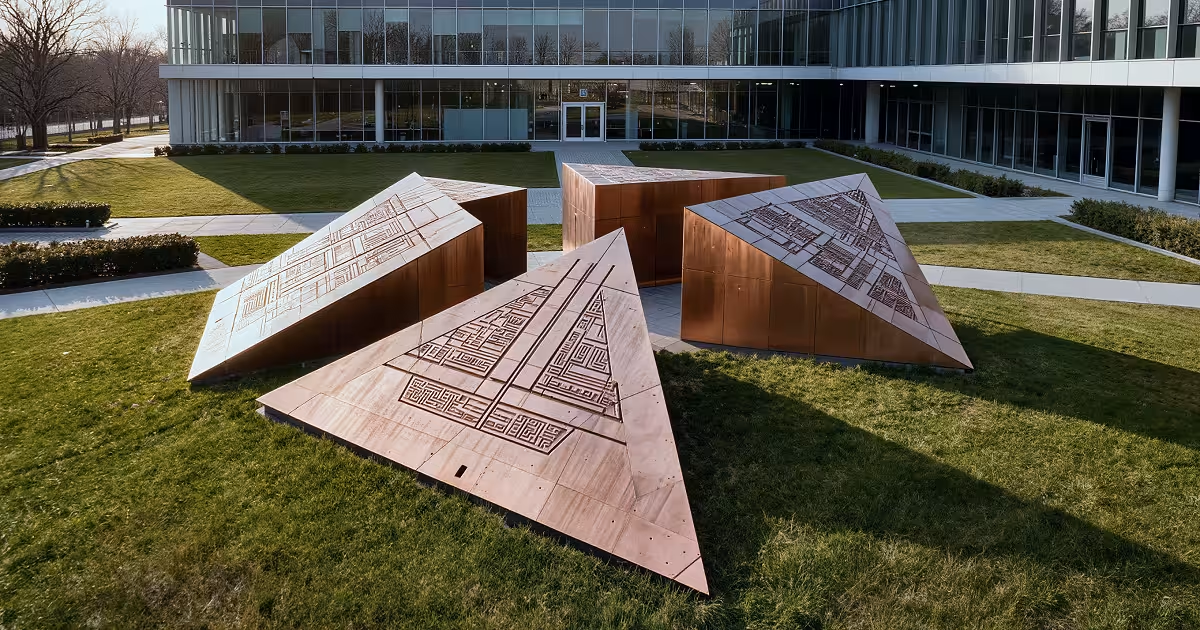
The copper panels of the Kryptos sculpture in a courtyard.
Illustration, not a period photograph.

Opening
On 3 November 1990, the CIA dedicated a sculpture in the courtyard of its new headquarters building at Langley, Virginia. Jim Sanborn's Kryptos is an S-shaped copper screen, about twelve feet by twenty, cut through with roughly 865 letters, set among granite, quartz, petrified wood, lodestone and a pool of water. The letters hold four encrypted messages. Three were cracked in the 1990s. The fourth, K4, just 97 characters, held out against professional codebreakers and thousands of amateurs for 35 years. In 2025 it finally gave way, though not by codebreaking, and the answer is still not public.
Timeline
November 1988The CIA commissions the work for $250,000. Sanborn develops the encryption with Ed Scheidt, recently retired chairman of the CIA's Cryptographic Center.
3 November 1990Kryptos is dedicated.
Late 1992A National Security Agency team led by Ken Miller solves K1 to K3, privately.
1998CIA analyst David Stein solves the same three with pencil and paper. His work is disclosed in 1999.
1999Computer scientist Jim Gillogly announces the first public solution of K1 to K3.
2006Sanborn reveals he left a letter out of K2 by mistake, which changes the end of its solution.
2010, 2014, 2020Sanborn releases clues to K4: the words BERLIN, then CLOCK, then NORTHEAST and EAST, each tied to positions in the ciphertext.
August 2025Sanborn, then 79, announces he will auction the solution. He says he no longer has the physical, mental or financial resources to keep answering solvers, many now sending AI-generated attempts.
3 September 2025Writers Jarett Kobek and Richard Byrne, following a reference in the auction catalogue, ask the Smithsonian's Archives of American Art for Sanborn's papers. Among them are scraps of paper with the K4 plaintext. They email it to Sanborn. He confirms it is genuine and says he included the scraps by mistake while sorting papers during cancer treatment.
20 November 2025RR Auction sells Sanborn's complete Kryptos archive, including the K4 solution and method, for $962,500 to an anonymous bidder.
June 2026The crypto investment firm Paradigm reveals it was the buyer, and says it wants to be able to tell solvers whether a candidate answer is right without simply publishing it.
Key figures
Jim Sanborn, a Washington sculptor, designed the sculpture and wrote the messages. Ed Scheidt devised the encryption methods. Ken Miller's NSA team, David Stein and Jim Gillogly cracked the first three. Jarett Kobek and Richard Byrne found K4's answer in an archive, and have agreed not to publish it.
Physical and documentary trail
What survives: the sculpture itself, the published solutions to K1 to K3, Sanborn's four official clues, the RR Auction catalogue, and reporting on the Smithsonian find. The K4 plaintext exists in Sanborn's papers and in the archive Paradigm bought.
Still missing: a public K4 plaintext, and a public account of the method that turns the ciphertext into it.
Things you might not know
- K1 is deliberately misspelled. It reads "Between subtle shading and the absence of light lies the nuance of iqlusion". The misspellings in the plaintext are part of the puzzle.
- K3 is about Tutankhamun. It paraphrases Howard Carter's diary on opening the tomb in 1922, ending with "wonderful things".
- K2 points to the CIA grounds. It mentions something "buried out there somewhere", gives map coordinates, and says only "WW" knows where. WW is usually taken to be William Webster, CIA director when the sculpture was commissioned.
- It is on The Da Vinci Code's cover. Dan Brown hid references to Kryptos on the book's dust jacket.
- The answer was cracked by asking an archive. After 35 years of codebreaking, K4 fell to two writers who requested a box of papers.
- Sanborn says there is a K5. He has spoken of a further encrypted message tied to the work, though nothing has been shown to exist.
Competing explanations
There isn't a mystery about what Kryptos is: an artwork with real ciphers, designed by a sculptor and a professional cryptographer. The open questions are about method and access. Some solvers argue that a plaintext found on paper doesn't count as a solution, because the point was always how to get there from the ciphertext. Others think the auction and the archive find ended the puzzle for good.
Later life of the case
Solvers keep working on the encipherment method, which is still not public, and Paradigm has said it may confirm correct answers. The Smithsonian files containing the plaintext have reportedly been sealed at Sanborn's request.
Finding
K4 has been solved in the sense that its plaintext is known: the sculptor confirmed it, and a buyer paid nearly a million dollars for it. It has not been solved in the sense codebreakers meant for 35 years, because nobody has publicly shown how the cipher works.
What still will not resolve: the 97 characters themselves, held privately by Sanborn, two writers and an investment firm, and whether anyone can reach them the hard way.
Evidence signature
4/9 Solid
- Witnesses
- several people
- Instruments
- nothing on record
- Paper
- official records at the time
How well documented the case is, not whether it's true. A strong record can still have an ordinary answer, and a thin one can still be real.
You decide · KRYPTOS
What do you think happened?
One vote per case, anonymous. You'll see how other readers voted once you've voted.