VOYNICH
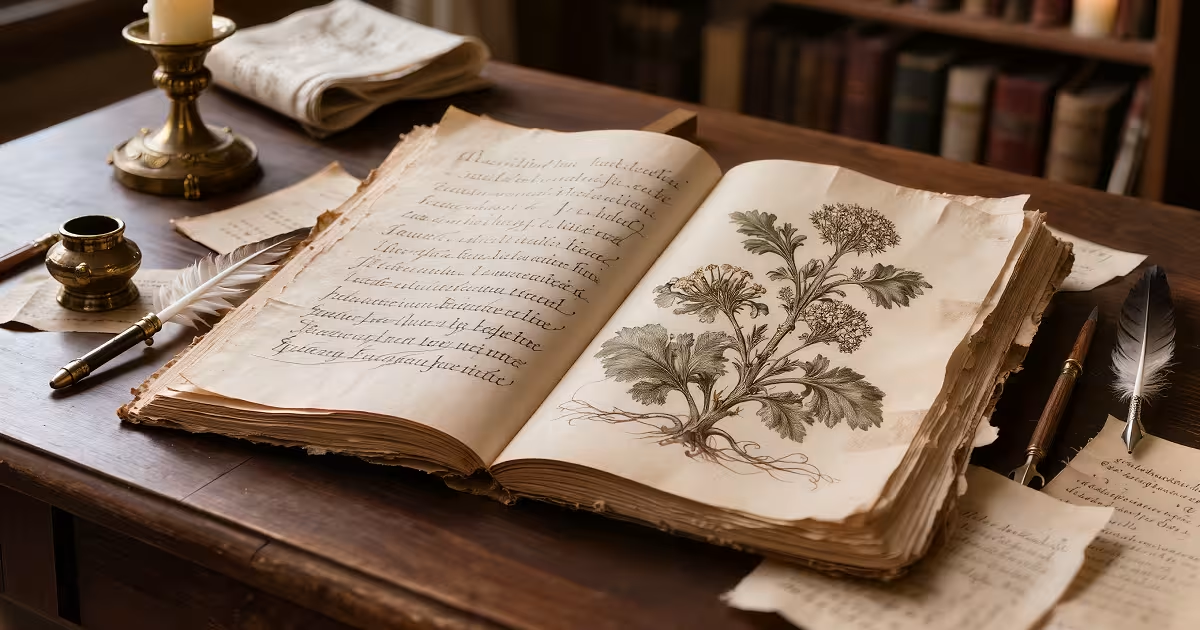
Open vellum folio. Invented plants and unread script.
Illustration, not a period photograph.
Opening
The Voynich Manuscript sits at Yale's Beinecke as MS 408: vellum, plants that do not sit still in a known flora, bathing women, and a script no one has read to a consensus. Wilfrid Voynich bought it in 1912. Carbon sits it in the early 1400s. Roger Bacon stories and later decipherments have not held. The book is a real object. The language is the lock.
Voynich is not a CIA courtyard. It is a medieval book that behaves like one until the alphabet. Keep crackpot solves on the later shelf unless a reading predicts text not used to build the reading.
The spine of the file is unread vellum at Yale. Voynich is Beinecke 408. It is not a solved herbal in a Prague drawer.
Timeline
Early 1400s vellum in the later carbon. Ownership traces through Prague and Rome sit incomplete.
1912 Voynich buys. 1969 Yale.
A century of failed and half-failed readings. Statistical work on the script continues.
Later "solved" headlines are later life. The unread pages are first.
The Voynich manuscript is a real bound book with a script no school has read to consensus. Plants and charts sit on the pages. Authors have been offered and withdrawn. The book is first. The unread is the file.
A cipher that will not open is still an object you can hold. Prize readings are later life unless they predict unused pages.
Key figures
The unknown fifteenth-century makers own the vellum.
Wilfrid Voynich owns the modern name.
The Beinecke owns the shelf.
A century of solvers own the unheld readings.
Physical and documentary trail
On the paper, the book itself is the tray.
One: the physical manuscript at Yale.
Two: carbon dates in the early fifteenth century.
Three: a script without a consensus plain text.
Four: plants and diagrams that will not sit in a known work. Beinecke Rare Book and Manuscript Library, MS 408, is the object.
There is no signed plain text. There is no later author everyone accepts. There is no proof it is modern.
A standing manuscript and no consensus hand are the stay-behinds. A reading that predicts unused pages would finish the script. A signed author both camps take would finish the other door.
The script has not been read to a standard the library can stamp.
Competing explanations
A cipher or unknown language with meaning. This is the hope. It has statistics that look language-like. It has no reading.
A medieval hoax or generated nonsense. The other door. Has to carry the cost of vellum and the care of the drawings.
A known language in a private alphabet. Offered every year. Not held.
Hybrid caution. The book is real and old. The words are still dark.
Later life of the case
Annual solved headlines. I keep those on the later-life shelf. The unread quires stay first.
Finding
A fifteenth-century book at Yale is written in a script no consensus has read, and the plants will not sit still in a known flora. Believe the vellum. A library does not invent a shelf number for a later headline.
What still will not resolve: a plain text that predicts unread pages, or a proof the script was never language. Either one would pin MS 408. The proving object is still that reading, held against pages not used to build it.