STAR DUST
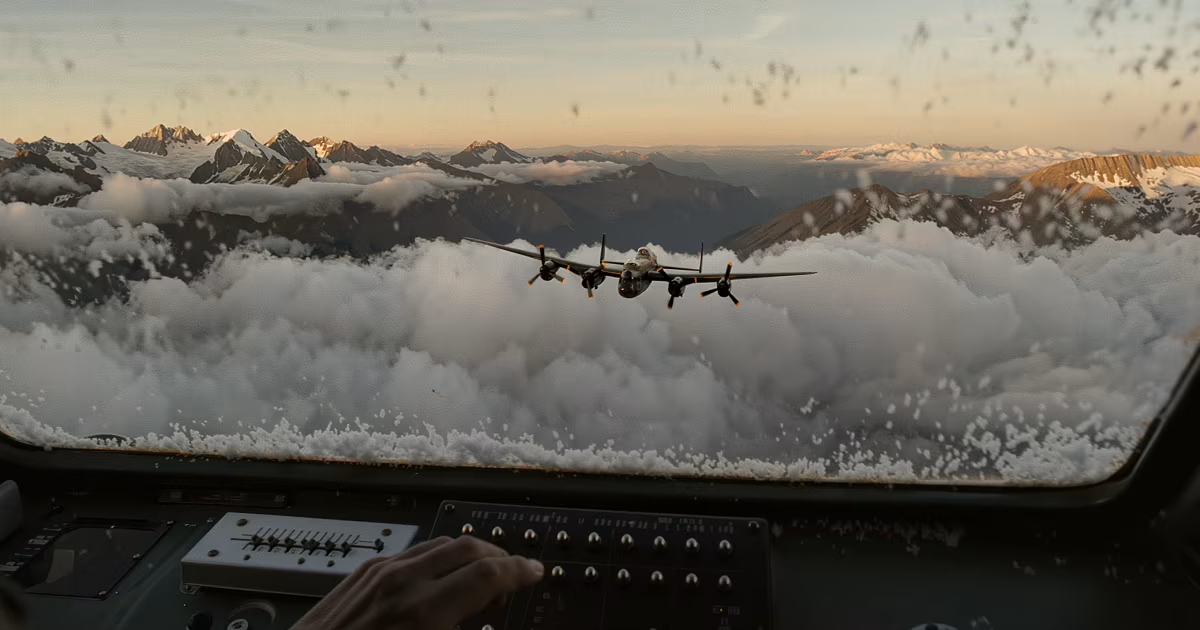
Andes glacier. Metal fragment, no letters visible.
Illustration, not a period photograph.
Opening
On 2 August 1947 British South American Airways Lancastrian G-AGWH, Star Dust, left Buenos Aires for Santiago with eleven people and did not arrive. The last Morse from the Andes was STENDEC, sent at 17:41 and repeated. Santiago asked again. The word came once more. Then silence. For fifty years the wreck was missing and the word did work that a crash in cloud could not. In 1998 and after, wreckage and remains came out of Mount Tupungato. The board reading became a high impact in white-out, a jet stream, a mountain. STENDEC stayed a word without a settled expansion.
Star Dust is a found wreck that still carries an unsolved last group. Keep those two facts on the same page without letting the paperback eat the ice.
The spine of the file is a Morse group and a mountain that finally gave the airframe up. Star Dust is 2 August 1947. It is not still missing.
Timeline
2 August 1947 the flight and the last group. Search fails in the Andes.
Fifty years of STENDEC theories. 1998 climbers find wreckage on Tupungato.
Later recoveries and identifications. Accident reading settles on the mountain.
The word remains later life as a puzzle. The ice is first for the aircraft.
BSAA was already losing aircraft in a way that made Star Dust look like a pattern until Tupungato produced aluminium and bone. The word did fifty years of work that ice later made unnecessary for the machine and still necessary for the letters.
Key figures
The eleven on board own the loss.
The Santiago radio operator owns the last group as received.
BSAA owns the route and the later company weather.
The 1998 climbers own the find that ended the missing years.
Physical and documentary trail
On the paper, 1947 and 1998 give you four hard objects and no living expansion of the word.
One: the flight plan and the last Morse, STENDEC.
Two: fifty years of no wreck.
Three: Tupungato wreckage from 1998 on.
Four: the high-impact accident reading. BSAA Star Dust last transmission, 2 August 1947, and Tupungato recovery, 1998, are the two trays. Keep them both.
There is no signed expansion of STENDEC everyone accepts. There is no longer a missing airframe. There is no paperback door required for the ice.
A mountain wreck and a last Morse group are two stay-behinds. The ice closed the missing years. It did not write the expansion.
STENDEC
Competing explanations
A navigation error into a mountain in cloud. This is the wreck. It has ice. It has no need of a triangle.
A last word that still means something else. This is the puzzle. It has letters. It has no agreed phrase.
A disappearance that was never a crash. Ended on Tupungato.
Hybrid caution. The aircraft is on the mountain. The last group is still a group.
Later life of the case
STENDEC essays and later recovery films. I keep the essays on the later-life shelf. The ice stays first for the machine.
Finding
Star Dust sent STENDEC from the Andes on 2 August 1947 and then hit Tupungato, where wreckage was found in 1998. Believe the radio. Believe the mountain. A Morse room does not invent a last group for a later puzzle book.
What still will not resolve: a signed expansion of STENDEC, or a page that makes the wreck someone else's aircraft. Either one would finish the word or the ice. The proving object is still that expansion, written at the time, which Santiago never logged as plain English.