ROANOKE
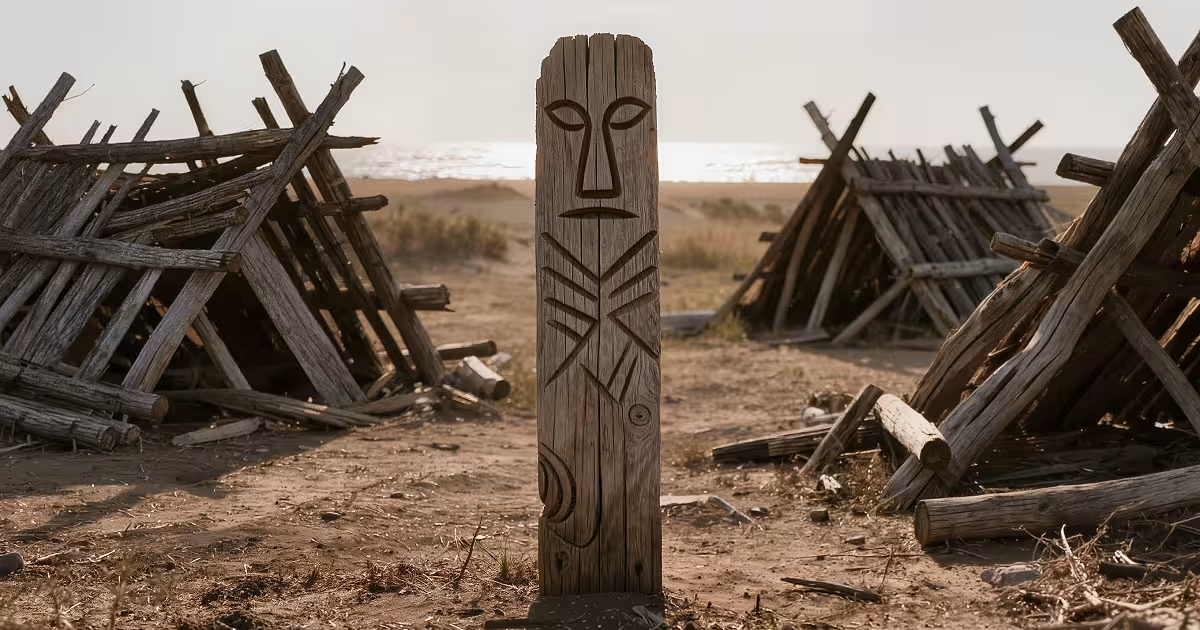
A carved wooden post among collapsed shelters in an empty settlement.
Illustration, not a period photograph.

Opening
In the summer of 1587, about 115 English men, women and children settled on Roanoke Island, in what is now North Carolina, under governor John White. His granddaughter Virginia Dare was born there on 18 August, the first English child born in the Americas. Nine days later White sailed for England to fetch supplies, promising to be back within the year.
War with Spain kept him away for three years. When he finally landed on Roanoke on 18 August 1590, Virginia's third birthday, the settlement was empty. The houses had been taken down, and there were no bodies and no sign of a fight. The only message was a word carved on a post: CROATOAN.
Timeline
27 August 1587White leaves with the fleet. Before going, he agrees with the colonists that if they move, they will carve the name of their destination, and add a cross if they leave in distress.
1588The Spanish Armada threat leads Queen Elizabeth to keep able ships in port. White gets two small ships, the Brave and the Roe, away on 22 April, but they are attacked and looted near Morocco on 6 May and turn back.
1590White sails as a passenger with a privateering fleet organised by John Watts, aboard the Hopewell, with the Moonlight in company.
15 August 1590The ships see smoke on Roanoke.
17 August 1590Crossing to the island, Captain Edward Spicer's boat overturns in the inlet. Seven of the eleven men aboard drown, Spicer among them. Captain Cooke strips and rows out to save the other four.
18 August 1590White and Captain Cooke reach the settlement. They find "CRO" cut into a tree and "CROATOAN" carved on a post at the entrance of a palisade. Five chests that the colonists had hidden, three of them White's own, have been dug up and broken open.
Late August 1590White means to sail to Croatoan, about 50 miles south. An anchor cable snaps, leaving the Hopewell with one anchor, and storms drive the ship off the coast. The search is abandoned.
24 October 1590The Hopewell reaches England. White never returns to America.
Key figures
John White, an artist as well as a governor, is the only source for what was found in 1590. His account was printed by Richard Hakluyt in 1600, and his last known word on the colony is a 1593 letter to Hakluyt from Ireland.
Eleanor and Ananias Dare, White's daughter and son-in-law, and their infant Virginia were among the missing.
The Croatoan people lived on the island the carving names, on what is now Hatteras Island. Manteo, a Croatoan man who had been to England, was an ally of the colony.
Captain Abraham Cooke commanded the Hopewell and made the call to give up the search after the anchor was lost.
Physical and documentary trail
The record: White's 1590 narrative, the agreed signal, the carved word, the absence of the cross, and the dismantled houses, which suggest the colonists left in an orderly way rather than in flight. White's 1585 map, La Virginea Pars, held by the British Museum, adds a later clue: in 2012 a patch on the map was found to hide a fort symbol on the mainland, now called Site X. What is missing is any English record of the colonists after 1587.
5. foote from the ground in fayre Capitall letters was graven CROATOAN without any crosse or signe of distresse
Things you might not know
- He arrived on her birthday. White reached the empty settlement on 18 August 1590, his granddaughter's third birthday.
- The governor painted. White's watercolours of Algonquian people and coastal wildlife are among the earliest English images of North America.
- The map had a secret. Researchers from the First Colony Foundation spotted the patch in 2011, and British Museum imaging found the fort symbol beneath it.
- His own chests were looted. White found his books torn from their covers, his pictures and maps spoiled by rain, and his armour rusted.
- The gold ring is brass. A signet ring found at Cape Creek on Hatteras in 1998 was hailed as gold, but 2017 X-ray analysis showed it was brass.
- The Dare Stones were a hoax. Inscribed stones said to be left by Eleanor Dare surfaced from 1937 and were exposed as forgeries by 1941.
Competing explanations
The colonists moved to Croatoan as agreed. This reading follows the carving and the missing cross, and it fits the European artefacts, including part of a sword and part of a gun, found at Native sites on Hatteras by Mark Horton's team.
They moved inland, perhaps to Site X. The hidden fort on White's map and Tudor-period pottery reported from the site in 2017 support some kind of English presence there, though critics note it could date from the 1585 expedition.
They were killed. William Strachey, writing by 1612, claimed survivors had lived with a tribe beyond Powhatan's territory before Powhatan attacked them. Samuel Purchas later cited a confession by Powhatan, but John Smith never mentions it, and historians have treated it as unreliable.
They split up, with groups absorbed into different Native communities. This is compatible with most of the physical finds and requires no single fate.
Later life of the case
Archaeology is still moving the case. In 2020 Scott Dawson argued the colonists simply merged with the Croatoan and that the mystery is over; critics replied that the evidence is suggestive, not conclusive, and his book was not peer reviewed. In 2025 Dawson and Horton announced hammerscale, a by-product of ironworking, in a late-16th-century layer on Hatteras. That result is also awaiting peer review.
Finding
The colonists left Roanoke deliberately, took their houses down, and told White where they were going. The strongest reading is that at least some of them reached Croatoan and lived among its people, and the Hatteras finds point the same way. No find yet ties an object to a named colonist, so assimilation is the best explanation, not a proven one.
What still will not resolve: a document, burial or artefact that links a named 1587 colonist to a place after 1590, and a full excavation of Site X.
Evidence signature
3/9 Thin
- Witnesses
- nothing on record
- Instruments
- photo, film or physical traces
- Paper
- official records at the time
How well documented the case is, not whether it's true. A strong record can still have an ordinary answer, and a thin one can still be real.
You decide · ROANOKE
What do you think happened?
One vote per case, anonymous. You'll see how other readers voted once you've voted.