MAD GASSER
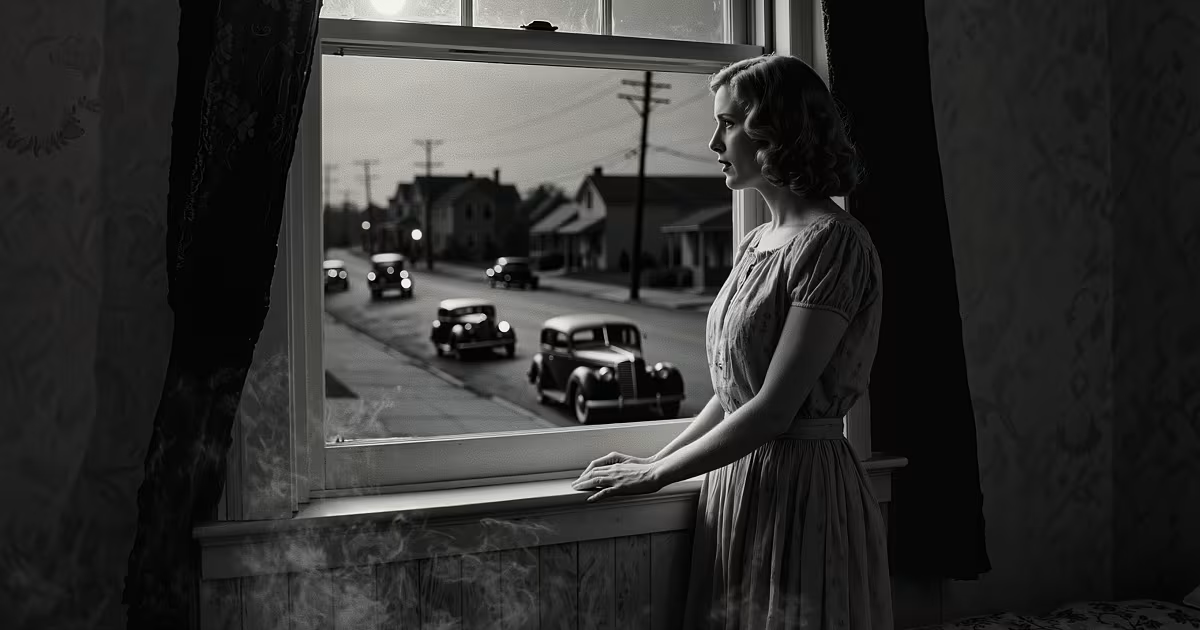
A woman in a 1940s dress at a window, looking out at a night street.
Illustration, not a period photograph.

Opening
Around 11 p.m. on 1 September 1944, Aline Kearney of 1408 Marshall Avenue, Mattoon, Illinois, smelled a sickly sweet odour in her bedroom, felt her legs go numb and cried for help. Her sister smelled it too, near the open window. When her husband Bert, a taxi driver, came home at about 12:30 he saw a tall, thin man in dark clothes and a tight cap at the window, who ran off. The next day's Journal-Gazette called her and her daughter the "first victims" of an "anesthetic prowler".
Over the next twelve days dozens of people in the town of about 16,000 reported sweet smells, nausea, vomiting and temporary paralysis. Armed residents patrolled at night, state investigators and the FBI came in, and no gasser was caught. On 12 September the police chief declared there was no gasser at all. In 1945 a psychologist made Mattoon a textbook case of mass hysteria. Others have argued ever since that someone really was spraying gas.
Timeline
Night of 31 August to 1 September 1944Urban Raef, a sheet-metal worker on Grant Avenue, wakes nauseous and vomiting. His wife finds she cannot get out of bed. A young mother nearby reports the same.
1 September 1944The Kearney case. Police find no prowler.
2 September 1944The Mattoon Daily Journal-Gazette headline: "Anesthetic Prowler on Loose".
5 September 1944Beulah Cordes of North 21st Street sniffs a cloth found on her porch and becomes violently ill. A well-used skeleton key and an almost empty lipstick tube are found nearby. The cloth is tested and no chemical is found.
6 to 10 September 1944Reports multiply across town. Police warn armed residents to disband their patrols. Two sisters on Moultrie Avenue report a blue vapour and a buzzing sound.
12 September 1944The Daily Illini counts 33 victims in 12 days. Police Chief C. E. Cole announces there is no prowler, blaming fumes carried on the wind from a war plant and public fear.
13 September 1944Bertha Burch reports a gasser who was a woman dressed as a man. A woman's shoe prints are reported under her window. Reports then stop.
1945Donald M. Johnson publishes "The 'Phantom Anesthetist' of Mattoon: A Field Study of Mass Hysteria".
2003Scott Maruna's book The Mad Gasser of Mattoon: Dispelling the Hysteria names a suspect.
Key figures
Aline and Bert Kearney, whose case launched the scare and supplied the only widely circulated description of the gasser.
C. E. Cole, Mattoon's police chief, who declared the gasser imaginary.
Richard Piper, superintendent of the Illinois Bureau of Criminal Identification and Investigation, who sent investigators.
Donald M. Johnson, the psychologist whose 1945 field study defined the hysteria reading.
Scott Maruna, a Jacksonville, Illinois, chemistry and physics teacher who argued for a real gasser.
Farley Llewellyn, the Mattoon man Maruna named.
Physical and documentary trail
The record is local and national newspapers, police statements, Johnson's 1945 paper and later work by the sociologist Robert Bartholomew with Bob Ladendorf (Skeptical Inquirer, 2002) and Jeffrey Victor (Sociological Quarterly, 2004). No gas sample, sprayer or residue was ever recovered. The one object tested, the Cordes cloth, showed nothing that would explain her reaction. Victims recovered quickly and none died.
The local industry was checked too. Cole suggested carbon tetrachloride or trichloroethylene from the Atlas Imperial diesel engine plant. The company said it held only five gallons of carbon tetrachloride, in fire extinguishers, and that its workers would have fallen ill first. The plant had been certified safe by the state health department.
Farley, the obvious chemical genius behind the gas's synthesis, was the real gasser.
Corrections to the earlier version of this report. The first victim reported in the press was Aline Kearney, not "Aileen". Hers was not the first incident: the Raefs reported theirs the night before. The suspect named in 2003 comes from Scott Maruna's book.
Things you might not know
- The wife never saw a prowler. Aline Kearney and her sister described a smell. The prowler came from her husband's sighting hours later, and the newspaper joined the two into an attack.
- A horror film opened mid-scare. Invisible Man's Revenge began playing at the Mattoon Theater on 6 September under the line "The Phantom Shadow!" Ladendorf noted that "phantom" entered the gasser coverage only after that.
- Reporting a gassing got harder. According to Maruna, the police chief threatened to arrest anyone who reported a gassing without agreeing to a medical examination.
- The prosecutor blamed the press. State's Attorney William Kidwell said a Journal-Gazette reporter "with a vivid imagination" had fuelled the scare.
- Virginia had a gasser first. Botetourt County reported a similar wave of night-time gassings in 1933 and 1934.
Competing explanations
A real gasser. The early cases are hard to dismiss. Several households independently described the same sweet smell, specific symptoms and the timing of open summer windows. Bert Kearney saw a man at the window. The Cordes cloth came with a key and a lipstick tube, and the last report came with shoe prints. The state's top criminal investigator, Piper, told the press the anesthetic was genuine. Spraying a sedative into a bedroom is possible: in 2011 Bolivian courts convicted seven men from the Manitoba Mennonite colony of rapes committed after spraying a veterinary anaesthetic through bedroom windows. A clean cloth test does not rule out a volatile gas that evaporated.
Farley Llewellyn. Maruna argues the gasser was Llewellyn, a University of Illinois chemistry student and local outcast who drank heavily and kept a home laboratory that once exploded. He says Llewellyn's sisters, Florence and Katherine, carried on after he fell under suspicion, that he was sent to a mental hospital, and that the chemical was tetrachloroethane or nitromethane. Maruna says many older residents knew Farley was responsible. Critics, including Ladendorf, point out that the book has no footnotes and gives no documentation for the profile, the chemical or the sisters' role.
Mass psychogenic illness. Johnson found the reports followed the newspaper coverage, not the gasser, and that they stopped once police treated them as false. Bartholomew and his co-authors add wartime fears of Nazi gas attacks and a local crime wave. The symptoms reported, nausea, choking and leg weakness, are typical of psychogenic outbreaks, and every victim recovered quickly.
Industrial fumes. Cole's own explanation. The plant's response, and the lack of illness among its workers, made it the weakest of the four.
Later life of the case
Johnson's paper made Mattoon a staple of psychology and sociology courses for decades. Maruna's book and the Bolivian convictions gave the real-gasser reading new life. The case also became a fixture of paranormal writing: Loren Coleman's Mysterious America carried an illustration of the gasser as a not-quite-human figure.
Finding
The strongest reading is that most of the Mattoon gassings were psychogenic, spread by a newspaper that turned one smell and one shadow into an attack. Reports rose with the coverage and stopped when police stopped believing them, and no gas, device or culprit was ever found. That does not show the first few nights were empty. A prowler at the Kearney window and an early real gassing remain possible, and the Llewellyn theory, while undocumented, has never been tested.
What still will not resolve: what made the Raefs and Aline Kearney ill on the first two nights, before any newspaper had mentioned a gasser. No samples were taken that could answer it now.
Evidence signature
4/9 Solid
- Witnesses
- several people
- Instruments
- nothing on record
- Paper
- official records at the time
How well documented the case is, not whether it's true. A strong record can still have an ordinary answer, and a thin one can still be real.
You decide · MAD GASSER
What do you think happened?
One vote per case, anonymous. You'll see how other readers voted once you've voted.