PARACAS SKULLS
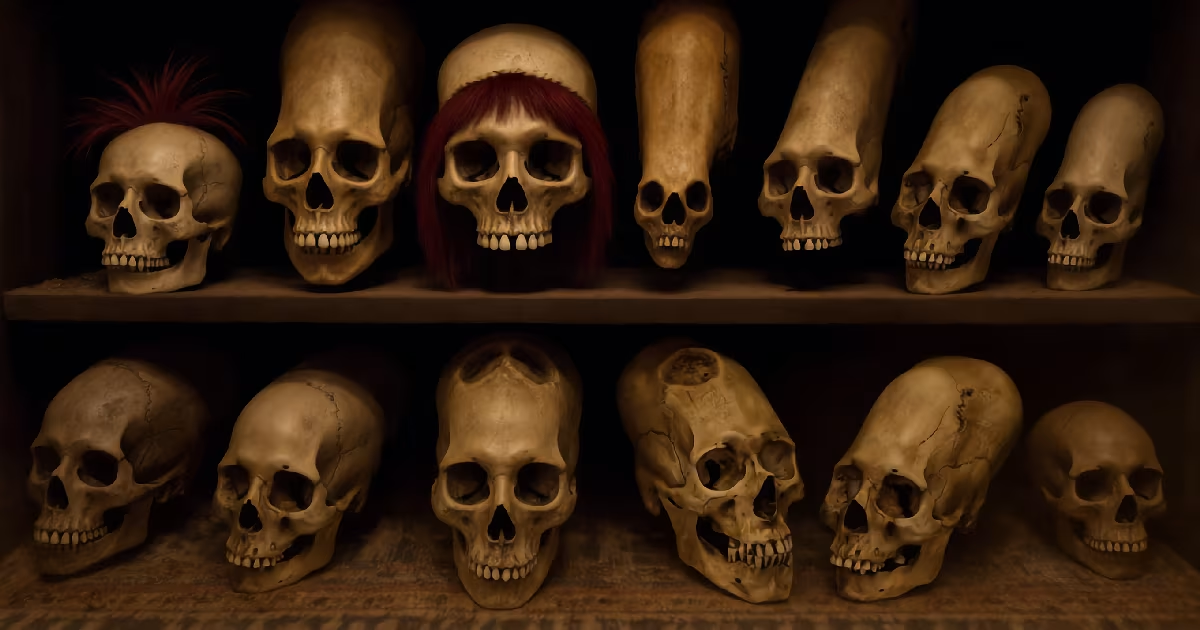
Two shelves of elongated skulls, some with tufts of dark red hair, in a dark museum cabinet.
Illustration, not a photograph.
Opening
In the late 1920s, Peruvian archaeologist Julio C. Tello excavated a vast cemetery on the Paracas peninsula on Peru's southern coast and found hundreds of mummy bundles. Many of the skulls were dramatically long, swept back into a cone. The Paracas culture that buried them flourished from about 800 BC to 100 AD. Archaeologists say the shape comes from binding infants' heads, a practice known from cultures all over the world. A smaller group of researchers says some of the skulls are too large, and built too differently, to be human at all.
Timeline
About 800 BC to 100 AD. The Paracas culture lives on the desert coast, famous for its textiles and its large necropolis burials.
1927 to 1928. Tello excavates the Paracas necropolis, recovering more than 400 bodies, many with elongated skulls.
2000s. A collection of skulls goes on display at the privately owned Paracas History Museum, run by Juan Navarro.
2014. Researcher and author Brien Foerster announces that preliminary DNA results from samples of the skulls showed mitochondrial DNA with "mutations unknown in any human, primate, or animal known so far." The geneticist who did the work is not named at first, and no paper follows.
2016 to 2018. Later results from Foerster's project are reported to show ordinary human lineages, some of them typical of Europe and the Middle East rather than the Americas. These are also presented outside peer-reviewed journals.
30 September 2026. Joe Rogan shows the skulls to David Grusch on air, saying they lack the sagittal suture and hold 20 to 30 percent more brain than a normal human skull.
Key figures
Julio C. Tello is often called the father of Peruvian archaeology, and his excavations are the reason the skulls are known at all. Brien Foerster has done more than anyone to bring the skulls to a wide audience through books, tours and documentaries. Juan Navarro's museum holds the collection most often shown on screen.
On the paper
Head binding is extremely well documented. Paracas infants' heads were wrapped with cloth and pads, and the practice appears in the Andes, Africa, Europe and Asia across thousands of years. Binding changes the shape of the skull but not, according to anatomists, the amount of brain it holds.
The two claims that would move the skulls beyond binding are their volume and their sutures. Both have been asserted in talks, books and interviews. Neither has been published with measurements in a scientific journal where other researchers can check them. The 2014 DNA claim was described by Foerster himself as preliminary, and the later results he reported pointed to human ancestry.
Competing explanations
Head binding. Shape, location, age and the cloth wraps found with some burials all fit it, and it is the consensus view among archaeologists.
A different kind of human. Supporters argue that the largest skulls have more volume than binding could produce and are missing the suture that runs along the top of a normal skull, which would point to a genetic difference rather than a cultural practice. Some suggest a lost population, others an outside origin.
Disease or inherited traits. Conditions that fuse the skull's sutures early can produce long, narrow skulls without any binding. That could explain a missing suture in some individuals.
Finding
The long shape of most Paracas skulls is best explained by head binding, which the Paracas people clearly practised. The more striking claims, larger brains and missing sutures, have been put forward by researchers who have handled the skulls but have not yet been tested in published, measured studies.
What still will not resolve: a published study measuring the volume of the largest skulls and sequencing their DNA in the open. The skulls are in collections that could be studied tomorrow. Until someone does, both sides are describing them rather than proving anything.