JOHN TITOR
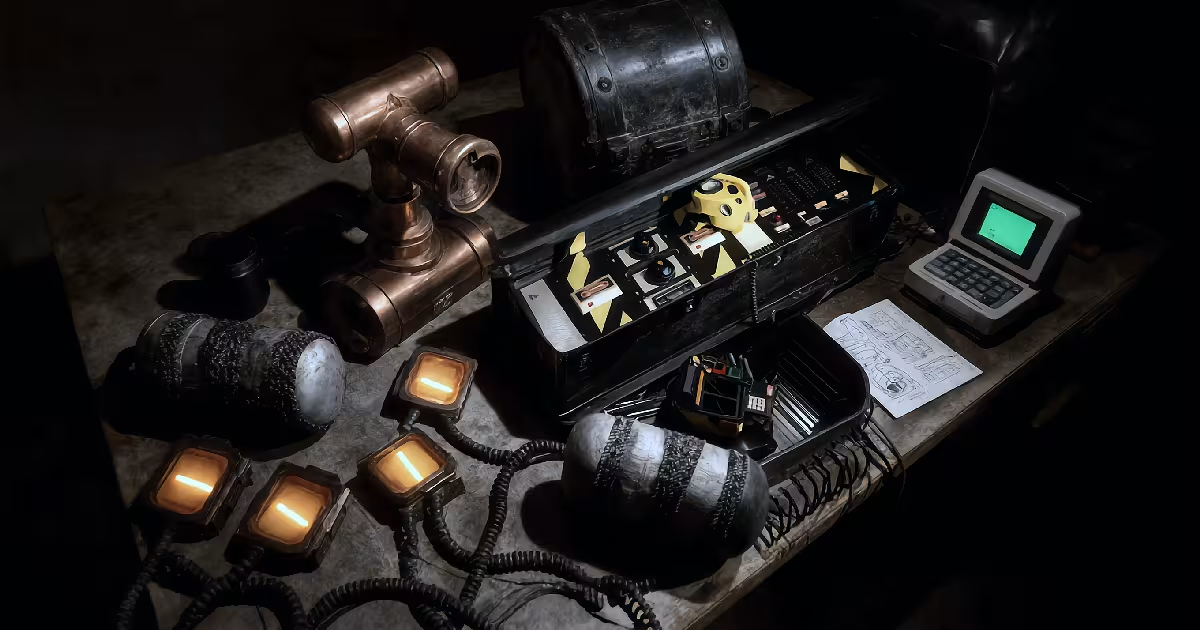
A time machine in pieces on a workbench beside an old computer.
Illustration, not a photograph.

Opening
On 2 November 2000, a user calling himself TimeTravel_0 began posting on an internet forum about time travel. Within weeks he had a name, John Titor, and a story: he was an American soldier from the year 2036, sent back to 1975 to collect an old IBM computer, and stopping off in 2000 for personal reasons. He answered hundreds of questions, posted photographs of his "time machine," described the coming collapse of the United States, and then, in March 2001, said goodbye and vanished.
His predictions didn't come true. But one of his technical claims, about a forgotten feature of a 1970s computer, turned out to be right, and more than twenty years later nobody has proved who John Titor really was.
Timeline
29 July 1998The first of two faxes reaches the late-night radio host Art Bell, describing time travel through "a contained singularity engine." They are later linked to Titor.
14 October 2000On an internet chat channel, TimeTravel_0 says he is 38, from Florida, and based at MacDill Air Force Base near Tampa.
2 November 2000His first post appears on the Time Travel Institute forum. He explains that he has come from 2036.
January 2001He starts calling himself John Titor and moves to the Post-2-Post message board linked to Art Bell. Over the following weeks he posts photographs of his device and pages from what he says is its manual.
March 2001Titor posts for the last time. He says he is leaving to continue his journey back to 2036, and he is never heard from again.
2003The John Titor Foundation, a company registered in Florida, publishes the posts as a book, John Titor: A Time Traveler's Tale, and registers his name as a trademark.
August 2004Bob Dubke, an engineer who worked on the IBM 5100, tells Rochester Magazine that the machine really did have the hidden capability Titor described.
19 May 2008The Italian television programme Voyager broadcasts an investigation. Investigator Mike Lynch finds no record of anyone called John Titor and traces the foundation to a rented mailbox in Kissimmee, Florida.
2009An investigation by the website Hoax Hunter concludes that the posts were most likely written by people connected to the foundation. They deny it. The same year, the Japanese visual novel Steins;Gate makes the Titor legend part of its plot.
Key figures
John Titor, the name he took in January 2001. He described himself as a soldier in a unit based in Tampa, born in 1998, which made him a toddler in 2000 and 38 in 2036.
Art Bell, whose audience and message board gave Titor his biggest stage.
Bob Dubke, the IBM engineer whose confirmation of the 5100's hidden feature is the strongest point in Titor's favour, and who still suspected a prank.
Mike Lynch, the investigator who followed the paper trail to Florida.
Joseph Matheny, a writer of alternate-reality games, who said in 2018 that he consulted on the Titor story as a "literary experiment," though he said it was not his project.
Physical and documentary trail
The posts themselves survive in archived copies and in the 2003 book, along with Titor's photographs: a device on a car seat, a laser beam that appears to bend, and diagrams from a manual for what he called a gravity distortion time displacement unit, model C204, made by General Electric. Nothing in the photographs requires anything more than props and a camera.
The key document is not Titor's but IBM's. The IBM 5100, a portable computer released in 1975, was built to run software written for IBM's big mainframe computers by imitating them in its own internal code. IBM designed it that way on purpose, but it was a detail few people outside the company knew. Dubke confirmed it was real. He also said Titor's information looked "derived from information available on the Internet," that he suspected a prank by someone from the 5100 team, and that nobody on that team would have used Titor's phrase "legacy code."
What is missing is a person. No one named John Titor has been traced, the foundation was a mailbox, and no one has ever produced the man in uniform, the device or the truck.
Derived from information available on the Internet.
How the machine worked, by his account
Titor described his "C204" in more detail than almost any other claimed time machine, and he stayed consistent across months of questions. In his words, it was powered by "two, top-spin, dual-positive singularities," tiny black holes held in magnetic housings. He listed its parts as:
- Magnetic housing units for the two micro-singularities.
- An electron injection manifold to change their mass and gravity.
- A cooling and X-ray venting system.
- Gravity sensors, which he called the VGL, or "variable gravity lock."
- Four caesium clocks.
- Three main computers, which checked each other for errors.
Charging the singularities, he said, changed the size of their event horizons, and turning them altered the shape of the gravity field around the vehicle. The computers controlled that field, so "in a sense you do dial in a date." The unit weighed about 500 pounds, needed a vehicle with strong suspension, and had to stay still while running because the gravity sensors were so sensitive. At full power it travelled "about 10 years an hour," and it became unreliable beyond about 60 years.
Inside, he said, you felt 1.5 to 2 G the whole way, heard a slight hum and got hot and stuffy. The view went from "driving under a rainbow" to total darkness, until "the world fades in from black." Anyone watching from outside would see the air ripple and the vehicle seem to accelerate as light bent around it, and needed sunglasses against a burst of ultraviolet.
The vocabulary is borrowed from real physics. Spinning black holes and Frank Tipler's 1974 idea of a rotating cylinder that could bend time are genuine scientific ideas, and Titor's "Tipler sinusoid" nods to them. But no one has made a micro black hole, let alone held two in a box on a car seat, and nothing in the description goes beyond the ideas a well-read enthusiast could find in 2000.
Things you might not know
- The time machine was in a Corvette. Titor said his device was first fitted to a 1967 Chevrolet Corvette for the trip to 1975, then moved to a 1987 four-wheel-drive truck.
- He had a reason to need the old computer. He said the 5100 was needed to fix computer systems in 2036, a problem many readers linked to the real "year 2038" bug, when older Unix clocks run out of numbers.
- He had an answer for being wrong. Titor said that every trip creates a slightly different timeline, so our future need not match his. That made his predictions impossible to disprove.
- His future was grim. He said a civil war would begin in the United States around 2004 and that a nuclear war in 2015 would leave Omaha as the new capital.
- He changed the model number. In the October 2000 chat he named the IBM 5110 four times. From his first forum post he said 5100, and he never mentioned the switch.
- Japan made him famous again. Steins;Gate, built around the Titor legend, became one of the best-loved time-travel stories in anime.
Competing explanations
A real time traveller. Titor's supporters point to the IBM 5100 detail, the consistency of his answers over months, and his own explanation for the failed predictions: our timeline is not his. It is a perfectly closed argument, which is also its weakness, since nothing could ever count against it.
A hoax by someone who knew computers. The 5100 feature was obscure but not secret to people who had worked with the machine or read about it, and Dubke himself suspected an insider prank. The faxes, the chat, the forum posts and the book form a pattern that fits a carefully built character.
A deliberate work of fiction. On this reading, Titor was an early example of collaborative online storytelling, a kind of game played in public, which later became common. Matheny's "literary experiment" comment points this way.
Later life of the case
Titor became the template for every "time traveller from the future" post that followed, and his story has been retold in documentaries, podcasts, novels and games. The predictions failed, but the mystery of who wrote him, and how he knew about the IBM 5100, kept the story alive.
He belongs to the great age of Art Bell's late-night radio, alongside the Area 51 caller, Mel's Hole and Jonathan Reed. Among the archive's other stories of slipping through time are Versailles 1901, the secret experiments claimed at Montauk and the Philadelphia Experiment.
Finding
The strongest reading is that John Titor was a character, written by someone with real knowledge of old IBM hardware, and played out over five months with great skill. His predictions failed, no one by that name has been found, and his own theory meant he could never be proved wrong. The 5100 detail is impressive, but an IBM engineer who confirmed it also thought it came from an insider.
What still will not resolve: who sat at the keyboard. Investigators have pointed at people, and they have denied it. More than twenty years on, John Titor is still the internet's best-kept secret.
Evidence signature
3/9 Thin
- Witnesses
- one person, or a tradition
- Instruments
- photo, film or physical traces
- Paper
- press and later accounts
How well documented the case is, not whether it's true. A strong record can still have an ordinary answer, and a thin one can still be real.
You decide · JOHN TITOR
What do you think happened?
One vote per case, anonymous. You'll see how other readers voted once you've voted.