VERSAILLES 1901
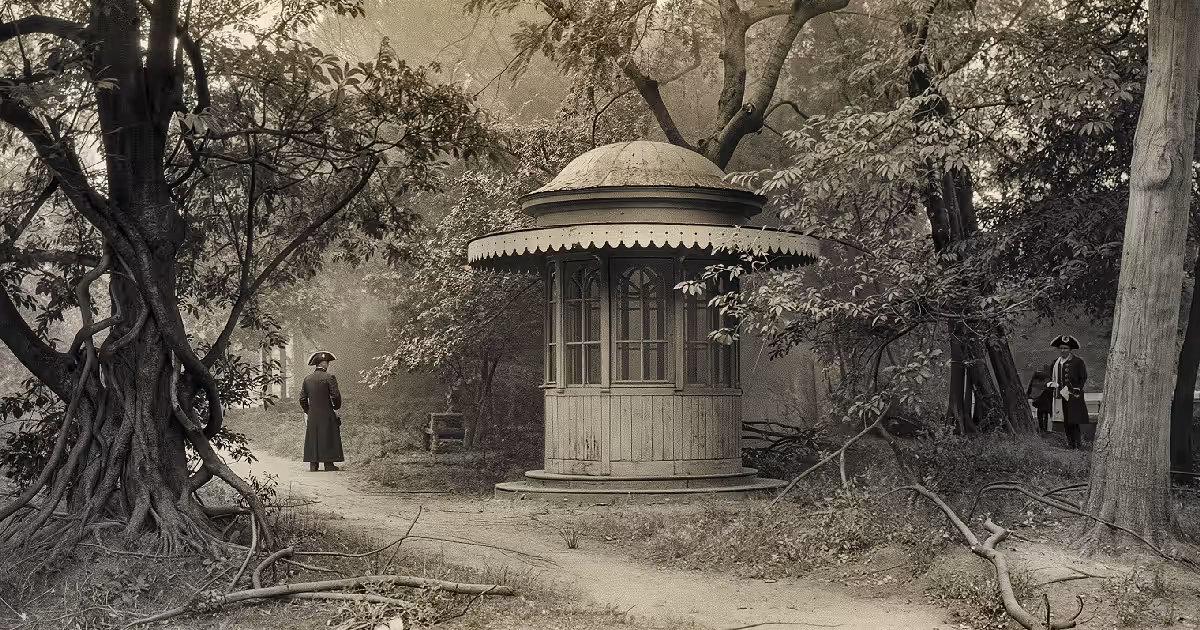
A small round kiosk on a garden path at the Petit Trianon, with figures in eighteenth-century dress among the trees.
Illustration, not a period photograph.
Opening
On the afternoon of Saturday 10 August 1901, two English academics went looking for the Petit Trianon in the gardens of Versailles and got lost. Charlotte Anne Moberly, principal of St Hugh’s in Oxford, and Eleanor Jourdain, who would soon become her vice-principal, came home convinced they had walked through the grounds as they looked in the 1780s, and that one of the people they passed was Marie Antoinette. Ten years later their book about it became a bestseller, and the argument about what they saw has never quite ended.
Timeline
10 August 1901. After a visit to the palace, the two women miss the main avenue to the Petit Trianon and wander. Moberly sees a woman shaking a white cloth from a window. Jourdain sees an old farmhouse with a plough outside. Both feel a sudden heaviness and gloom. They meet two men in long greyish-green coats and small three-cornered hats, who direct them on. By a garden kiosk sits a man with a pockmarked face whose expression Jourdain finds evil. Near the Trianon, Moberly sees a lady in an old-fashioned dress sitting on the grass, apparently sketching. Jourdain doesn’t see her at all.
About a week later. Neither has mentioned the walk. When Moberly asks, “Do you think that the Petit Trianon is haunted?”, Jourdain says she does.
November 1901. Back in Oxford, each writes a separate account. Moberly becomes convinced the sketching lady was Marie Antoinette.
2 January 1902. Jourdain goes back alone. She reports that the atmosphere changes again, she sees labourers in old-fashioned clothes, and she hears faint music. The paths and buildings don’t match what she remembers from August.
1902 to 1910. The two return several times and research the gardens in archives, trying to show that what they saw matched the grounds of 1789 and not 1901.
1911. They publish An Adventure under the names Elizabeth Morison and Frances Lamont. Eleanor Sidgwick reviews it for the Society for Psychical Research and is not persuaded.
1915. Jourdain succeeds Moberly as principal of St Hugh’s.
6 April 1924. Jourdain dies suddenly during a bitter row at the college over the dismissal of a tutor, which had led several staff to resign.
1931. Their real names are publicly attached to the book.
Key figures
Charlotte Anne Moberly, daughter of a bishop and the first head of St Hugh’s. Eleanor Jourdain, a French scholar with a flat in Paris, and sister of the mathematician Philip Jourdain. Eleanor Sidgwick, the Society for Psychical Research’s sharpest reviewer. Joan Evans, Jourdain’s friend and literary heir, who later accepted a natural explanation.
Physical and documentary trail
On the paper: the two separate accounts written in November 1901, the 1911 book and its later editions with maps and appendices, and Moberly’s papers, now in the Bodleian Library in Oxford. That is an unusually good record for a ghost story, with two independent written accounts. The weakness is time. The accounts were written three months after the visit, after the two had compared notes, and the historical research that seemed to confirm them came after that, when they already believed.
Competing explanations
A retrocognition, a glimpse of the past. The women’s own view. They were serious, educated people, not publicity seekers, and they published under false names. Supporters point to details they said they only later confirmed in the archives, such as a bridge and a kiosk that were no longer there in 1901.
A heat-struck walk remembered badly. Sidgwick’s view: a hot afternoon, fatigue and a feeling of oppression, then months of shared discussion that shaped the memories. The “old-fashioned” clothes may have been ordinary dress, gardeners’ uniforms or the outfits of other visitors.
Real people in costume. In 1965 Philippe Jullian’s biography of the poet Robert de Montesquiou suggested that Montesquiou and his friends held costume events and tableaux in the grounds nearby, and that the women walked into one. Joan Evans found this convincing. Others point out that no event has been placed on 10 August 1901.
Later life of the case
Other visitors reported similar experiences at the Trianon in the decades after the book appeared. Lucille Iremonger’s The Ghosts of Versailles (1957) questioned the two women’s reliability. In 2016 Mark Lamont’s book reworked the case again, drawing on the Bodleian papers, and argued that the music Jourdain heard in 1902 may have been army bands practising outside the grounds.
Finding
The strongest reading is that two honest women had a strange, unsettling afternoon in a large and confusing garden, and that their memory of it was shaped over months of comparing notes and years of research into what they already believed. Nothing shows they invented it. The costume-party idea is attractive but unproven, and the time-slip idea rests entirely on accounts written after the fact.
What still will not resolve: who the sketching lady and the men in green coats actually were on 10 August 1901, and why only Moberly saw the lady.