MARGERY THE MEDIUM
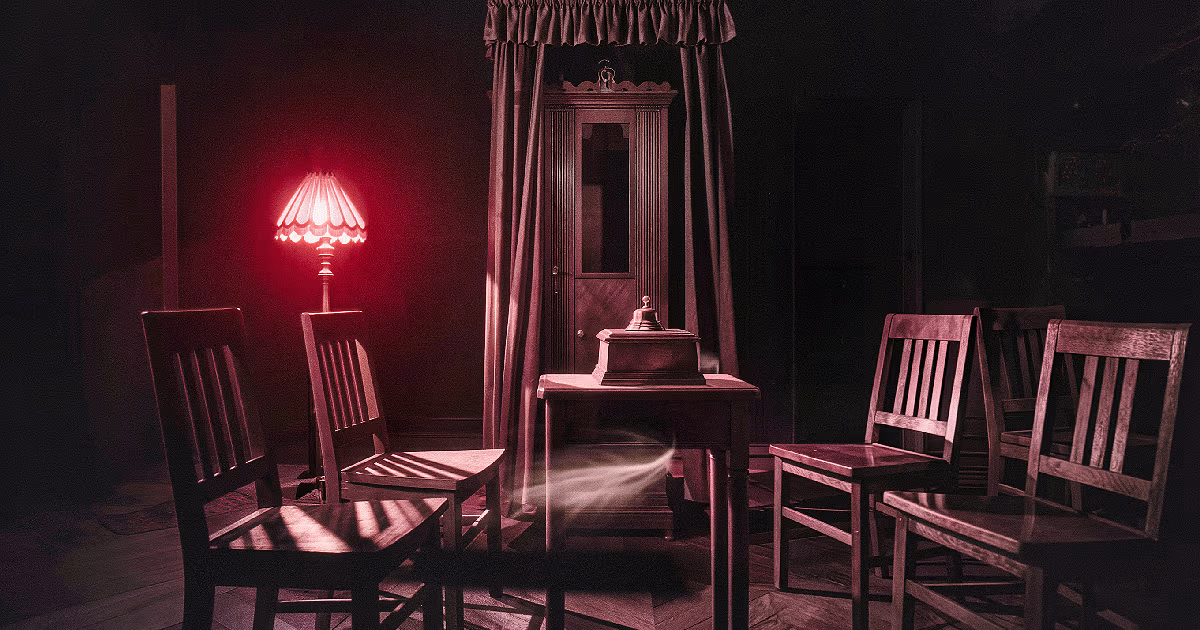
A dim parlour lit by a red lamp, with wooden chairs, a small bell box on a table and a cabinet.
Illustration, not a period photograph.
Opening
From 1923, in a townhouse at 10 Lime Street on Beacon Hill, Boston, Mina Crandon held séances in the dark for her husband’s circle of doctors and academics. Bells rang in boxes, tables moved, and a voice claiming to be her dead brother Walter joked and swore through her. The press called her “Margery.” In 1924 she came closer than any medium before her to winning Scientific American’s prize for proof of genuine psychic phenomena, and Harry Houdini made it his job to stop her.
Timeline
1911. Walter Stinson, Mina’s older brother, is killed at 28 when a freight wagon topples off the tracks onto him.
1923. Mina, now married to the Boston surgeon Le Roi Goddard Crandon, sits at a table with friends in red light after he grows curious about mediums. He later wrote that the table began to tilt and rap almost at once. Within weeks “Walter” is speaking.
1924. Scientific American offers $2,500 for a physical phenomenon produced under test conditions. Its committee: psychologist William McDougall of Harvard, physicist Daniel Comstock of MIT, researcher Walter Franklin Prince, investigator Hereward Carrington and Houdini. The magazine’s J. Malcolm Bird acts as secretary and writes up the sittings favourably, which leads Houdini to object that the magazine is promoting her before the tests are done.
23 to 24 July 1924. Houdini’s first sittings. He wears a tight bandage below his knee all day beforehand so his leg is sensitive, and reports feeling her foot slide over to ring an electric bell box.
23 to 27 August 1924. Houdini brings a wooden cabinet that encloses her up to the neck, with holes for her head and arms. On 25 August the lid is found forced open. At another sitting a folding carpenter’s rule turns up inside it, which Houdini says she could have used to reach the bell. Each side accuses the other of planting it. At the final sitting, under a stricter hold on her hands, nothing happens.
Late 1924. Houdini publishes a pamphlet, Houdini Exposes the Tricks Used by the Boston Medium “Margery”, and publicly calls Bird her accomplice.
Early 1925. The committee declines to award the prize. Only Carrington votes that her phenomena are real.
1925. Hudson Hoagland and a Harvard group sit with her. At one sitting a luminous band meant to track her ankle turns up on the floor under her slipper. Eric Dingwall of the British Society for Psychical Research handles her “ectoplasm” in red light and describes it as cold, damp and like blancmange to the touch.
December 1925. Newspapers report that “Walter” has given Houdini a year to live. Houdini dies on 31 October 1926 of peritonitis.
1926. Physicist R. W. Wood of Johns Hopkins touches an ectoplasmic “rod” and judges it to be animal tissue stiffened with wire.
1932. E. E. Dudley shows that the wax thumbprints credited to Walter match those of Frederick Caldwell, Margery’s own dentist, who had been at her first sitting and who taught her how to take wax impressions.
1939. Le Roi Crandon dies after a fall.
1 November 1941. Mina Crandon dies in Boston, aged 54, of complications from chronic alcoholism.
Key figures
Mina “Margery” Crandon, charming and quick, and a real draw to serious men. Dr. Le Roi Crandon, her husband and fiercest defender. Harry Houdini, who had spent years exposing mediums. J. Malcolm Bird, the insider whose support later soured. Hereward Carrington, the one committee member won over. Biologist Robin Tillyard and novelist Hamlin Garland, two outsiders who came away convinced.
Physical and documentary trail
On the paper: the case is unusually well recorded. Scientific American published the committee’s progress through 1924, Houdini’s pamphlet survives, and the Boston Society for Psychic Research and the American Society for Psychical Research kept years of séance records and photographs of the “ectoplasm”. The thumbprints were photographed and compared. What is missing is any sitting under full control where the phenomena still happened.
Competing explanations
Genuine mediumship. Her supporters argued that the sheer volume of phenomena, witnessed by educated sitters over years, couldn’t all be fraud, and that Houdini wanted her to fail. Tillyard thought Walter’s voice too distinct to be faked. Garland wrote that he was convinced the phenomena were genuine. The ruler dispute shows that not every accusation against her was clean.
Skilled fraud with help. The sitting conditions were set by her husband, in her own home, in darkness. The thumbprints are the hardest single piece: they matched a living man she knew.
Later life of the case
The case split the American Society for Psychical Research, whose leadership backed her. Walter Franklin Prince and others left and founded the Boston Society for Psychic Research in 1925. The Walter “prophecy” followed Houdini into legend after his death. Bird’s 1930 statement, that Margery once asked him to ring the bell himself if nothing happened, was not published at the time. Her last sittings were described by the researcher Nandor Fodor as pitiful.
Finding
The data points strongly to fraud in the key phenomena. The thumbprints matched her dentist, investigators repeatedly saw or felt objects handled in the dark, and under the tightest controls nothing happened. That doesn’t settle every sitting she held over nearly two decades, and some of the early accusations against her were themselves disputed.
What still will not resolve: how much of the Lime Street circle knew, and whether Le Roi Crandon was a partner or the first person she convinced.