CROGLIN GRANGE
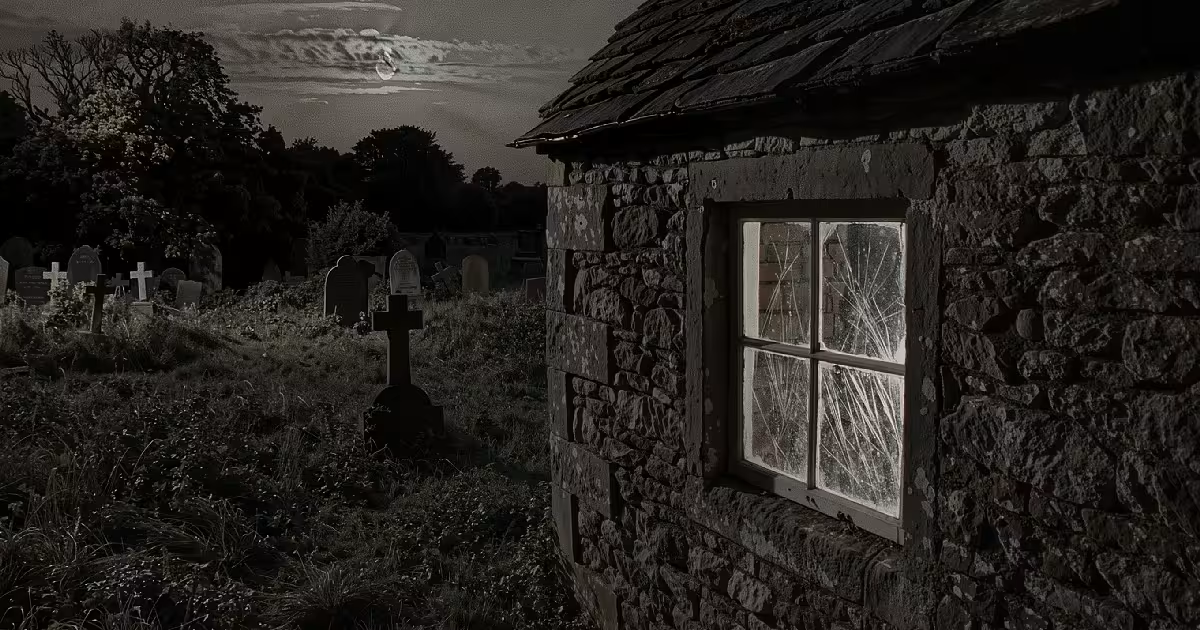
Croglin Low Hall, Cumbria, present day.
Illustration, not a period photograph.
Opening
Sometime before 1874, at a dinner party in Surrey, retired army officer Captain Edward Fisher-Rowe told his host, the writer and socialite Augustus Hare, an "extraordinary story connected with his own family." According to Fisher-Rowe, his relatives had once owned an ancient, single-story Cumberland house called Croglin Grange, and one of its later tenants, a young woman, had twice been attacked in her bedroom by a corpse-faced, red-eyed creature that climbed in through her window from the direction of the nearby churchyard. Hare recorded the story in his diary and later published it in his six-volume autobiography. It became, and remains, the most famous vampire legend in English folklore, predating Dracula by over two decades. It is also, on the sustained effort of more than a century of researchers, a story whose central location has never been definitively located, whose named witnesses cannot be independently confirmed, and whose earliest known appearance in print is Hare's own book and nothing before it.
Timeline
1874 (the dinner conversation itself undated more precisely). Fisher-Rowe relates the story to Hare over an after-dinner conversation, giving no exact names, dates, or precise details beyond the family connection and the general outline of events, a genuinely important limitation later researchers would spend decades trying to work around.
Per the story's own internal narrative. Events are placed between roughly 1875 and 1876 (in some retellings, or as early as the 1750s in an earlier, less-cited variant), describing the Cranswell siblings, two brothers and a sister named Amelia, renting Croglin Grange after the Fisher family relocated to Surrey. Amelia reportedly sees moving lights in the adjacent churchyard from her bedroom window on a warm night, is later attacked directly by a creature that scrapes at her window, breaks through, and bites her before fleeing when disturbed; a second attack follows some time later, after which her brothers pursue the fleeing figure, wound it, and track it to a vault in the churchyard, where they later discover, upon opening the local crypts, one coffin containing a body that appears remarkably well preserved but bears a fresh leg wound matching the injury they had inflicted.
1871 or 1890s-1900 (accounts of the actual publication history vary). Hare's account of the story appears in print, first, per one research thread, possibly in an earlier 1871 volume titled Memorials of a Quiet Life, and definitively in his later Story of My Life, published across 1896 and 1900.
1907. Author Charles G. Harper, researching a book on haunted houses, travels to the actual village of Croglin in Cumberland and finds no evidence a house called Croglin Grange ever existed under that specific name, though he locates two similarly named buildings, Croglin High Hall and Croglin Low Hall, neither of which precisely matches Hare's physical description. Harper tentatively concludes Croglin Low Hall was probably the house Hare meant, while separately noting the churchyard near it had not had an accompanying church standing for many years, a detail hard to reconcile with the story's own churchyard-centered narrative.
1929. Author and clergyman Montague Summers republishes Hare's story alongside the opening chapter of the earlier gothic vampire novel Varney the Vampire, explicitly pointing out substantial similarities between the two and arguing the Croglin story should be read as folklore derived from or influenced by existing vampire fiction rather than an independent factual account.
1930s. Researcher F. Clive Ross conducts his own investigation, interviewing local residents including a Mrs. Parkin, who reportedly claimed personal acquaintance with a descendant of the Fisher family, and concludes Croglin Low Hall was indeed the Croglin Grange of the legend, noting the property did have a chapel on its grounds built on the foundations of an earlier church, a detail Ross treated as at least partially corroborating.
1992. Writer C.M. Drapkin publishes a detailed critical review of the case in The Skeptic magazine, laying out the accumulated investigative history and its persistent contradictions in one place.
2012. Paranormal researcher Geoff Holder, in his book Paranormal Cumbria, conducts a systematic literature search through Cumbrian folklore collections published between 1874 and 1900, the exact window during which the story would have been circulating locally if it had any independent local currency, and finds not a single mention of Croglin Grange or its vampire in any of them, an absence Holder himself carefully notes does not prove the story false but which independent researchers have since treated as significant given how thoroughly documented Victorian-era local folklore collection generally was.
Later investigation, per Skeptoid's own review. St. John the Baptist's Church, the current place of worship nearest the proposed site, is established to have been built in 1878, after the story's own internally claimed timeframe of 1875-76, meaning even the specific church the narrative depends on cannot have existed as described when the events supposedly occurred.
Key figures
Fisher-Rowe is the story's sole originating source, a retired, seemingly credible Crimean War veteran whose personal credibility Hare himself vouched for, but who gave no verifiable names, dates, or specific details beyond the general family connection, an absence of specificity that has made every subsequent researcher's attempt at independent verification extremely difficult by design or by accident.
Hare is the story's sole documented conduit to the public record, and the case's entire evidentiary foundation rests on his own written account of a private dinner conversation, with no independent corroborating witness to that conversation ever surfacing.
Harper and Ross represent the case's two earliest serious on-the-ground investigations, reaching genuinely different conclusions, Harper skeptical of the location's existence under the name given, Ross more inclined to accept Croglin Low Hall as a plausible match, despite examining much of the same physical and testimonial evidence.
Holder is the case's most methodologically significant modern researcher, whose systematic search through the actual contemporary folklore record, rather than simply visiting the village and asking around decades after the fact, represents the most rigorous documentary test the story has ever been subjected to.
Physical and documentary trail
On the paper, this file has exactly one primary source, Hare's own written account, with every other document in the case's history representing later researchers' attempts to verify, locate, or contextualize that single account against physical geography, property records, and the contemporary folklore record.
What it lacks is precisely what would settle the matter either way: any independent contemporary document, a newspaper report, a parish record, another writer's separate account, predating Hare's own publication and confirming any part of the story existed as local knowledge before he wrote it down. Holder's systematic 1874-1900 folklore search finding nothing is the closest thing to a definitive negative result the case has ever produced.
Without any reasonable doubt, no publicly known version of the story existed until Captain Edward Fisher-Rowe shared his family anecdote with Augustus Hare over a whisky in 1874.
Competing explanations
A genuine family anecdote, real in its broad outline (an intruder, a violent nighttime assault, a later confrontation), passed down and embellished across at least one generation before reaching Hare, with the specifically vampiric and supernatural framing added either by Fisher-Rowe himself or by earlier retellings within his own family. This reading treats the story as distorted personal history rather than pure invention, and does not require Hare himself to have fabricated anything.
A piece of literary fiction, either invented outright by Fisher-Rowe as an after-dinner entertainment or substantially borrowed from existing vampire literature circulating at the time, per Summers's specific comparison to Varney the Vampire. This reading is bolstered by Holder's systematic finding of zero independent contemporary folklore corroboration and by the persistent inability of any researcher to locate a real property matching every detail of Hare's description.
A genuine but geographically confused account, where real events occurred at an actual Cumberland property, but under a different name than "Croglin Grange," with Hare, Fisher-Rowe, or an intervening retelling introducing the specific name error that has sent every subsequent researcher looking in slightly the wrong direction. Ross's identification of Croglin Low Hall, with its genuine chapel-on-old-church-foundations detail, represents the most developed version of this reading, though it remains unconfirmed.
A complete fabrication invented by Hare himself, a writer with a well-documented fondness for dramatic ghost stories throughout his multi-volume autobiography, using Fisher-Rowe as a convenient, safely deceased-by-publication-time attributed source. This reading is possible but not specifically better evidenced than the others; Hare's own broader reputation as a collector rather than inventor of stories cuts somewhat against it.
Later life of the case
Croglin Grange remains the foundational English vampire legend, predating Bram Stoker's Dracula by over two decades and cited in virtually every subsequent survey of British vampire folklore, despite, or perhaps because of, its remarkably thin sourcing. The story's more than a century of alternating debunking and rehabilitation, Harper's skepticism, Ross's partial vindication, Summers's literary dismissal, Holder's systematic negative finding, makes it a genuinely useful case study in how a single, unverifiable dinner-party anecdote can generate over a hundred years of serious, sustained, and ultimately inconclusive investigative effort.
Finding
Every version of the Croglin Grange vampire story traces to one man's account of one private conversation, with no independent contemporary document, folklore reference, or property record ever definitively confirming any specific detail, up to and including the existence of a house by that exact name. The most systematic modern research, a full search of the actual contemporary Cumbrian folklore record, finds no trace of the story circulating locally before Hare published it.
What still will not resolve: the true identity, if any, of the actual Cumberland property the story describes, and whether any part of the underlying account reflects a real, if now unidentifiable, historical event. Given how thoroughly more than a century of dedicated searching has failed to produce either a confirmed location or an earlier independent source, the most honest reading of this file is that its most famous vampire may never have had a house to haunt at all.