SALLIE HOUSE
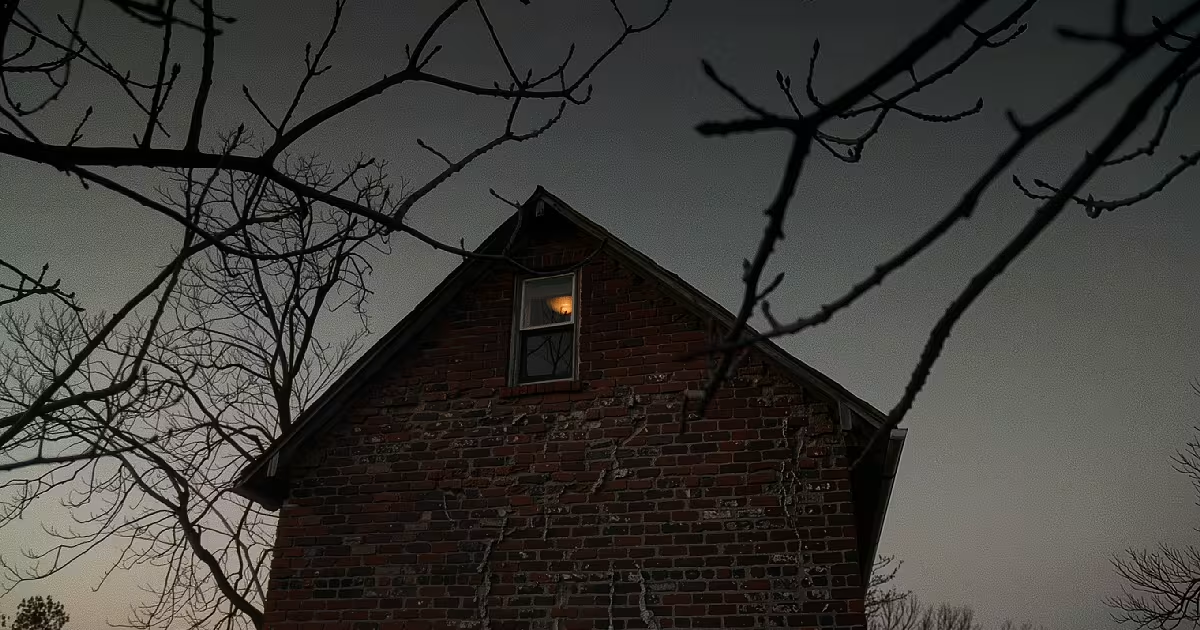
Sallie House, 508 N 2nd St, Atchison KS.
Illustration, not a period photograph.
Opening
The Sallie House, a small brick residence at 508 North Second Street in Atchison, Kansas, built between 1867 and 1871 by the Finney family, has become one of the most investigated allegedly haunted private homes in the United States, featured on Sightings, Ghost Adventures, BuzzFeed Unsolved, and Paranormal Witness. Its central legend holds that a young girl named Sallie died there, in the 1870s or early 1900s depending on which version is told, during a botched surgery performed by a resident physician who, in some tellings, had failed to properly anesthetize her before an emergency operation, and that her vengeful, specifically man-hating spirit has tormented the home's occupants ever since. There is no surviving historical record, birth certificate, death record, obituary, or physician's file, confirming that a girl named Sallie ever lived in or died at the address at all.
Timeline
1866. Michael Cromen Finney, an Irish immigrant from County Cork who had lived in downtown Atchison for a decade, purchases two adjoining lots, one of which will become the site of the house.
1867-1871. Construction of the brick house proceeds; the Finney family reportedly lives in the completed basement while the rest of the structure is finished.
27 September 1872. Michael Finney dies at the property at age unspecified, leaving behind his wife, two sons, a daughter, and an unborn child.
25 May 1873. A son, Edwin, is born to the family; he dies on 29 September 1874, a documented child death in the house's actual genealogical record, though of a different name and circumstance than the "Sallie" legend that would emerge over a century later.
Later period, disputed exact date. Some retellings place a Dr. Finney (whose relationship, if any, to the original Michael Finney family is unclear in surviving accounts) operating a home medical practice from the residence in the early 1900s, a period when home-based physician practice was still common in the United States; no surviving record confirms Dr. Finney actually performed operations from the house.
1958-1990. Ethel Anderson owns and lives in the home for over three decades. Until her death in 2000, she consistently and specifically maintained that the house was not haunted, a genuinely significant piece of negative testimony from the single longest-tenured occupant in the property's documented history.
Early 1990s, reported but only secondhand. The Humbard family reportedly lives briefly at the Sallie House before the Pickmans; one account states the family's daughter was the first to report an entity by that specific name, though this detail circulates with less independent sourcing than the Pickmans' own later, extensively documented experience.
Winter 1992 (some sources say March 1993). Tony and Debra Pickman, newlyweds expecting their first child, move into the house with no prior knowledge of any haunted reputation.
Summer 1993, following the birth of their son Taylor. Debra reports the first significant unexplained events: dimming lights, their dog growling persistently at the nursery door, sudden temperature drops, and electronics malfunctioning.
Following months. Reported activity escalates: shadows, self-igniting candles, objects reportedly moving or floating, and unexplained bite marks and scratches appearing on both Tony and Debra's bodies. Tony reports seeing and later sketches an apparition of a young girl.
Summer 1994. A medium who had been working with the Pickmans shares their story with Fox television, leading to a feature on the program Sightings; the crew reportedly visits the house four times, during one of which Tony's shirt catches fire and new scratches appear on his arms, back, and stomach in front of the crew.
October 1994. Following an incident in which Tony reports feeling an unseen force attempt to push him from an upstairs balcony, the Pickmans move out permanently after roughly two years in the house, having attempted multiple house-cleansing rituals in the interim without lasting effect.
2010. Debra Lyn Pickman publishes The Sallie House Haunting: A True Story, a full book-length account of the family's experiences.
2001. Wichita Eagle reporter Beccy Tanner publishes a feature on Atchison's broader haunted reputation, including the Sallie House, folding the property into the town's wider paranormal tourism identity.
2014-2019. A dedicated paranormal investigation group leads public investigations at the house, logging over 250 hours of on-site investigation time and more than 1,000 hours of recorded evidence across that period, reflecting the sheer scale of sustained amateur and semi-professional interest the property has continued to attract decades after the Pickmans' original account.
Ongoing. Despite the extensive investigative attention, no historical researcher has located any birth, death, medical, or newspaper record confirming a girl named Sallie ever lived at or died in the house, at any point in its documented ownership history from the Finneys through Ethel Anderson.
Key figures
The Finney family are the house's actual, documented original occupants, and their real, genealogically confirmed history, Michael Finney's 1872 death, his infant son Edwin's 1874 death, provides the property with a genuine, if unrelated to the "Sallie" legend, record of real family tragedy in its early years.
Anderson is the case's most significant negative witness: over three decades of continuous residence with no reported paranormal activity and an explicit, maintained denial that the house was haunted, standing in direct contrast to the dramatic escalation reported within months of the very next family's arrival.
The Pickmans are the case's foundational and most thoroughly documented witnesses, whose reported experiences, corroborated at least in the sense that both Tony and Debra independently reported physical marks and a television crew present for one incident directly observed a shirt catching fire, represent the entire evidentiary basis for the house's modern reputation.
"Sallie" herself, as a specific named historical individual, is the case's central and entirely unverified figure: no researcher, believer or skeptic, has ever produced a primary document establishing she existed, a genuinely unusual gap for a haunting legend built around a supposedly documentable, dateable childhood death.
Physical and documentary trail
On the paper, this file has a real, confirmed property ownership history back to 1866, genuine genealogical records for the Finney family including two documented family deaths in the 1870s, Ethel Anderson's decades-long, explicitly negative testimony, and an unusually well-documented modern haunting account beginning with the Pickmans, including a nationally broadcast television segment during which a crew member's camera reportedly captured a shirt catching fire in real time.
What it conspicuously lacks, despite extensive investigation by multiple paranormal research groups logging hundreds of documented hours, is any historical record of the legend's own central named figure. No Sallie appears in any Finney family genealogy, Atchison newspaper archive, or medical or civic record from any period the various tellings propose for her death.
There is no physical records or any evidence of a Sallie living nor passing away at the Sallie House.
Competing explanations
A genuine haunting by an entity that has adopted the false identity of a sympathetic young girl specifically to gain occupants' trust before escalating to more aggressive and specifically male-targeted physical activity, a reading some paranormal investigators and the Pickmans themselves have proposed, treating the absence of a real "Sallie" as itself evidence of a deceptive rather than a straightforwardly benign spirit.
A modern legend constructed after the fact, built around the house's genuinely old age and its real, if different, history of early childhood death (Edwin Finney), with the specific name and backstory of "Sallie" invented or absorbed from unrelated local ghost-story tradition once the Pickmans' own frightening and unexplained experiences began, giving an otherwise nameless phenomenon a more marketable and emotionally resonant story.
Genuine psychological and environmental factors affecting the Pickmans specifically, unrelated to any entity, name real or invented: new parenthood stress, an older home's ordinary structural quirks (drafts, settling, aging wiring explaining electrical malfunctions), and the specific pressure of increasing media attention once the family began sharing their experiences publicly, potentially amplifying both perception and reporting of ordinary occurrences.
A combination of genuine unexplained personal experience for the Pickmans specifically, whatever its ultimate cause, later commercially amplified and given a specific marketable name and backstory by the broader paranormal tourism and media industry that formed around the house once its reputation took hold, a pattern that does not require dismissing the family's original experience to remain skeptical of the specific "Sallie" identity later attached to it.
Later life of the case
The Sallie House has become a fixture of American paranormal media and tourism, with over 1,000 hours of recorded investigation material accumulated by just one dedicated research group between 2014 and 2019 alone, a volume of sustained amateur and semi-professional attention matched by very few private residences anywhere. Its persistent commercial and media life continues almost entirely independent of the fact that its own title character has never been historically documented.
Finding
The house itself, its original Finney family, and their genuine, documented 1870s tragedies are real and verifiable. The Pickmans' reported two-year experience, corroborated in part by a television crew's own recorded footage of a spontaneous fire, represents the case's actual evidentiary foundation. The specific figure of "Sallie," the name, backstory, and cause of death that gives the house its title and its marketed legend, has never been supported by any surviving primary document across any period of the property's documented history.
What still will not resolve: any historical confirmation that a girl named Sallie ever lived or died at the address, and any explanation for why Ethel Anderson's three decades of residence produced no reported activity at all while the very next family experienced an escalating two-year ordeal almost immediately upon arrival. Until either is explained, this file separates what actually happened to the Pickmans from the specific, never-verified name attached to it.