WINCHESTER HOUSE
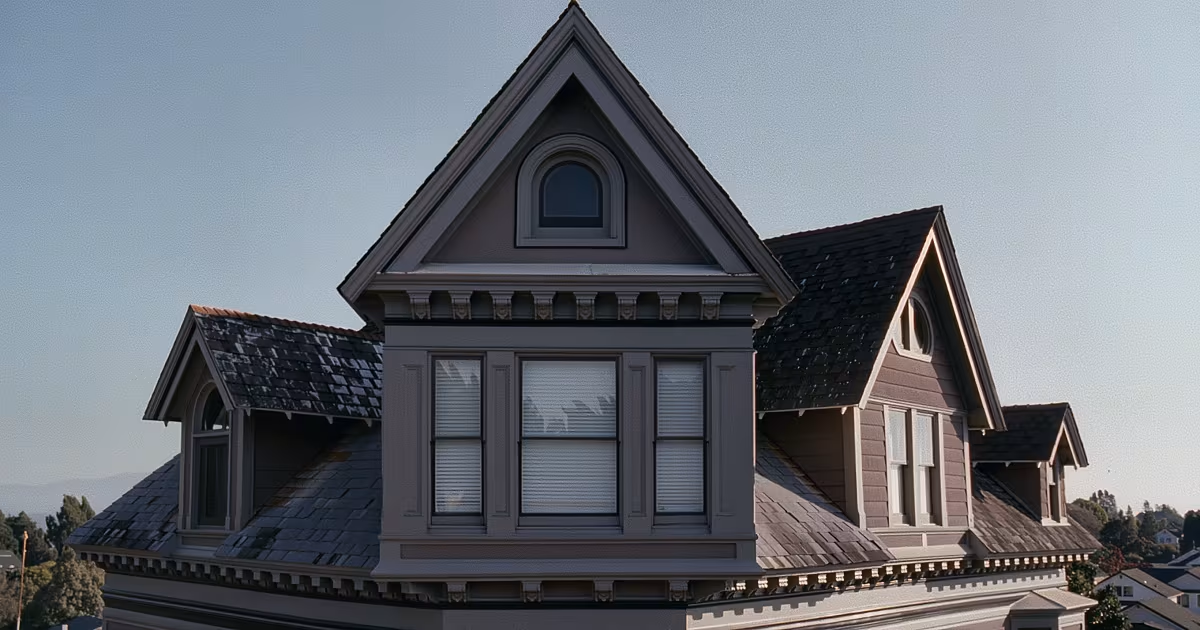
The steep gables and dormers of the Winchester House roofline.
Illustration, not a period photograph.

Archive / Paranormal / BOT313-0115
PAR-18865 SEP 1922ParanormalFOLKLORE
SARAH WINCHESTER'S SAN JOSE MANSION AND ITS LEGEND
Fig. 01 The steep gables and dormers of the Winchester House roofline. Illustration, not a period photograph.
Opening
Sarah Winchester, widow of the heir to the Winchester Repeating Arms fortune, bought an eight-room farmhouse on a 45-acre ranch outside San Jose in 1886 and named it Llanada Villa. For about two decades she kept adding to it, room by room, without an overall plan. By the time she died there on 5 September 1922 it had about 160 rooms, 2,000 doors, 10,000 windows and 47 stairways, some of them leading to ceilings.
The famous explanation is that a Boston medium told her the ghosts of people killed by Winchester rifles were following her and that she must build for them without ever stopping. That story first appears in print in 1967. Her letters, her staff and the building record describe something less dramatic: an intelligent, private, very rich woman who enjoyed designing, stopped work often and largely gave up building after the 1906 earthquake.
Timeline
4 June 1839Sarah Lockwood Pardee is born in New Haven, Connecticut. She is called Sallie all her life.
30 September 1862She marries William Wirt Winchester, son of the shirt manufacturer Oliver Winchester, who later founds the Winchester Repeating Arms Company.
15 June 1866Their only child, Annie, is born. She dies of marasmus, a wasting illness, within weeks.
May 1880 to March 1881Sarah loses her mother, then her father-in-law in December 1880, then her husband, who dies of tuberculosis in March 1881.
1886A Winchester company agent, Edward "Ned" Rambo, shows her a ranch near San Jose. She buys it, with its two-storey farmhouse, from John Hamm. Within six months the house has about 26 rooms.
29 March 1895The San Jose Daily News prints the first known claim that she believes she will die when the house is finished.
After 1896Storeys are added, parts of the house reach five floors, and a seven-storey tower goes up. The San Jose News later reports it was rebuilt 16 times.
18 April 1906The earthquake brings down the tower, the upper floors and most chimneys. She has the debris cleared and the house made safe, and builds very little more there. She spends most of her time at her house in Atherton.
1916An elevator is installed, the last notable addition.
5 September 1922She dies at Llanada Villa, aged 83, and is buried in New Haven beside William and Annie.
1923Leased by John and Mayme Brown, the house opens to paying visitors within months of her death. Mayme is the first guide.
1967Susy Smith's book Prominent American Ghosts tells the story of a Boston medium named Adam Coons.
Key figures
Sarah Winchester (1839 to 1922) was under five feet tall and badly affected by rheumatoid arthritis in later life. She inherited 777 shares in the company in 1881 and 2,000 more in 1898, and managed her money well. Her estate was worth three to four million dollars.
Mary Jo Ignoffo, a historian, wrote Captive of the Labyrinth (2010), the main documentary study. Most of the corrections in this report rest on her work.
John and Mayme Brown turned the house into an attraction and leaned into the rumours. Former staff were reportedly upset that the Browns were making money from falsehoods.
Susy Smith, a popular writer on ghosts, is the earliest known source for the medium story.
Physical and documentary trail
The house survives and has been surveyed. There are also county records of the purchase, Sarah's surviving letters, local newspapers from 1895 on, and statements by employees and the family's lawyer. The letters show a woman who stopped work for months when she was tired or the weather was wrong. In one, from June 1898, she describes taking out a wall to put in a skylight after people kept missing their footing on a darkened stair. Her chauffeur, nurse-secretary and lawyer all later said she was neither superstitious nor unbalanced.
The ghost story has no documentary trail at all. Emily Mace and other researchers searched the spiritualist paper Banner of Light and the Boston city directories, which listed spiritualists, and found no Adam Coons. No séance record, letter or diary entry links Sarah to a medium.
An earlier version of this report said Annie and William both died of tuberculosis in 1881, that the farmhouse was bought in 1884 from a Dr. Caldwell, that she built around the earthquake damage and that construction stopped the morning she died. Annie died in 1866 of marasmus. County records cited by Ignoffo date the purchase to 1886, and the seller was John Hamm. The year 1884 comes from later tourist literature and a federal building survey. I found no source for Dr. Caldwell. Building had largely stopped after 1906, so nothing ended on the morning of her death. Those details have been corrected.
Ten years ago the handsome residence was apparently ready for occupancy, but improvements and additions are constantly being made, for the reason, it is said, that the owner of the house believes that when it is entirely completed, she will die.
Things you might not know
- Llanada is Spanish. She named the house after the Llanada Alavesa, a plain in the Basque Country she and William had visited.
- The switchback stair was for her joints. A staircase of 44 steps rising only about ten feet suited a woman with arthritis.
- The thirteens came later. A carpenter, James Perkins, said the house's famous sets of thirteen, from chandeliers to coat hooks, were added after her death.
- The séance room was a gardener's bedroom. Researchers identify the room shown on tours as her nightly séance room as a staff bedroom.
- The windows are not Tiffany. An envelope postmarked July 1894 and found inside a wall during restoration points to the Pacific American Decorative Company of San Francisco.
- Houdini visited in 1924. Some accounts credit him with suggesting the name "mystery house".
Competing explanations
A house built for the ghosts of rifle victims on a medium's orders. This rests on a 1967 book with no source. The medium cannot be found in the records where a Boston spiritualist should appear, and the never-stopping build did not happen.
A superstition of her own, without a medium. This is what the 1895 newspapers said, citing rumour, not her. People who worked for her for years denied it.
An amateur architect with money, time and no family to house. Ignoffo, Dickey and a 1951 thesis by Bruce Spoon, based on interviews with people who knew her, read the house this way. She subscribed to Architectural Record, drew her own plans, tore down what she disliked and kept local tradesmen employed. Rambling, ever-growing mansions were not unique. Elizabeth Colt built one in Hartford.
Later life of the case
The house has been an attraction for more than a century and was listed on the National Register of Historic Places in 1974. From 1973 its general manager, Keith Kittle, restored it and advertised it with billboards suggesting ghosts. The 2018 film Winchester, starring Helen Mirren, retold the medium story. Ignoffo's book and Joe Nickell's investigations have pushed back. The attraction still sells both the architecture and the ghosts.
Finding
The house is real and very strange, and its strangeness is explained by the documents: a wealthy widow designing room by room for about 20 years, an earthquake that left stairs and doors going nowhere, and owners who built a ghost story on newspaper gossip after she died. The Boston medium and the spirit-driven build are folklore, first printed 45 years after her death and unsupported by any record.
What still will not resolve: how Sarah Winchester herself thought about the rumours. She is not known to have answered them publicly, and no surviving document records her view.
Evidence signature
2/9 Thin
- Witnesses
- nothing on record
- Instruments
- nothing on record
- Paper
- official records at the time
How well documented the case is, not whether it's true. A strong record can still have an ordinary answer, and a thin one can still be real.
You decide · WINCHESTER HOUSE
What do you think happened?
One vote per case, anonymous. You'll see how other readers voted once you've voted.