WHALEY HOUSE
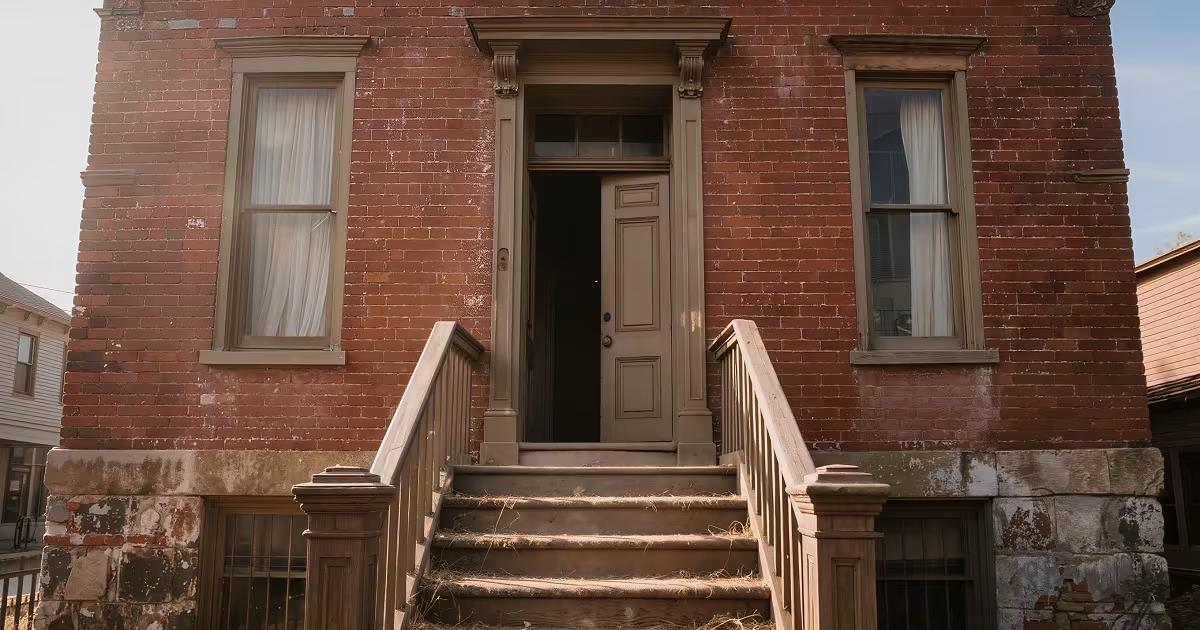
The brick front steps and open door of the Whaley House in San Diego.
Illustration, not a period photograph.

Archive / Paranormal / BOT313-0222
PAR-185218 SEP 1852ParanormalLOT FIRST
THE HOUSE ON THE HANGING GROUND
Fig. 01 The brick front steps and open door of the Whaley House in San Diego. Illustration, not a period photograph.
Opening
The Whaley House in San Diego's Old Town, built by Thomas Whaley in 1857, stands on a lot that had, five years earlier, hosted the public hanging of James "Yankee Jim" Robinson, convicted of grand larceny for stealing a rowboat, a documented civic execution predating the house's construction by half a decade. Thomas Whaley himself reportedly witnessed the hanging before later choosing to build his family home on that exact ground.
The U.S. Commerce Department's Travel Service once officially listed the house as a genuinely haunted historic house, one of relatively few properties to receive that specific government-adjacent designation, though the site's own documented family and civic history, real deaths, real financial ruin, real historical significance, provides more than enough dark material without requiring the more elaborate ghost narratives later tour scripts have added.
Timeline
1852James "Yankee Jim" Robinson is convicted of grand larceny for stealing a boat and is publicly hanged on the lot that would later become the Whaley House property, a documented civic execution under California territorial law rather than a folkloric later addition.
1857Thomas Whaley, who reportedly witnessed Robinson's execution years earlier, builds his family home directly on the same ground, one of the first brick structures in San Diego, deliberately choosing to build over an execution site despite, or perhaps because of, its prominent civic history.
1858-1885, the Whaley family's residenceThe house serves multiple civic functions over the following decades, including as a granary, a theater, and, notably, briefly as San Diego's county courthouse, giving the property an unusually varied documented institutional history beyond its residential use.
Real documented family tragedies during this period. The Whaley family experiences genuine losses during their residence, including the death of an infant son, Thomas Jr., from scarlet fever, and later, daughter Violet Whaley's suicide following a difficult and short-lived marriage, both real, documented family tragedies independent of any ghost narrative later attached to the house.
Early 20th centuryFollowing the family's departure, the house passes through various uses and periods of neglect before its historical significance prompts restoration efforts.
1960The restored Whaley House opens to the public as a museum, beginning its modern institutional life as a historic house and, increasingly over subsequent decades, a promoted haunted attraction.
1960s onwardThe U.S. Department of Commerce's Travel Service, in materials promoting historic American tourism, includes the Whaley House among a small number of properties officially characterized as a genuinely haunted historic site, a specific governmental endorsement frequently cited by the house's later promoters, though the exact original sourcing and formal status of this characterization has been variously described across different retellings.
Ongoing tour traditionDocents and later paranormal investigation programs report a range of phenomena, footsteps, the scent of cigar smoke associated with Thomas Whaley himself, and apparitions connected to Yankee Jim Robinson specifically, layering the civic execution and the family's own real tragedies into a combined haunted-house narrative.
Key figures
Robinson is the site's earliest documented connection to violent death, a real, civically executed criminal whose 1852 hanging on the property predates the house itself and requires no embellishment to be a genuinely dark piece of the location's history.
Thomas Whaley is the house's builder and a documented historical figure of real local significance, his family's residence and civic use of the property (as granary, theater, and courthouse) giving the site a genuinely varied institutional history distinct from and prior to its later museum and ghost-tourism identity.
Violet Whaley's documented suicide and young Thomas Jr.'s death from scarlet fever are the family's own real, independently verifiable tragedies, historical facts that ground the house's dark reputation in genuine family history rather than requiring invented detail.
Later museum docents and paranormal investigators are the figures most responsible for the house's modern, elaborated ghost narrative, building tour material around the documented historical deaths without, in most cases, producing independent physical evidence beyond personal testimony and equipment readings.
Physical and documentary trail
The case has a documented 1852 civic execution record, extensive Whaley family and San Diego civic history including the property's varied institutional uses, and genuine, independently verifiable family tragedies (the infant death, the suicide) rather than invented ghost-story deaths.
What it lacks is any primary document specifically describing a ghost or apparition connected to Robinson or any Whaley family member during the family's own actual residence; the haunted characterization appears to develop substantially after the house's 1960 museum opening rather than during its working residential period.
Things you might not know
- A bedroom became a theatre. In October 1868 Whaley rented an upstairs room to the Tanner Troupe, who opened to a crowd of about 150. Ladies were advised not to wear hoop skirts.
- The theatre's owner died within weeks. Thomas Tanner died 17 days after opening night, and the troupe broke up early in 1869.
- The county records were moved under threat. On 31 March 1871 they were taken from the house to New Town, despite threats of armed resistance from Old Town residents.
- A daughter lived there until 1953. Corinne Lillian Whaley stayed in the house until her death.
- Regis Philbin said he saw something. Filming a local morning show in 1964, he claimed an encounter with Mrs Whaley, saying "there was something going on in that house".
- Television crowned it. The Travel Channel's America's Most Haunted called it the most supernatural home in the United States.
Competing explanations
A house with a genuinely dark civic and family history, later elaborated into a formal ghost narrative once it became a public museum with an evident commercial incentive to market that history as an active haunting rather than simply a historically significant site.
A site with real, independently documented tragedy, Robinson's execution, the Whaley family's own losses, sufficient on its own historical merits without requiring any actual paranormal activity to justify its dark reputation or its place in local and national historic preservation.
A genuine haunting connected specifically to the documented violent and tragic history of the site, the reading the house's own promotional material and the historical Commerce Department characterization both implicitly supported, resting on accumulated visitor and docent testimony rather than independently verified physical evidence.
Later life of the case
The Whaley House remains one of the most frequently cited "officially haunted" houses in America specifically because of its historical governmental characterization, layered onto a genuinely well-documented civic execution and real family tragedy that together give the property more substantive historical grounding than many comparable haunted-house tourist attractions can claim.
Finding
The Whaley House sits on a documented 1852 execution site and carries its own family's genuine, independently verifiable tragedies across its working residential decades. Its modern ghost narrative, layering apparitions of both Robinson and Whaley family members onto this real history, develops substantially in the period following the house's 1960 museum opening rather than during the family's own lifetime, without any contemporary account from that earlier period describing the house in comparably haunted terms.
What still will not resolve: any primary document from the Whaley family's own era describing the house as haunted, and independent verification of the exact original source and scope of the Commerce Department's historical "haunted" characterization. Until either is addressed, this report treats the execution and family tragedies as documented history and the specific haunting narrative as a later museum-era development built on genuinely dark, but not itself supernatural, source material.
Evidence signature
4/9 Solid
- Witnesses
- several people
- Instruments
- nothing on record
- Paper
- official records at the time
How well documented the case is, not whether it's true. A strong record can still have an ordinary answer, and a thin one can still be real.
You decide · WHALEY HOUSE
What do you think happened?
One vote per case, anonymous. You'll see how other readers voted once you've voted.