HAMPTON COURT
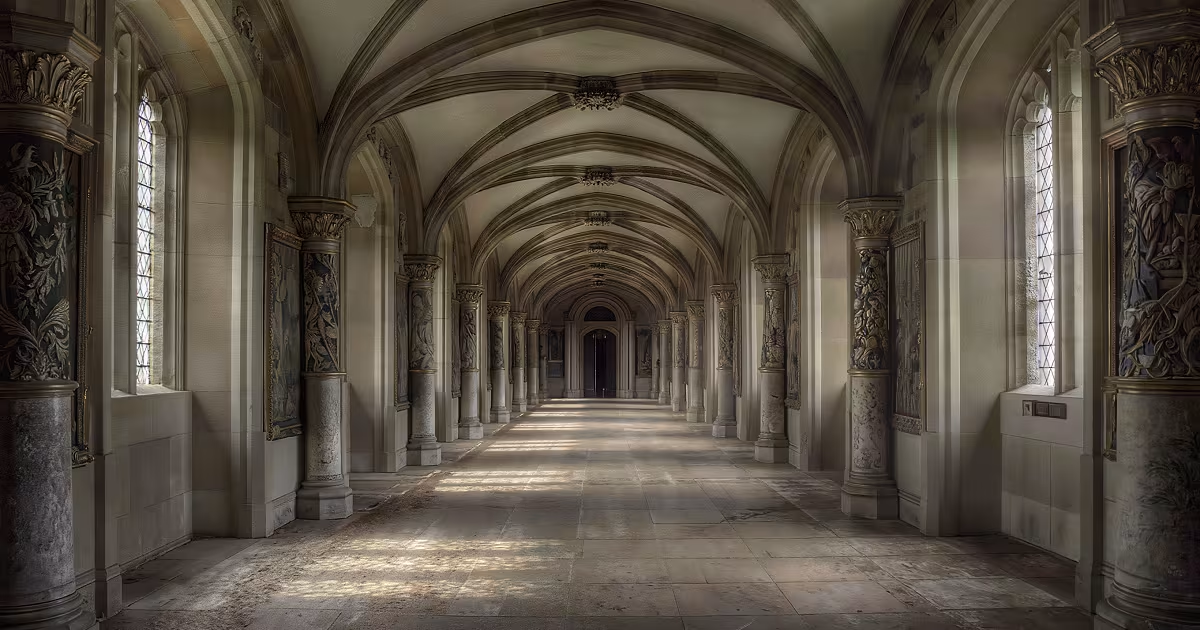
A long stone palace gallery with light through the windows.
Illustration, not a period photograph.

Archive / Paranormal / BOT313-0231
PAR-182913 FEB 1542ParanormalGALLERY PAUSE
THE GHOST ON THE SECURITY CAMERA
Fig. 01 A long stone palace gallery with light through the windows. Illustration, not a period photograph.
Opening
Hampton Court Palace, built by Cardinal Wolsey and later seized by Henry VIII, has carried ghost stories for centuries, most famously the "Grey Lady," and a specific tradition holding that Catherine Howard, Henry's fifth wife, runs screaming through what is now called the Haunted Gallery, reenacting her desperate, failed attempt to plead for her life before her 1542 execution.
In October 2003, the palace's own security cameras at a fire door captured a still image of a robed, apparently human figure that made national news as possible photographic proof of the palace's ghosts. The palace is a genuine Tudor structure with a documented, extensive violent royal history. Howard, notably, was actually executed at the Tower of London, not at Hampton Court itself, a specific geographic detail the gallery legend does not quite account for.
Timeline
1515-1529Cardinal Thomas Wolsey builds Hampton Court as his own residence, later surrendering it to Henry VIII amid his political fall from favor.
1540Henry VIII marries his fifth wife, Catherine Howard, at Hampton Court.
1541Howard is accused of adultery; per the traditional, though not fully independently verified, account, upon learning of her impending arrest she breaks free from her guards and runs through what is now called the Haunted Gallery specifically to reach the king and plead for her life, only to be recaptured before reaching him.
13 February 1542Howard is executed, by beheading, at the Tower of London, not at Hampton Court, a specific and significant geographic detail that any literal "ghost in the gallery" reading has to reconcile with the fact that her actual death occurred at an entirely different royal site.
Subsequent centuries. Ghost stories accumulate around the palace generally, including the "Grey Lady," most commonly associated with Sybil Penn, a former royal nurse, reported particularly in connection with an old spinning wheel sound, and separate reported sightings in the Haunted Gallery specifically tied to the Howard legend.
October 2003A member of palace security staff reviewing CCTV footage from a fire door notices a still frame showing what appears to be a robed, human-like figure positioned as though closing the doors from the outside, at a location where the doors were, by palace accounts, found flung open on three consecutive nights without an identified cause.
Following the discoveryThe image draws significant national and international press coverage, generally framed as potential photographic evidence of the palace's ghosts, with palace officials, per contemporary reporting, treating the frame as a genuine security anomaly worth investigating rather than dismissing it outright.
Ongoing analysis and skepticismNo individual has ever been definitively identified as the figure in the frame, and no palace record confirms the image was ever forensically analyzed by an independent laboratory capable of ruling out a costumed staff member, a visitor in historical dress (the palace does host costumed interpreters and events), or a camera or lighting artifact.
Ongoing tourism traditionThe palace continues to feature both the Grey Lady and the Catherine Howard "Haunted Gallery" legends prominently in its own visitor materials and guided tours, presenting the 2003 CCTV still alongside the older oral tradition as complementary pieces of the site's ghost reputation.
Key figures
Howard is the case's central historical figure for the gallery legend specifically, and the geographic mismatch between her legend's claimed haunting location and her actual, separately documented execution site at the Tower of London is worth stating plainly rather than glossing over, since it is exactly the kind of detail that distinguishes a historically grounded ghost story from a more loosely attached one.
Penn is the figure most commonly associated with the palace's separate Grey Lady tradition, a real historical royal servant whose specific connection to the reported spinning-wheel sound phenomenon rests on considerably older and less individually verifiable oral tradition than the 2003 photographic case.
The unnamed 2003 security staff member who first noticed the CCTV still is the case's key contemporary witness, whose discovery, whatever its ultimate explanation, is a documented, dated, and specifically located security event rather than a secondhand story reconstructed after the fact.
Palace press officials, who engaged with and helped publicize the 2003 image rather than issuing an immediate mundane explanation, represent the case's notable institutional openness to the ghost framing, a choice that has real, if unstated, tourism value for a site that markets its haunted reputation actively.
Physical and documentary trail
The case has a genuine, documented Tudor royal history, a real security-camera still image from a specific, dated 2003 incident with a preserved photographic record, and centuries of separately circulating oral ghost tradition predating the CCTV case by a considerable margin.
What it lacks is any independent forensic examination of the 2003 image ruling out mundane explanations, any confirmed identity for the figure captured, and any documentary connection at all between the Howard gallery legend and her own separately, well-documented execution at a different royal site entirely.
Things you might not know
- Staff call him Skeletor. The robed figure from the 2003 CCTV earned that nickname among palace staff, and the footage is now projected onto a large canvas on ghost tours.
- The door opened three nights running. Cameras recorded the same fire door near Clock Court being flung open on three nights in a row. The figure appeared on the second.
- Two visitors fainted in the same spot. In 1999 two women on separate tours fainted at the same place in the Haunted Gallery on the same day.
- A psychologist tested the gallery. In 2001 Richard Wiseman used thermal cameras to check reports of cold spots. Every report was explained, and the one figure the cameras caught at 6 a.m. turned out to be a cleaner.
- The Howard ghost is Victorian. The historian Lucy Worsley notes that Catherine Howard's ghost was not really reported until the nineteenth century.
- The Grey Lady died at the palace. Sybil Penn died of smallpox at Hampton Court on 6 November 1562. The haunting stories began after her tomb was moved when Hampton church was rebuilt in 1829.
Competing explanations
A costumed staff member or visitor, given the palace's genuine, regular use of historical costume for interpreters and special events, caught by the security camera in an entirely mundane context that the still image's dramatic framing made appear more significant than it actually was.
A camera artifact or lighting effect, a mundane technical explanation common to many claimed "ghost photograph" cases, that has never been definitively ruled out given the absence of any confirmed independent forensic analysis of the original footage.
A genuine unexplained phenomenon, the reading the palace's own public engagement with the story implicitly supported at the time, resting on the doors' reported unexplained opening on two consecutive days as much as on the photographic still itself.
A folkloric tradition (the Howard gallery legend) mistakenly treated as though it required the same location as her actual death, when in fact her real execution occurred at the Tower of London, a distinct site with its own separate and better-documented history, a reading that simply requires being precise about which specific royal location holds which specific historical event.
Later life of the case
Hampton Court remains one of Britain's most visited historic royal palaces, its combination of genuine Tudor-era violence, older oral ghost tradition, and one specifically dated, photographically documented modern incident giving it an unusually layered haunted reputation compared to sites relying on oral tradition alone.
Finding
Hampton Court's 2003 CCTV still is a real, dated, specifically located photographic record of an unexplained figure, never definitively identified or forensically analyzed by any confirmed independent laboratory. The palace's older Catherine Howard gallery legend, while genuinely tied to a real historical figure, describes a haunting location distinct from her actual, separately documented execution site at the Tower of London, a specific geographic detail worth keeping precise rather than blurred.
What still will not resolve: independent forensic analysis of the 2003 footage, and any documentary account reconciling the Howard gallery tradition with the geographic fact of where she actually died. Until either is addressed, this report treats the 2003 still as a genuine, unexplained but unverified security anomaly, distinct from the older, separately unresolved oral tradition surrounding Howard herself.
Evidence signature
5/9 Solid
- Witnesses
- one person, or a tradition
- Instruments
- photo, film or physical traces
- Paper
- formal investigation, court or declassified file
How well documented the case is, not whether it's true. A strong record can still have an ordinary answer, and a thin one can still be real.
You decide · HAMPTON COURT
What do you think happened?
One vote per case, anonymous. You'll see how other readers voted once you've voted.