BORLEY RECTORY
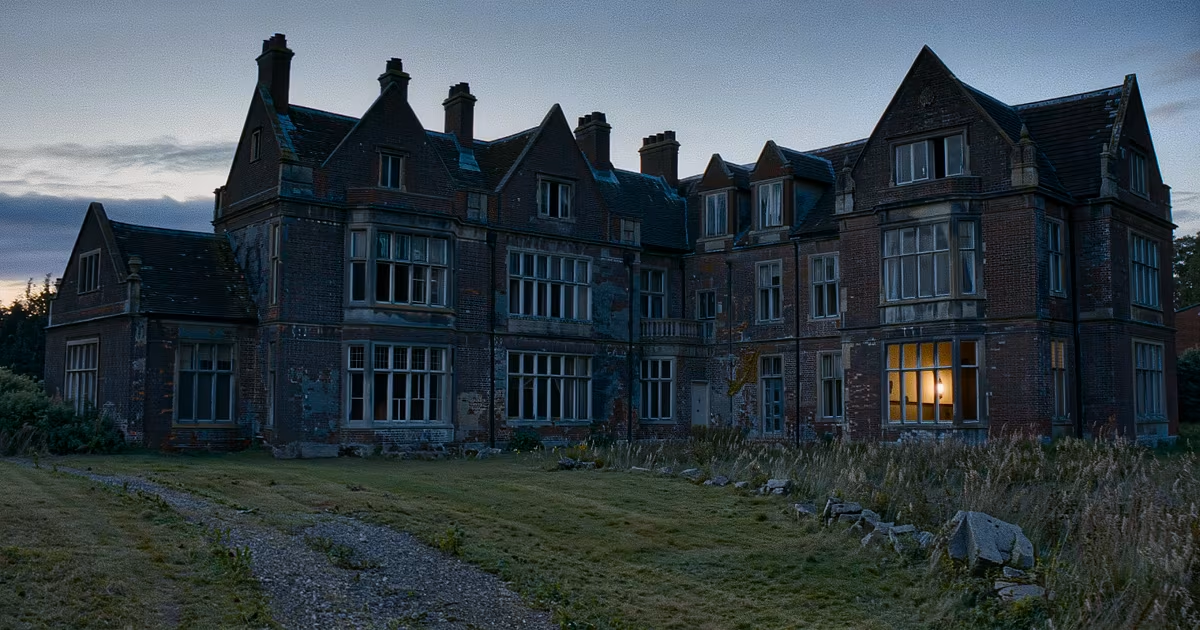
Victorian Essex rectory at dusk. Empty lawn.
Illustration, not a period photograph.
Opening
Borley Rectory was a large brick house built in 1862 for the parish of Borley, Essex. Stories of a nun on the lawn and a coach on the drive sat with the Bull family who first lived there. In June 1929 the Daily Mirror put Harry Price on the place with cameras and sealing wax. After that the house was famous as haunted before it was famous as a building.
Lionel and Marianne Foyster took it in 1930. Pencil on walls asked Marianne for help. Objects moved in their telling. Price later rented the empty rectory and filled it with observers. On 27 February 1939 Captain Gregson, the new owner, upset an oil lamp. The house burned. Insurers thought the fire looked set. Demolition finished the walls in 1944.
The spine of the file is a parish house that Price named the most haunted in England, then a fire and a gap in the ground. Borley is a press visit and a ruin. It is not a nun in a locked room.
Timeline
1862-1920s. The Bull incumbency. Family talk of a nun and a coach. Local, not yet national.
June 1929. Mirror story. Price arrives. Phenomena become a list: bells, lights, a thrown brick. The Smith incumbency is already unhappy in the house.
October 1930 to 1935. The Foysters. Lionel's written account to Price. Marianne's name on plaster. An adopted child in the same rooms. This is the heaviest domestic layer.
1937-38. Price's year of official observers. Logs grow. February 1939 fire under Gregson. 1944 demolition. Later excavations and bones are after the house is gone. They are not 1929 rooms.
Key figures
The Bulls are the first household memory. Without them Price has no folklore to test.
Harry Price is the man who makes Borley a national object. His instruments and his books are why the file is thick. His interest is also why later readers treat every knock as a booking.
Marianne Foyster is the name on the wall and the living woman at the centre of the 1930s nights. Lionel writes. Marianne is the target of the pencil. Later interviews pull her life apart. The 1930-35 house is still the place to keep her.
Captain Gregson owns the fire. The insurance sentence about a deliberate start is 1939 paper, not a ghost.
Physical and documentary trail
On the paper, 1929-1939 give you four hard objects and no standing house.
One: the 1929 Daily Mirror visit and Price's first instrumented nights at the rectory.
Two: the Foyster occupancy record, including wall writing addressed to Marianne and Lionel's account sent to Price.
Three: Price's observer year and the incident logs that made the "most haunted" label stick in his books.
Four: the 27 February 1939 fire, the insurance doubt, and the 1944 demolition. Daily Mirror coverage of Harry Price at Borley Rectory, June 1929, is the sheet that takes the house out of the parish.
There is no continuous photograph of a nun. There is no sealed room that later produced a body with a name. There is no rectory left to walk.
Marianne please help get light mass prayers Marianne help me.
Competing explanations
Persistent haunting. Price's reading. Many incidents, many witnesses, a house that performs. It depends on trusting logs compiled by a man selling a title.
Fraud and suggestion. Smith discomfort, Foyster stress, Price's need for a flagship. A brick can be thrown by a living hand. Wall pencil can be a living hand. This reading is strongest after the fire looks set.
Ordinary old-house noise plus a press machine. Bells, rats, light through stained glass, then the Mirror. Contagion after June 1929 is real work. It does not automatically write Marianne on the plaster.
Hybrid caution. People in that house reported contact. The house is gone. The contact was never taken into a court as a named living hoaxer for the whole run.
Later life of the case
Price's two books, the SPR attacks, and every most-haunted list keep Borley standing in print. I keep the post-demolition digs and the later Marianne interviews on the later-life shelf. The 1929 visit, the Foyster walls, and the 1939 fire stay first.
Finding
Borley Rectory troubled the people who slept in it. The Bulls had a nun and a coach. The Mirror put Harry Price on the drive. Marianne Foyster got her name on the plaster and a house that would not stay kind. Believe the households first, before the brand. A brick on a forehead and a plea on a wall are domestic facts, not a ticket sale.
What still will not resolve: a photograph of the nun, or a living hand caught at the pencil. Price made a title out of the place. Gregson's fire took the rooms. What would have proved the haunting is a figure on film in those rooms, or a confession that covers the whole run and not only the oil lamp.