ÉMILIE SAGÉE
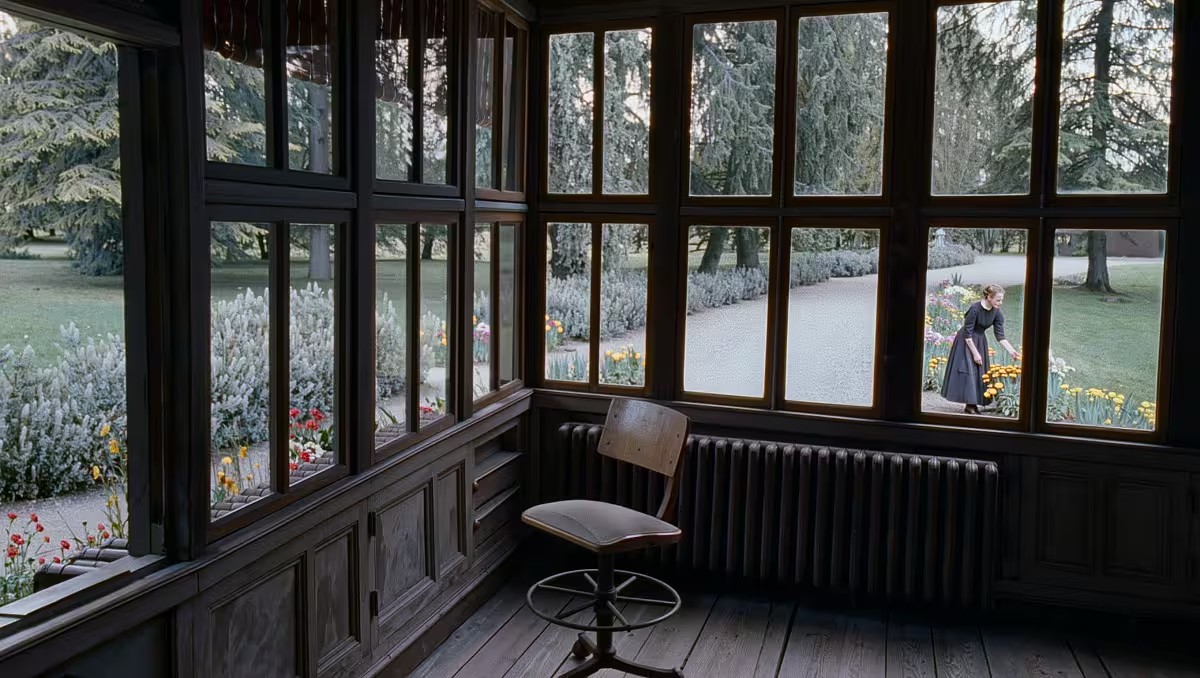
Baltic school garden. A woman picking flowers, empty chair indoors.
Illustration, not a period photograph.
Opening
In 1845 a French teacher named Emilie Sagee was hired at the Pensionnat of Neuwelcke in Livonia, a Moravian school for girls of Baltic families. She was thirty-two, fair, from Dijon by the later telling. Julie von Guldenstubbe, thirteen, was in the class. One day Sagee wrote on the board and the girls saw two of her: one with chalk, one without, the same gestures. That is the first double. It was not the last that year.
The story reaches print in 1860 through Robert Dale Owen, who had it from the Guldenstubbe line. Camille Flammarion and Alexander Aksakov pass it on. Everything flows through Julie. Forty-two young women were said to be in the house. We have one named witness on the page.
The spine of the file is a teacher seen twice in the same room. Sagee is a blackboard and a second body that did not hold chalk. It is not a photograph of both women at the slate.
Timeline
1845-46, Neuwelcke, then in Livonia, now Latvia. Sagee takes a post. Pupils notice a second figure at lessons, at meals, in the garden while the living woman is seen elsewhere in the grounds. One account puts her gathering flowers while the double sits in her chair in class. Strength is said to drain when the double is out. The school loses pupils. She loses the post. Nineteen prior places are claimed in the later chain, which is a large number to take on trust.
1857-60. Owen collects the story from Julie's family and publishes Footfalls on the Boundary of Another World. That book is the tap. Flammarion and Aksakov drink from it.
No 1845 school minute book has surfaced in public with Sagee's dismissal written in a rector's hand. No Dijon civil register is tied cleanly to the woman in Owen. The case lives on a memoir chain.
Later occult encyclopedias repeat the class of thirteen and the garden. They do not add a second independent 1845 pen.
Key figures
Emilie Sagee is the teacher, if the name on Owen's page is hers. She is said not to have seen the double herself, which is either the saddest detail or the tell.
Julie von Guldenstubbe is the only direct pupil named. Thirteen in 1845, source for the rest of her life.
The other girls are a crowd in the telling. They do not sign the 1860 chapter.
Owen is the writer who made the pensionnat a classic. He is later than the slate.
Physical and documentary trail
On the paper, 1845 into 1860 give you four hard objects and no plate of both figures.
One: the blackboard incident as Julie told it, two Sagees, one writing, one mimicking.
Two: further doubles in garden and classroom the same season, always through the same witness line.
Three: the school's reported loss of pupils and Sagee's reported dismissal.
Four: Owen's 1860 chapter drawn from the Guldenstubbes. Robert Dale Owen, Footfalls on the Boundary of Another World, 1860, is the published tray.
There is no 1845 letter from another named girl. There is no staff log. There is no image.
They were exactly alike; and they used the same gestures, only that the real person held a bit of chalk in her hand, and did actually write, while the double had no chalk.
Competing explanations
Bilocation as reported. This is Julie's class. It has many implied witnesses and one named pen. It has no second 1845 document.
Optical or nervous contagion in a boarding school. Possible among tired girls and a striking teacher. The garden-and-classroom split is the part this reading works hardest for.
A tale grown in spiritualist hands between 1845 and 1860. Owen's chain is long enough for embroidery. It is also the only chain we have.
Hybrid caution. A class said they saw their teacher twice. A book kept that sentence. The slate itself was not photographed.
Later life of the case
Doppelganger handbooks, Flammarion, the internet's favourite twin teacher. I keep those on the later-life shelf. Julie's board and Owen's chapter stay first.
Finding
Girls at Neuwelcke said Emilie Sagee stood at a blackboard in 1845 and also stood beside herself without chalk, and Julie von Guldenstubbe carried that sentence until Owen printed it. Believe the class as Julie gave it. A schoolgirl does not need a double to make a teacher memorable.
What still will not resolve: a second named pupil on an 1845 page, or a school book that records the dismissal in a rector's hand. Either one would pin the double to the house instead of to one memoir. The proving object is still both women at that slate, held by someone who signed her name in 1845.