TINA RESCH
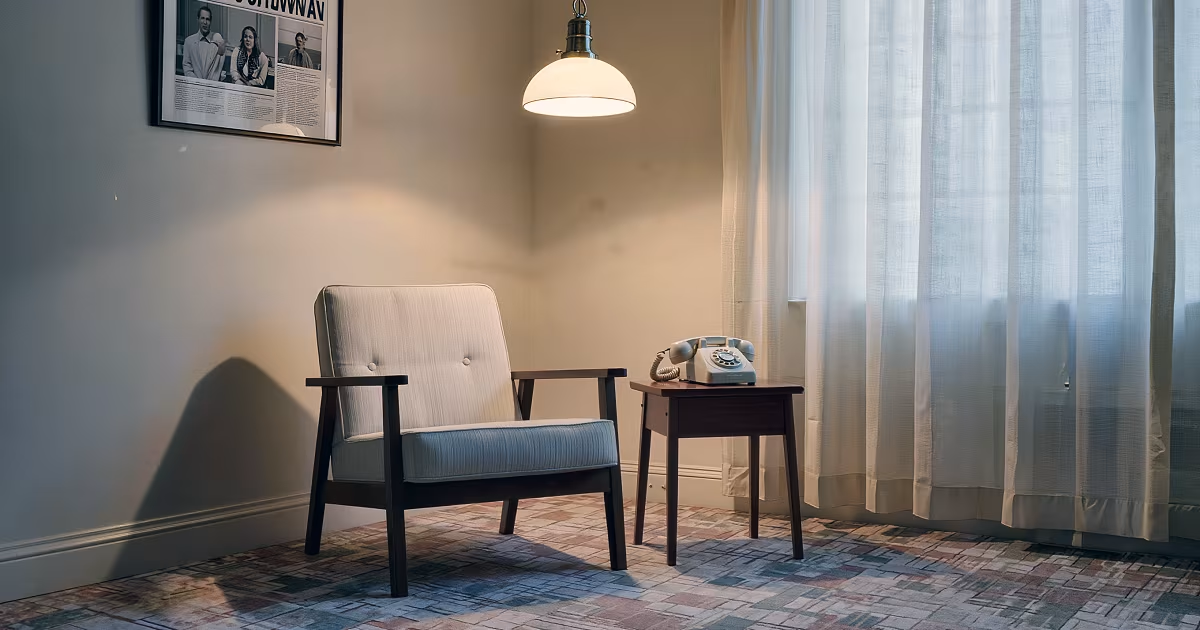
1980s suburban living room. Rotary phone on a table, empty chair.
Illustration, not a period photograph.
Opening
In March 1984 the Columbus Dispatch photographer Fred Shannon stood in the kitchen of Joan Resch's house in Columbus, Ohio, and shot a sequence of a telephone in the air near fourteen-year-old Tina Resch. The paper ran a frame. The house had already been throwing things, in the family's telling, lights and sockets misbehaving, objects moving when Tina was in the room. William Roll and others sat with the case. James Randi sat against it. A wrist in one frame became the fight the sceptics kept.
Tina's life after the paper was harder than a kitchen. Foster care, later crime, later interviews that did not stay still. Keep that later life on its shelf. The Dispatch sequence is 1984 paper. A flying telephone in a daily is why this card exists.
The spine of the file is a newspaper frame and a girl in a kitchen. Tina Resch is a Columbus sequence. It is not a lab demonstration everyone signed.
Timeline
Early 1984 the Resch house reports objects in motion. Investigators arrive. 17 March Shannon shoots. The Dispatch prints.
Roll treats it as a poltergeist. Randi treats it as a girl who can throw when the eye blinks. The wrist argument is the sceptical stay-behind.
Tina leaves the house and the front page into a worse life. That life is not the telephone.
Every American camera-poltergeist list keeps the Dispatch frame. That list is later life. March 1984 is first.
Key figures
Tina Resch owns the kitchen and the year she was fourteen.
Joan Resch owns the house that called for help.
Fred Shannon owns the sequence.
William Roll and James Randi own the two readings that never met.
Physical and documentary trail
On the paper, March 1984 gives you four hard objects and no lab keep.
One: the household account of moving objects around Tina.
Two: Shannon's sequence of the telephone.
Three: the Columbus Dispatch publication.
Four: Roll's notes and Randi's wrist reading. Columbus Dispatch telephone sequence, March 1984, is the originating tray.
There is no continuous film of the lift that both camps accept. There is no instrument log from a clean kitchen. There is no later calm that undoes the frame.
The telephone was in the air when I shot.
Competing explanations
A poltergeist tied to a girl. This is Roll. It has a published frame. It has no instrument keep.
A throw timed to a shutter. This is Randi. It has a wrist. It has to carry the rest of the household week.
A newspaper stunt. Weak once Shannon is a working photographer with a sequence, not a single souvenir.
Hybrid caution. A kitchen put a telephone in a daily. Morning had no second camera on a stand.
Later life of the case
Tina's later years and anthology fights. I keep those on the later-life shelf. The Dispatch frame stays first.
Finding
Fred Shannon shot a telephone in the air in the Resch kitchen in March 1984 and the Columbus Dispatch printed it. Believe the shutter as an event in that room. A daily photographer does not invent a sequence for a girl he had just met.
What still will not resolve: a continuous film of the lift, or a frame that ends the wrist argument for both camps. Either one would pin the phone. The proving object is still that lift, held as throw or as event by more than one still from a motor drive.