50 BERKELEY SQUARE
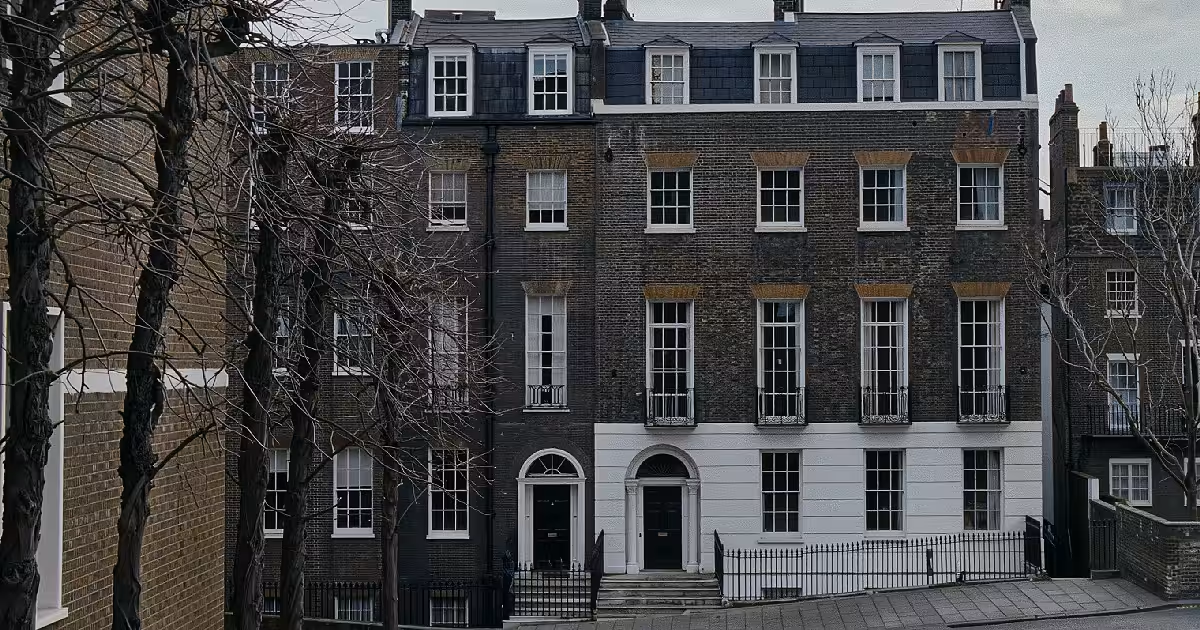
A narrow brick Georgian townhouse with dark windows on a square.
Illustration, not a photograph.

Archive / Paranormal / BOT313-0510
PAR-1872ParanormalNO WITNESS FOUND
THE MOST HAUNTED HOUSE IN LONDON
Fig. 01 A narrow brick Georgian townhouse with dark windows on a square. Illustration, not a photograph.
Opening
50 Berkeley Square is a narrow, Grade II listed townhouse in Mayfair, in the middle of London. For about a century it was known as the most haunted house in the city. The legend says that the attic is haunted by a young woman who threw herself from a top-floor window to escape an abusive uncle, and that her spirit appears as a brown mist, or sometimes a white figure, and can frighten people to death. In rarer versions it is a young man locked in the attic and fed through a hole in the door, or a little girl murdered by a cruel servant.
The house was once the home of the Prime Minister George Canning. Since the late 1930s it has been occupied by the Maggs Brothers, the antiquarian booksellers, and no phenomena have been reported since. Historians who have looked into the legend, including Jan Bondeson and Steve Roud, argue that the house was never haunted at all, and that the stories grew out of its decay and a reclusive tenant. It is a good case of how a ghost story is built.
Timeline
1859 to November 1874Thomas Myers lives in the house. He is rumoured to have been rejected by his fiancée and to have become a recluse. The house falls into disrepair, and its reputation begins to grow.
1872Lord Lyttelton is alleged to have spent a night in the attic on a bet, firing his shotgun at an apparition. He found only cartridges the next morning. The story rests partly on a 2007 blog post.
1872 and 1873Letters in the journal Notes and Queries discuss the house. The council is said to have summonsed the owners for unpaid taxes and not prosecuted them because of the haunting, which is a claim and not a documented fact.
1879A Mayfair Magazine piece alleges that a maid who stayed in the attic was found mad and died in an asylum the next day. Another claim says a nobleman was left unable to speak after a night there.
1880 and 1881A third round of letters appears in Notes and Queries.
1887Two sailors from HMS Penelope are said to have stayed the night. One was found dead after tripping while fleeing, and the other reported seeing Myers's ghost.
1906Lady Dorothy Nevill, who said Myers was a relative, writes that he was reclusive and active at night, and that the whole story was nonsense.
Late 1930sThe Maggs Brothers buy the house.
1975Peter Underwood's Haunted London renews interest.
Key figures
Thomas Myers was the tenant whose seclusion started the stories. Lady Dorothy Nevill said he was a relative, and that others misread his night-time activity as ghostly.
Lord Lyttelton, the aristocrat of the shotgun story, is a source of questionable quality, since the tale rests partly on a 2007 blog post.
Elliott O'Donnell, a ghost writer, invented the story of the sailors, according to the sceptical accounts.
Jan Bondeson and Steve Roud, the researchers, are the most thorough of the modern sceptics. Bulwer-Lytton's story The Haunted and the Haunters closely resembles the reported events.
Physical and documentary trail
The record: a listed building, rate and tenancy records, the letters in Notes and Queries, the Mayfair Magazine article and the later books on haunted London. The Notes and Queries letters generally concluded that the neglect of the house inspired the stories.
The weakness is that almost none of the incidents is documented by anyone present. The sailors' story is dated to 1887 in the legend, but the sceptical accounts say that the claim that sailors entered in the 1870s was invented by O'Donnell, and the two accounts are not reconciled. The same is true for the maid and the nobleman, reported in the Mayfair Magazine without names. Since the Maggs Brothers moved in, investigators have found nothing unusual.
Things you might not know
- A Prime Minister lived there. George Canning, though what he did there is not recorded in the sources I read.
- A bookshop is the occupant. The antiquarian booksellers Maggs Brothers have been there since the late 1930s.
- The ghost may come from fiction. Bulwer-Lytton's story The Haunted and the Haunters closely resembles the reported events.
- A recluse is the likely seed. Myers was active at night, according to a relative.
- Three rounds of letters. Notes and Queries debated it in 1872 to 1873, 1879 and 1880 to 1881.
- The story could kill. The legend said that the spirit could frighten people to death.
- It was never prosecuted. The claim that owners escaped tax summons because of the haunting is undocumented.
Competing explanations
Neglect and a recluse. The strongest reading. An empty, decaying house in a fashionable street, with an eccentric tenant who kept odd hours, invited gossip. Lady Nevill, who knew the family, called it nonsense.
A literary ghost. Elements of the story follow a published tale, and the later additions were invented by writers, such as O'Donnell, who needed material.
A real haunting. The legend's defenders point to the long list of stories. The weakness is that none of them can be traced to a named, firsthand witness, and no phenomena have been reported since the late 1930s.
Later life of the case
The house remains a landmark of London ghost lore, and it appears in books and on tours, though the occupants are a firm of booksellers. It makes a useful comparison with real hauntings, such as Borley Rectory, where the contemporary records are fuller.
Finding
The haunting of 50 Berkeley Square is a Victorian legend with no traceable witnesses, built on a decaying house, a recluse and several invented stories. The best explanation is that it grew in the telling, from a real house and a real tenant, with the details added later.
What still will not resolve: who first told the story of the girl in the attic, and what Thomas Myers was actually doing there at night.
Evidence signature
1/9 Thin
- Witnesses
- nothing on record
- Instruments
- nothing on record
- Paper
- press and later accounts
How well documented the case is, not whether it's true. A strong record can still have an ordinary answer, and a thin one can still be real.
You decide · 50 BERKELEY SQUARE
What do you think happened?
One vote per case, anonymous. You'll see how other readers voted once you've voted.