HEXHAM HEADS
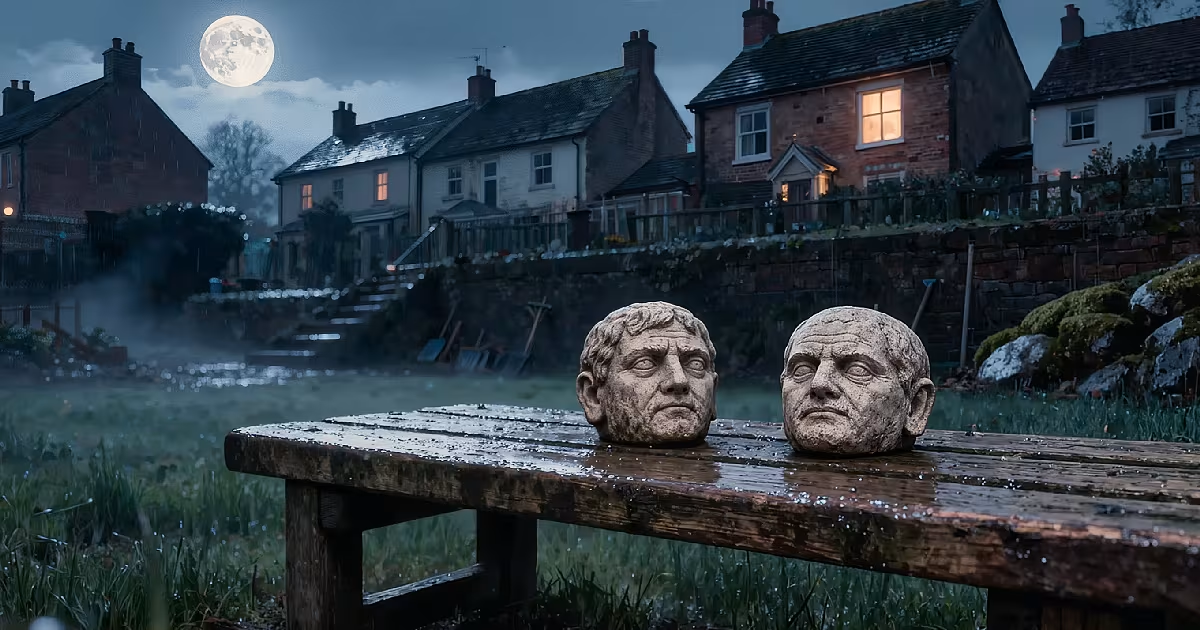
Two stone heads on a wet garden bench under a full moon.
Illustration, not a photograph.

Archive / Paranormal / BOT313-0518
PAR-1971ParanormalHEADS LOST
THE STONE HEADS AND THE WOLF-MAN
Fig. 01 Two stone heads on a wet garden bench under a full moon. Illustration, not a photograph.
Opening
In 1971, in a garden in Hexham, Northumberland, two children dug up a pair of small carved stone heads, each about six centimetres high. Over the following months, the family who found them and a neighbouring family reported strange events, and one of the experts who examined the heads said that a wolf-like creature had walked through her house.
The Hexham Heads became one of the best-known British poltergeist-and-curse stories of the 1970s. They also became a lesson in how a story changes when someone claims to have made the object. A man said he had carved them himself, in 1956, for his daughter, and the heads vanished before the question was properly settled.
Timeline
1971The Robson children, Colin and Leslie, find two small stone heads in the garden of their home on Rede Avenue, Hexham. Some sources wrongly give 1972.
After the findThe Robsons report that the heads seem to turn or move when no one is there, and that bottles are thrown across rooms. The next-door family, the Dodds, report that a boy's hair is pulled at night. His mother, Nelly Dodd, says she saw a half-man, half-goat figure leaving the house.
1972The heads are sent to Anne Ross, who receives them at her home in Southampton. She is a scholar of Celtic archaeology. While they are in her home she reports a part-wolf, part-man figure leaving her room, and her daughter Berenice reports a large dark werewolf-like figure on the stairs.
After Ross speaks publiclyShortly after Ross's view is published, a lorry driver, Desmond Craigie, says he made the heads in 1956 for his daughter, while living in the house the Robsons later occupied. He says a third head was damaged and thrown away.
LaterProfessor Dearman of the University of Newcastle examines the heads and concludes they were moulded, not carved. The originals are given to another man, and the heads and the man are said to have vanished.
1994Ross tells the writer Paul Screeton that she had not known similar hauntings, including a half-man, half-sheep creature, had been reported near the discovery site.
Summer 2012Ross dies after a long illness. Screeton publishes Quest for the Hexham Heads the same year.
October 2024BBC Archives restores a 1976 Nationwide interview with Ross.
Key figures
Colin and Leslie Robson were the finders. Nelly Dodd is the neighbour who described the half-man, half-goat figure. Anne Ross was an expert on Celtic artefacts who described the human head as venerated as a symbol of divinity and the powers of the otherworld, and who thought the heads were Celtic. She linked her wolf-man to the Hexham wolf that killed livestock in the winter of 1904. Paul Screeton wrote the 2012 book Quest for the Hexham Heads and has searched for the heads' whereabouts. In his conclusion he concedes that where the objects came from was essentially irrelevant to the events and that they belong to myth. Ross's youngest son, Richard Charles, describes the werewolf-like apparition in a postscript to Screeton's book. Desmond Craigie worked for a concrete company, which fits his claim that the heads were cast, though his own replicas did not closely match the originals.
Physical and documentary trail
The record: the heads themselves, which are no longer available to examine, the newspaper and television accounts of the Robsons, Dodds and Ross, and the laboratory opinion of Professor Dearman. The heads are small, about six centimetres high. The tests I could trace gave a reading that they were artificially moulded. Another account in popular sources says laboratory results were contradictory, some suggesting modern concrete and others old minerals; I could not trace the original reports.
The major gap is that the originals are gone, and the claim that they went to another man who disappeared with them has no source I could find. The accounts of the creature come from interviews given after the heads were widely discussed. No contemporary record of the poltergeist events, such as a police report, survives in the sources I found.
Things you might not know
- The finders were children. Colin and Leslie Robson dug the heads up.
- The date wanders. Many sources say 1972, but the find was in 1971.
- The creature changed shape. The Dodds described a goat-man. Ross described a wolf-man.
- A concrete worker claimed them. Craigie said he made the heads in 1956.
- A professor said moulded. Dearman concluded they had been cast.
- The BBC revisited it in 2024. It restored the 1976 interview.
Competing explanations
Modern casts and a good story. The strongest reading. A man says he made the heads, a professor says they were moulded, and the creature accounts followed publicity.
Ancient Celtic heads. Ross held this view. Celtic stone heads are known and are often found near water. The moulding finding runs against it.
Cursed objects. The paranormal reading. It depends on the witness accounts, which cannot be tested, and on events that have no record other than interviews.
Later life of the case
The Hexham Heads sit with cursed-object cases such as Annabelle and Robert the Doll, where an object and an interviewer's story carry the weight. Unlike those two, the Hexham objects are lost.
Finding
The Hexham Heads are a real pair of small stone figures that were dug up in 1971, and the strongest evidence points to a modern origin: a man said he made them, and a university professor judged them cast. The accounts of a wolf-man and a goat-man come from the families and from Anne Ross, who held a sincere belief about their age.
What still will not resolve: what the heads were made of and when, since the originals have disappeared and no one can run the tests again. Even Screeton, the heads' best-known chronicler, ends by conceding that where they came from was essentially irrelevant to the events.
Evidence signature
2/9 Thin
- Witnesses
- one person, or a tradition
- Instruments
- photo, film or physical traces
- Paper
- nothing on record
How well documented the case is, not whether it's true. A strong record can still have an ordinary answer, and a thin one can still be real.
You decide · HEXHAM HEADS
What do you think happened?
One vote per case, anonymous. You'll see how other readers voted once you've voted.