ROBERT THE DOLL
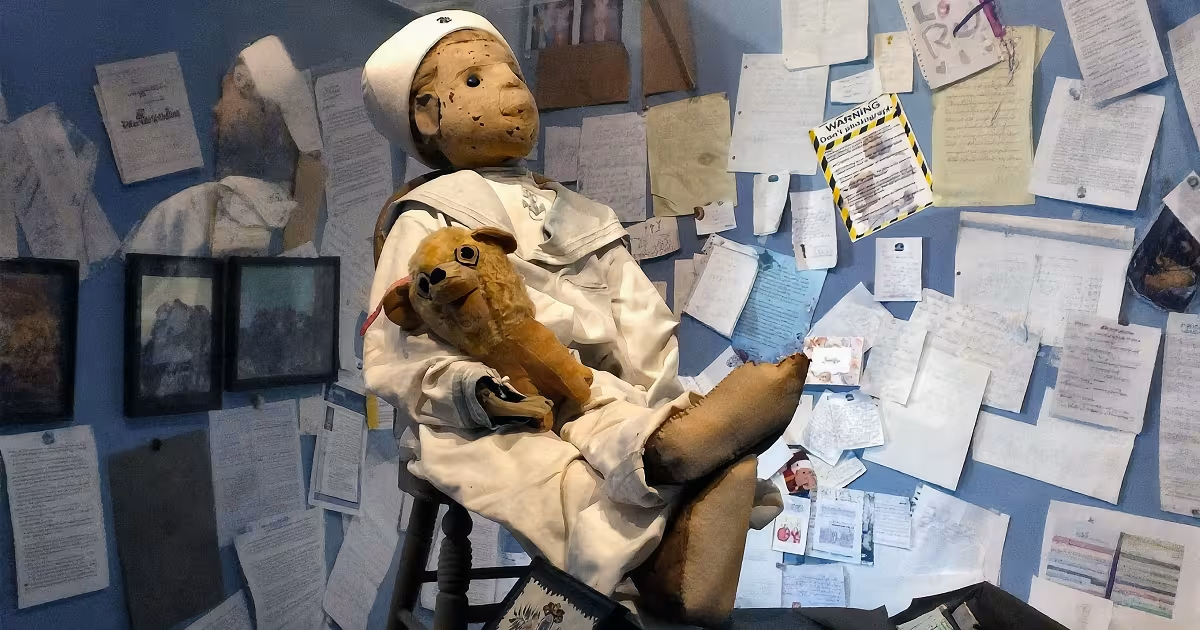
Robert the Doll in a sailor suit in his glass case, letters around it.
Illustration, not a period photograph.

Archive / Paranormal / BOT313-0271
PAR-1904ParanormalSORRY NOTES
KEY WEST CLOTH DOLL AND SORRY NOTES
Fig. 01 Robert the Doll in a sailor suit in his glass case, letters around it. Illustration, not a period photograph.
Opening
Robert the Doll, a roughly three-foot cloth sailor doll now displayed at the Fort East Martello Museum in Key West, Florida, belonged in childhood to Robert Eugene Otto, later a locally known painter, who kept the doll for most of his life.
Unlike Annabelle's largely undocumented origin story, Robert's real ownership history and the family's own genuine, later documented eccentricities give this case a somewhat firmer factual foundation, even as the museum's current visitor tradition, handwritten apology notes left at the case by people who claim to have photographed or mocked the doll and subsequently suffered bad luck, remains entirely a modern phenomenon with no confirmed connection to anything the Otto family themselves reported.
Timeline
Early 20th centuryRobert Eugene Otto, born in 1900 to a prominent Key West family, receives the doll, according to the most commonly repeated version of the story, as a gift, with some tellings specifically claiming it was given by a Bahamian servant with a background in folk magic, a detail that has never been independently confirmed through any documented household record.
Otto's childhood. Robert reportedly becomes deeply attached to the doll, insisting on its constant presence and, per family anecdote passed down through later owners of the house, sometimes blaming the doll directly for damage to his toys or furniture, ordinary childhood behavior that later retellings would come to treat as more sinister in retrospect.
Adulthood. Otto grows up to become a painter of some local reputation, marries Anne Otto, and the couple lives in the family's Key West home, with the doll reportedly kept in an upstairs turret room throughout much of this period.
Following Otto's death in 1974Anne Otto reportedly continues living in the house with the doll before it eventually passes out of family hands and into the possession of a subsequent homeowner.
LaterThe doll is donated to the Fort East Martello Museum, a historic fort now operated as a local history and folk-art museum, where it is placed in its own display case.
Following its museum placementVisitors reportedly begin claiming a range of misfortunes, equipment malfunctions, sudden illness, general bad luck, following visits during which they photographed the doll or treated it disrespectfully, and a tradition develops of visitors leaving small handwritten notes of apology at the case, a practice the museum has continued to accommodate rather than discourage, given its evident tourism value.
OngoingAmateur investigators and paranormal media programs have periodically examined camera equipment reportedly malfunctioning specifically in the doll's presence, though no such claim has been subjected to controlled testing capable of ruling out ordinary equipment failure occurring coincidentally.
Key figures
Otto is the case's central historical figure, and the fact that his real ownership of the doll throughout his childhood and adult life is independently documented through family and local historical record, rather than resting entirely on a single later investigator's retelling, gives this case a firmer factual foundation than many comparable haunted-object stories.
Anne Otto is a secondary figure in later retellings, sometimes described as having her own uneasy relationship with the doll during her years in the house following her husband's death, though the specific details of her own reported experiences vary across tellings and are not independently documented beyond secondhand anecdote.
The museum's visitors, collectively, are the case's most active modern participants, their continued practice of leaving apology notes representing a genuinely real, ongoing social phenomenon regardless of whether the doll itself has any actual causal role in whatever misfortunes those visitors subsequently experienced.
The unnamed Bahamian servant, credited in some tellings with an original folk-magic origin for the doll, represents the case's least verifiable claimed detail, appearing in popular retelling without any corresponding documented household record confirming the specific gift or its attributed origin.
Physical and documentary trail
The record has a genuinely documented ownership history connecting the doll to a real, named local historical figure across his entire life, and a substantial, still-growing collection of visitor-written apology notes preserved at the museum as a real, physical, if informally collected, body of testimonial material.
What it lacks is any contemporary account from Otto himself, or from his own family during his lifetime, describing the doll as an active malevolent agent rather than simply a cherished, if eccentric, childhood keepsake; the specific "haunted" framing appears to have developed substantially after the doll's museum placement rather than during Otto's own life.
Things you might not know
- He gets fan mail. Apology letters from visitors who photographed him without asking line the wall behind his case. Staff say one to three arrive each day.
- He is probably a Steiff. The doll is thought to have been made by the Steiff company in Germany, possibly as a display model.
- Gene married a pianist. Robert Eugene Otto met his wife, Anne, a concert pianist, in Paris.
- The family home is now a hotel. The Otto house, which Gene named the Artist House, now takes guests.
- He has been at the museum since 1994. That year the doll was donated to the East Martello Museum in Key West.
- Chucky probably owes him nothing. Robert is often called the inspiration for Chucky, but Don Mancini, Chucky's creator, has described other influences.
Competing explanations
A genuine, sincerely cherished childhood object whose owner's own eccentric attachment to it, ordinary in itself, was retrospectively reinterpreted as sinister once the doll entered public museum display and acquired a marketable ghost story, a reading consistent with the absence of any contemporary "haunted" claim during Otto's own lifetime.
A form of psychological confirmation bias among museum visitors, in which the doll's already-established reputation primes people experiencing entirely ordinary bad luck, a dropped phone, a minor illness, to specifically attribute it to their earlier visit, sustaining and growing the apology-note tradition independent of any actual causal connection.
A genuine haunted or cursed object, the reading the doll's continued popular reputation and the museum's own tourism-friendly framing both implicitly support, resting on the volume of visitor testimonial notes rather than on any independently verified incident.
Later life of the case
Robert the Doll remains one of the most visited "haunted object" attractions in the United States specifically because of the genuine, documented human story underlying it, a real man's real lifelong attachment to a childhood toy, giving the case an emotional and historical texture that purely invented haunted-doll stories generally lack, even as its modern reputation for active malevolence developed well after Otto's own death.
Finding
Robert the Doll has a genuinely documented ownership history connecting it to Robert Eugene Otto across his entire life, a real historical figure rather than an invented character. Its modern reputation as an actively dangerous object, and the associated visitor apology-note tradition, developed after its museum placement rather than during Otto's own lifetime, and no contemporary account from Otto or his immediate family describes the doll in the same terms the museum's current visitors do.
What still will not resolve: any confirmed connection between specific visitor misfortunes and the doll itself, and independent verification of the doll's claimed original folk-magic gift story. Until either is addressed, this report treats Otto's genuine lifelong attachment to the doll as documented fact and its claimed active malevolence as a later, museum-era development.
Evidence signature
5/9 Solid
- Witnesses
- several people
- Instruments
- photo, film or physical traces
- Paper
- official records at the time
How well documented the case is, not whether it's true. A strong record can still have an ordinary answer, and a thin one can still be real.
You decide · ROBERT THE DOLL
What do you think happened?
One vote per case, anonymous. You'll see how other readers voted once you've voted.