CHATEAU DE BRISSAC
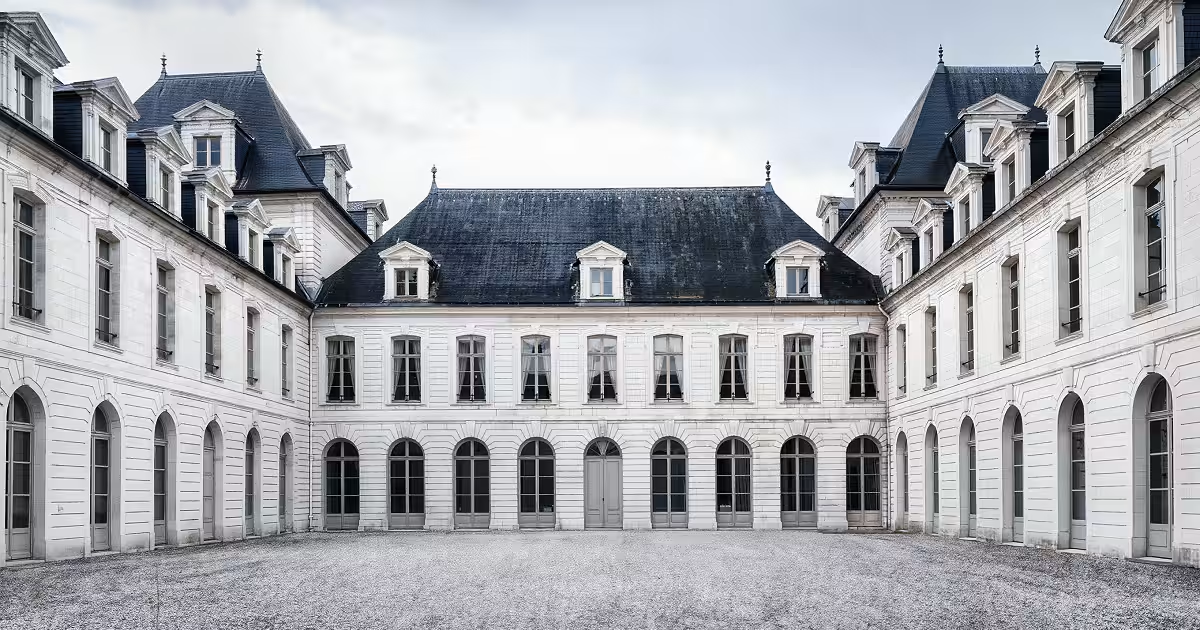
The white stone courtyard of the Château de Brissac.
Illustration, not a period photograph.

Archive / Paranormal / BOT313-0262
PAR-147731 MAY 1477ParanormalKILLED ELSEWHERE
THE GREEN LADY AND A MURDER THAT HAPPENED ELSEWHERE
Fig. 01 The white stone courtyard of the Château de Brissac. Illustration, not a period photograph.
Opening
Château de Brissac, in France's Loire Valley, is the tallest château in the country, seven stories and roughly 204 rooms, owned by the Cossé-Brissac family since 1502. Its resident ghost, La Dame Verte, "the Green Lady," is said to be Charlotte de Brézé, an illegitimate daughter of King Charles VII, murdered by her jealous husband after he caught her in an affair, her disfigured, hollow-eyed face and green gown reportedly still glimpsed in the chapel tower.
The real Charlotte de Brézé did exist, and she really was killed by her husband in 1477 for exactly this reason. What the popular legend consistently gets wrong, once checked against the actual historical and genealogical record, is almost everything else: the weapon, her age, and, most tellingly, the building where it happened.
Timeline
c. 1434-1446 (sources disagree by roughly a decade)Charlotte de Valois, later known as Charlotte de Brézé, is born, the illegitimate daughter of King Charles VII of France and his mistress Agnès Sorel.
1 March 1462Charlotte marries Jacques de Brézé, Seneschal of Normandy and Count of Maulévrier, an arranged, politically expedient match rather than a love match; the marriage produces at least five, and by some accounts six, children, including Louis de Brézé, who would later marry Diane de Poitiers, mistress of King Henry II.
Night of 31 May-1 June 1477 (the contemporary Chronique Scandaleuse dates the discovery itself to 13 June 1476, a full year earlier than the death date most modern sources give, one of several chronological inconsistencies in the surviving record). Jacques de Brézé, on a hunting trip, discovers his wife with Pierre de la Vergne, a gentleman of Poitou attached to his household, near a village by some accounts identified as Romiers-lès-Dourdan, and by other, more popularly repeated accounts at the Château de Rouvres in Eure-et-Loir, not at Château de Brissac itself. He kills them both.
Same event, disputed weaponContemporary and near-contemporary sources, including a documented review of the actual trial record by the historian Douët d'Arcq, describe Jacques killing his wife and her lover with his sword. The far more dramatic and widely repeated modern version of the story, that he struck each of them one hundred blows with a hunting axe, does not appear in the earlier documented accounts and looks to be a later embellishment.
Same event, disputed ageCharlotte's death is generally dated to 1477 at an age of roughly 30 to 31, per most modern genealogical sources; one older secondary account states she was forty-three at the time of her death, a discrepancy that has never been reconciled and that most later retellings simply ignore in favor of whichever figure suits the telling.
Following the killingJacques de Brézé is formally tried for the murder; historian Douët d'Arcq's documented review of the trial record confirms this was a real judicial proceeding, not merely private aristocratic retribution left unexamined. He is sentenced to death.
Following the sentenceRather than being executed, Jacques is pardoned in exchange for a substantial fine, one large enough to leave him financially ruined; sources differ on whether this pardon comes from Louis XI directly or from Louis XI's successor Charles VIII in 1486, with at least one source specifically crediting Charles VIII with the release from what had been a continued death sentence under Louis XI.
1483/1484, following the death of Louis XIJacques regains his confiscated property and his title of Seneschal of Normandy by decree of the Parlement, restoring him to the position and, presumably, to the properties from which the modern ghost legend would eventually draw its setting.
14 August 1494Jacques de Brézé dies at Nogent-le-Roi and is buried at Coulombs abbey, the same abbey where Charlotte herself was buried following her death seventeen years earlier.
Undated, modern legend formationAt some point after these events, local tradition attaches Charlotte's story specifically to Château de Brissac, the family's later, grander seat, rather than to Château de Rouvres, the location the more historically grounded accounts of the killing actually name, and gives her the "Green Lady" identity and appearance now associated with the site.
Ongoing, present dayThe Cossé-Brissac family, current owners of the château, operate it as a hotel and winery and are reported to have grown accustomed to the ghost's presence over generations; visitors and paranormal investigation teams continue to report cold spots, unexplained noises, and orbs of light, particularly in the chapel tower.
Key figures
Charlotte de Brézé is the case's real, documented historical subject, a genuine royal-adjacent figure whose 1477 murder is confirmed by contemporary chronicle and formal trial record rather than invented after the fact, even though nearly every specific detail attached to her modern ghost story has been altered somewhere between the historical record and the popular legend.
Jacques de Brézé is the confirmed, tried, and initially death-sentenced perpetrator, a documented historical figure whose later pardon, financial ruin, and eventual restoration to title and property are independently traceable through genealogical and Parlement records rather than resting on oral tradition alone.
Douët d'Arcq, the historian credited with reviewing the actual trial documentation in detail, represents the case's most direct link between the popular legend and a genuine primary legal record, a level of documentary grounding many château ghost stories entirely lack.
Pierre de la Vergne, Charlotte's lover and fellow victim, is a comparatively minor figure in most retellings of the legend despite being killed in the same incident, a detail popular versions of the story frequently minimize or omit entirely in favor of focusing on Charlotte alone.
Physical and documentary trail
The case has a genuine contemporary chronicle account (the Chronique Scandaleuse of Louis XI), documented genealogical records for both Charlotte and Jacques de Brézé, and historian Douët d'Arcq's specific, credited review of the actual 1477 murder trial documentation, a level of primary-source grounding considerably stronger than most European haunted-castle legends can claim.
What it lacks, and what every popular retelling of the ghost story glosses over, is any confirmed connection between the killing's actual documented location and Château de Brissac itself; the more historically grounded sources place the discovery and killing at Château de Rouvres or near a village in the Dourdan area, not at the château where her ghost is now said to walk.
Things you might not know
- It is seven storeys high. That makes it the tallest château in the Loire Valley, and when it was built, the tallest in France.
- It began as a fortress. The Counts of Anjou built the first castle on the site in the 11th century.
- A king paid for the rebuild. After Charles II de Cossé backed Henry of Navarre, he was given the property, the title Duke of Brissac and money to rebuild it in 1611.
- A royal quarrel was settled there. Louis XIII and his mother, Marie de' Medici, met at the château in August 1620 to patch up their differences.
- Revolutionaries sacked it. It was ransacked in 1792, and restoration only began in 1844.
- It is a protected monument. The château was listed as a monument historique in 1958 and 1966.
Competing explanations
A genuine historical murder, accurately remembered in its broad outline but relocated in popular memory to the family's later, grander, and more visitable seat at Brissac rather than the actual, more obscure Château de Rouvres where the historical record places it. This reading requires no supernatural element at all and accounts well for how a real royal-adjacent scandal could survive in local memory while drifting to a more prominent physical location over five centuries of retelling.
A genuine haunting tied specifically to Brissac itself, requiring either that Charlotte's remains or personal effects were later moved to the château, or that some other, currently undocumented connection ties her spirit specifically to that building rather than to the actual site of her death, a connection no available source in this search has established.
An entirely separate, later local legend that simply borrowed Charlotte's real, dramatic, and genealogically well-documented story to lend a more prosaic château haunting some genuine historical weight, a pattern common to European ghost lore generally, where a real regional scandal gets attached to whichever nearby landmark makes the better tourist story.
Later life of the case
Château de Brissac has built a substantial part of its modern tourism identity around the Green Lady legend, featuring regularly in roundups of Europe's most haunted castles and hosting paranormal investigation teams whose equipment readings, cold spots, unexplained sounds, are standard fare for this kind of site without ever approaching independent verification. The gap between the legend's confirmed historical seed and its actual claimed modern location remains almost entirely unexamined in the popular retellings that keep the story circulating.
Finding
Charlotte de Brézé was a real historical figure, murdered by her husband in 1477 in a killing confirmed by contemporary chronicle and a documented formal trial, a considerably stronger evidentiary foundation than most European castle ghost stories can claim. Nearly every specific detail in the popular modern retelling, the murder weapon, her age, and critically the location itself, diverges from what the more careful historical and genealogical sources actually record, with the more rigorously sourced accounts placing her death at Château de Rouvres rather than at Brissac, the building where her ghost is now said to appear.
What still will not resolve: any documented connection explaining why Charlotte's haunting became specifically attached to Brissac rather than to the château where the historical record places her actual death, and full reconciliation of the conflicting age and date details across the surviving sources. Until either is addressed, this report treats the murder itself as solidly historical and its specific modern location as a case of popular legend attaching a real story to the wrong building.
Evidence signature
5/9 Solid
- Witnesses
- several people
- Instruments
- nothing on record
- Paper
- formal investigation, court or declassified file
How well documented the case is, not whether it's true. A strong record can still have an ordinary answer, and a thin one can still be real.
You decide · CHATEAU DE BRISSAC
What do you think happened?
One vote per case, anonymous. You'll see how other readers voted once you've voted.