SANDRINGHAM
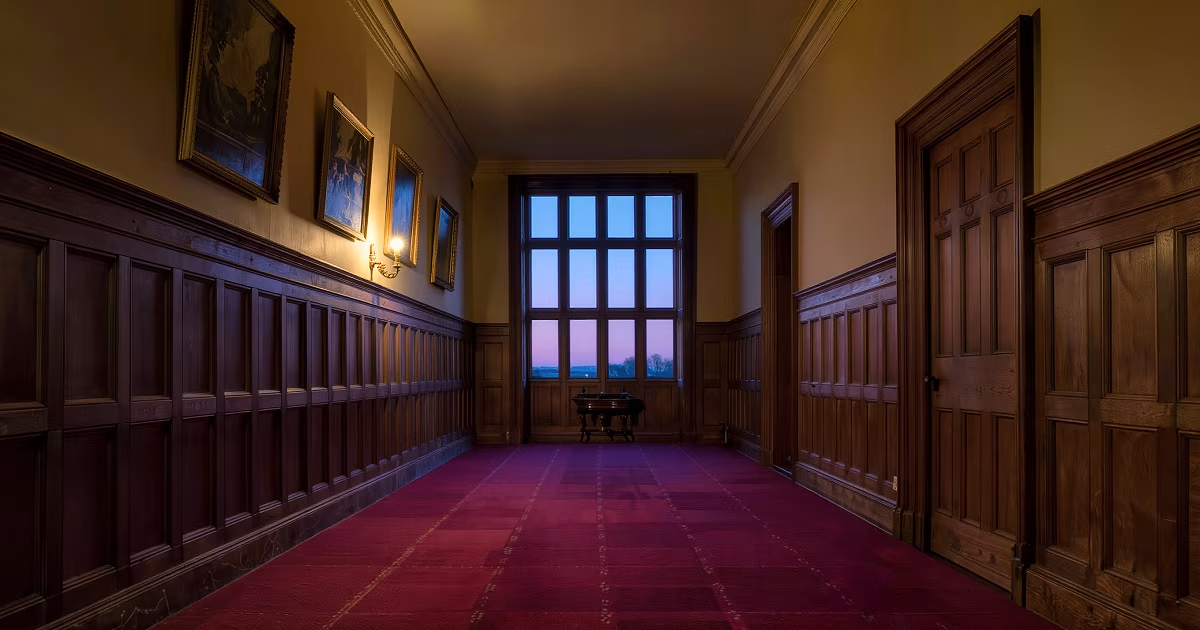
A long panelled corridor with a red carpet leading to a window.
Illustration, not a period photograph.

Archive / Paranormal / BOT313-0299
PAR-1910ParanormalFENCE UP
THE ROYAL HOUSE AND ITS CORRIDOR GHOST
Fig. 01 A long panelled corridor with a red carpet leading to a window. Illustration, not a period photograph.
Opening
Sandringham House, the royal family's private Norfolk estate since 1862, is not a ruin with a dungeon tour or a commercial haunted-house operation. It is a working residence, still gathering the family together every Christmas, and its ghost stories are correspondingly quieter and harder to verify: no torture chamber, no bricked-up skeleton, just a specific downstairs bedroom, the death of a king, and, according to a royal diarist's own posthumously published journal, a private religious service the Queen Mother arranged after her staff said they could no longer bear to go near the room.
Timeline
1862The estate is purchased for Edward VII, then Prince of Wales, and his wife Princess Alexandra of Denmark, beginning the property's continuous royal ownership. The 20,000-acre estate eventually includes Sandringham House itself along with Anmer Hall, York Cottage, Appleton House, its own church, a stud farm, and fruit farms.
20 January 1936King George V dies at Sandringham, the first of two monarchs to draw their last breath in the house.
6 February 1952King George VI dies at Sandringham in his sleep, in a downstairs bedroom that would later become the specific focus of staff unease.
Ongoing royal traditionThe family gathers at Sandringham every year between Christmas and New Year to exchange gifts and attend church together, a sustained annual pattern that has continued across multiple reigns.
Summer, prior to January 2001According to the diaries of veteran royal correspondent Kenneth Rose, published posthumously after his 2014 death, Prue Penn, lady-in-waiting to the Queen Mother, tells Rose that Queen Elizabeth II had invited her to a small service held in one of Sandringham's rooms, conducted by the local parson, with the Queen Mother the only other person present. Rose's diary entry notes that staff had complained specifically about the downstairs bedroom where George VI had died.
November 1995Tony Jarred, described as one of the Queen's favored servants, dies; the royal family attends his funeral, an indication of his personal standing within the household.
1996, roughly a year after Jarred's deathA royal footman is required to go to the cellar at Sandringham House, an incident subsequently folded into the estate's broader ghost lore, though the specific details of what the footman reported have not been independently confirmed beyond secondhand retelling.
Ongoing, per staff accounts relayed through royal biographers and tabloid coverage. Reported phenomena at the estate generally take the mild, ambient form common to many old country houses, unexplained footsteps in empty hallways, doors opening and closing without apparent cause, rather than any single dramatic apparition narrative, with reports said to increase specifically around Christmas Eve when the family is in residence.
2022Following Queen Elizabeth II's death, King Charles III hosts his first Christmas at Sandringham as monarch, and contemporary press coverage revisits the ghost rumors, including the earlier claim of the Queen's private cleansing service, as part of general holiday-season royal reporting rather than as new investigative material.
Separately reported. Historian commentary connects Sandringham's rumored haunting to the broader pattern of nearby royal properties, including a reported monk figure said to haunt Buckingham Palace, itself built on land once belonging to the monks of Westminster Abbey, though this second claim concerns a different property entirely and is not directly connected to anything reported at Sandringham specifically.
Key figures
Rose is the case's single most consequential documentary source, a professional royal diarist and journalist whose posthumously published diaries provide the only substantively sourced account of the Queen personally arranging a private religious service in response to staff concern, rather than the claim resting on anonymous tabloid sourcing alone.
Penn, as the Queen Mother's own lady-in-waiting and Rose's direct source, is the case's key firsthand witness to the service itself, though her account reaches the public only secondhand, through Rose's own diary entry rather than her own direct public statement.
Jarred is a specifically named household figure whose death and the subsequent, loosely connected cellar incident the following year illustrate how quickly an unremarkable staff event can become folded into an estate's broader ghost narrative once retold outside its original context.
George VI is the specific historical figure whose death in a particular downstairs room gives the staff's reported unease a concrete, dateable anchor, distinguishing this case from vaguer haunted-house claims with no specific attached history.
Physical and documentary trail
The record has two confirmed royal deaths at the property (George V and George VI), a specifically sourced diary account from a professional royal correspondent describing a real, private religious service, and consistent staff-reported ambient phenomena (footsteps, doors) concentrated seasonally around the family's own annual Christmas residence.
What it lacks is any account from the Queen herself, from the parson who conducted the service, or from named staff members describing their own specific experiences firsthand; every detail traces back through secondhand retelling, Penn to Rose, staff complaints to biographers, rather than direct primary testimony reaching the public.
Prue Penn tells me that at Sandringham in the summer, the Queen invited her to attend a little service in one of its rooms conducted by the local parson. The only other person present was the Queen Mother.
Things you might not know
- Its clocks ran half an hour fast. Edward VII set "Sandringham time" ahead of GMT to get more daylight for shooting. Edward VIII ended it in 1936.
- The house is a Victorian rebuild. The original hall was replaced with a much larger red-brick house, finished in 1870.
- It nearly burned in 1891. Fires lit to warm the bedrooms for Edward's fiftieth birthday got out of hand and the roof collapsed.
- The first royal Christmas message came from here. George V broadcast it from Sandringham in 1932, in words written by Rudyard Kipling.
- It opened to the public in 1977. Elizabeth II marked her Silver Jubilee by letting visitors in for the first time.
- The shooting was on an industrial scale. Annual game bags rose from 6,000 to 8,000 birds in the 1870s to more than 20,000 by 1900.
Competing explanations
A genuine, privately held religious service reflecting real staff unease about a room with a specific, documented death, exactly as Rose's diary describes, without requiring any judgment about whether the underlying concern reflected an actual paranormal event or simple discomfort with a historically significant deathbed.
Ordinary old-house phenomena, footsteps, doors, drafts, common to any large, aging residence, retroactively organized into a "haunting" narrative once the specific detail of the service and the room's royal-death history became public knowledge.
A largely unverifiable tabloid and royal-biography tradition, given how many of the case's specific claims (the cellar incident, the general pattern of Christmas Eve escalation) rest on secondhand retelling without a single named staff member's own direct, on-record account ever entering the public record.
Later life of the case
Sandringham's ghost reputation persists as a quieter, more institutionally cautious counterpart to Britain's more commercially haunted stately homes, resurfacing in press coverage specifically around royal Christmas gatherings rather than being actively promoted by the estate itself in the way a place like Chillingham markets its own hauntings. Its most credible documentary anchor remains Rose's diary, a genuine primary source rather than an anonymous tabloid claim, even though it confirms only that a service took place and not what, if anything, prompted the underlying staff concern.
Finding
Sandringham is a real, continuously occupied royal residence where two monarchs have died, and a credible primary source, a professional royal diarist's posthumously published journal, confirms that Queen Elizabeth II did arrange a small, private religious service in a specific room following staff complaints. What remains entirely unconfirmed is the underlying cause of that unease, since no staff member's own direct account of what they experienced has entered the public record.
What still will not resolve: any firsthand account from the parson, from Penn herself, or from the complaining staff describing what specifically prompted the 2001-era service, and full confirmation of the separate 1996 cellar incident's actual details. Until either surfaces, this report treats the documented service as real and its underlying cause as genuinely unknown rather than assumed.
Evidence signature
4/9 Solid
- Witnesses
- several people
- Instruments
- nothing on record
- Paper
- official records at the time
How well documented the case is, not whether it's true. A strong record can still have an ordinary answer, and a thin one can still be real.
You decide · SANDRINGHAM
What do you think happened?
One vote per case, anonymous. You'll see how other readers voted once you've voted.