GLAMIS
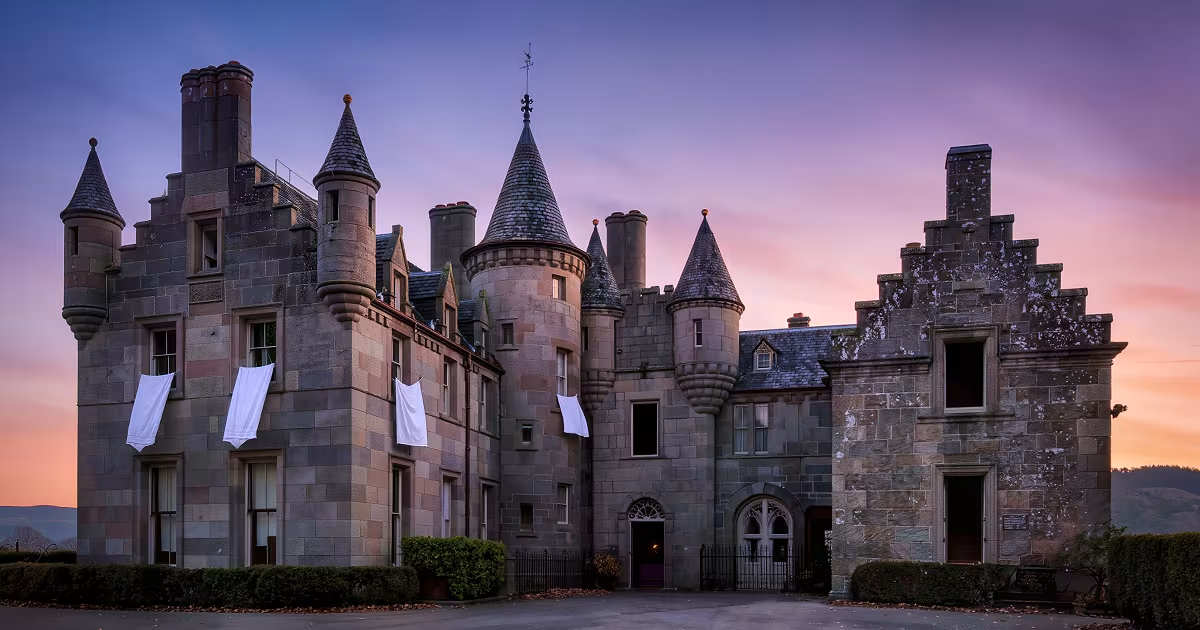
The turrets of Glamis Castle at dusk, white sheets at the windows.
Illustration, not a period photograph.

Archive / Paranormal / BOT313-0210
PAR-1716ParanormalTOWELS DOWN
THE SECRET ROOM AND THE MISSING WINDOW
Fig. 01 The turrets of Glamis Castle at dusk, white sheets at the windows. Illustration, not a period photograph.
Opening
Glamis Castle in Angus, Scotland, the childhood home of Queen Elizabeth the Queen Mother and the setting Shakespeare chose for Macbeth's own title, carries a specific and unusually durable local legend: that somewhere within its walls sits a secret room, containing either a hereditary family monster or a hidden, unspoken family secret, and that the castle's own windows, when counted from outside, will not match the number of rooms accounted for from within.
Visitors have reportedly tried counting for generations. The Bowes-Lyon family, who have held the castle since the 14th century, have never produced an inventory or floor plan confirming any such room exists, a genuinely persistent gap between a story treated as near-fact by generations of retelling and the total absence of the one document that would settle it.
Timeline
1372King Robert II grants Glamis to Sir John Lyon, beginning the family's continuous ownership of the castle across more than six centuries, through the Lyon and later Bowes-Lyon lines.
Medieval and early modern periods. The castle undergoes successive building phases and expansions, producing the complex, irregular structure whose exact internal layout would make a genuinely hidden room, at least architecturally, more plausible than in a more simply planned building.
1537Janet Douglas, Lady Glamis, is burned at the stake on trumped-up witchcraft charges widely believed at the time, and by most later historians, to have been politically motivated by King James V's hostility toward her family, a genuine, well-documented historical tragedy that predates and is distinct from the later "monster" legend, though the two are sometimes loosely conflated in popular retelling of the castle's dark history.
19th century, the specific window-counting and secret-room legend's clearest documented emergence. The story takes the form still told today: a family secret or a deformed, hereditary "monster" heir kept permanently hidden from public view, with only the current Earl, his heir, and a small number of estate officials said to know the room's actual location, and each heir supposedly told the secret only upon reaching majority.
Ongoing traditionThe specific claim that the castle's exterior windows cannot be reconciled with its interior room count when visitors attempt to verify the story themselves has become one of the most frequently repeated pieces of supporting "evidence" for the legend, despite no formal architectural survey result confirming an unaccounted-for enclosed space ever being published.
20th centuryThe castle becomes closely associated with the British royal family through the Queen Mother's own childhood there, adding a layer of genuine royal-family connection to a site already carrying centuries of ghost and secret-room folklore.
Ongoing, modern tourismGlamis operates as a major visitor attraction, with guided tours incorporating the secret-room legend, additional ghost stories including a "Grey Lady" reportedly seen in the chapel, and the castle's own genuine, extensive architectural and family history into a combined visitor experience.
Key figures
Douglas is the castle's most solidly documented historical tragedy, a real woman executed on political pretext in 1537, whose genuine, dark history sometimes lends unearned historical weight to the entirely separate and much less documented secret-room monster legend when the two are conflated in casual retelling.
The Bowes-Lyon family are the case's central and most consequential figures specifically through their silence: no family member has ever published or confirmed an inventory settling the secret-room question, a silence that functions simultaneously as the legend's most persuasive piece of circumstantial support and as the simplest possible explanation, that there is nothing there to reveal.
Generations of visitors who have personally attempted the window-count verification represent the legend's most active ongoing participant base, their repeated, informal efforts sustaining the story's credibility through sheer persistence rather than through any single conclusive result ever being published.
Physical and documentary trail
The record has a genuine, extensively documented six-century family ownership history, a real, dated historical tragedy in the 1537 Douglas execution, and a consistently repeated 19th-century-forward secret-room legend with a specific, checkable verification method (the window count) that generations of visitors have informally attempted.
What it lacks is any published architectural survey, family inventory, or floor plan confirming or definitively ruling out an unaccounted-for enclosed space, leaving the window-counting claim in the position of an oft-repeated but never formally documented or refuted piece of supporting evidence.
Things you might not know
- It was the Queen Mother's childhood home. Elizabeth Bowes-Lyon spent much of her childhood at Glamis, and Princess Margaret was born there on 21 August 1930.
- Macbeth never lived there. Shakespeare makes Macbeth Thane of Glamis, but the real king had no known connection to the castle.
- A king is said to have died there. Malcolm II died at the royal hunting lodge on the site in 1034, either murdered or after a nearby battle, depending on the account.
- An earl gambled with the Devil. The legend of Earl Beardie has him playing cards on the Sabbath with a stranger who turns out to be the Devil and takes his soul.
- A chapel seat is kept for a ghost. Guides say one of the chapel's 46 seats is always reserved for the White Lady, thought to be Janet Douglas.
- A singer helped spread the monster story. Virginia Gabriel, who stayed at the castle in 1870, is a source for some versions of the hidden-child legend.
Competing explanations
A genuine architectural irregularity, given the castle's centuries of successive, non-uniform building phases, that gave rise to an entirely explicable but visually confusing mismatch between interior and exterior counting, later elaborated into a monster or secret-heir narrative rather than reflecting any deliberately concealed room.
An actual concealed family secret, of the kind the legend describes, that the family has deliberately and successfully kept from public documentation for generations, a reading that requires accepting the family's own silence as confirmation rather than as simple absence of evidence.
A purely folkloric invention, drawing on the castle's genuine reputation for dark history (the Douglas execution, its Macbeth association) to construct a durable, dramatically satisfying story requiring no actual hidden room or secret to sustain itself across generations of retelling.
Later life of the case
Glamis remains one of Scotland's most visited castles specifically because of the combination of its genuine architectural grandeur, its real royal family connection, and a secret-room legend unusually durable for having never been either confirmed or definitively debunked by any published document from the one family actually positioned to settle it.
Finding
Glamis Castle's secret-room legend has circulated in its recognizable modern form since at least the 19th century, resting on a specific, repeatable verification claim, the mismatched window count, that generations of visitors have informally attempted without any published, conclusive architectural result ever settling the question either way. The Bowes-Lyon family's own genuine six-century ownership and their documented silence on the matter remain the case's central, unresolved fact.
What still will not resolve: any published architectural survey, inventory, or family statement definitively confirming or ruling out an unaccounted-for room. Until the family itself, or an independent survey, produces that document, Glamis stays exactly what it has been for well over a century: a well-loved story with no proof and no denial.
Evidence signature
4/9 Solid
- Witnesses
- several people
- Instruments
- nothing on record
- Paper
- official records at the time
How well documented the case is, not whether it's true. A strong record can still have an ordinary answer, and a thin one can still be real.
You decide · GLAMIS
What do you think happened?
One vote per case, anonymous. You'll see how other readers voted once you've voted.