LITTLEDEAN HALL
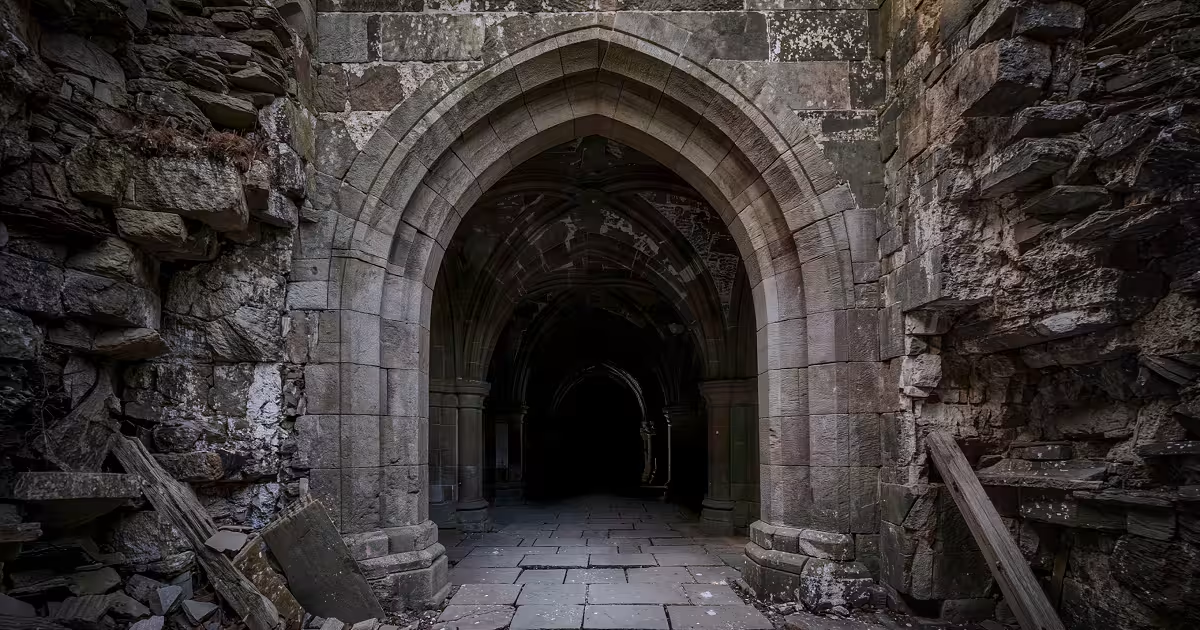
A dark stone archway leading into a passage at Littledean Hall.
Illustration, not a period photograph.

Archive / Paranormal / BOT313-0211
PAR--ParanormalBAT ROOST
THE GHOST OF CHARLES PYRKE
Fig. 01 A dark stone archway leading into a passage at Littledean Hall. Illustration, not a period photograph.
Opening
Littledean Hall, in the Forest of Dean village of Littledean, is described by some historians as the oldest continuously occupied house in Britain, its cellars holding genuine Saxon and Celtic remains and a Roman temple still standing in its grounds.
Its resident ghost story, unlike the generic "monk and cavalryman" figures that haunt so many English country houses, has a specific named historical figure at its center: Charles Pyrke, an 18th-century master of the hall, whose reported murder by his own manservant is said to trace back to a concealed birth and a hidden panel rather than to any anonymous medieval friar.
Timeline
Saxon period. The site's earliest structure begins as a Saxon hall; excavated cellars have since produced both Saxon and Celtic-era remains, giving the property a genuinely ancient documented occupation history independent of any ghost tradition attached to it later.
Roman period, earlier still. A Roman temple, sited at a springhead on the edge of the Forest of Dean escarpment, stands within the grounds, though neither the temple remains nor the hall's interior are generally open to public access.
1612, per the current standing structure's own documented date. The present house is substantially rebuilt, with an early 17th-century north wing added afterward and a further mid-19th-century top storey completed later still, giving the visible building its current layered architectural history.
18th centuryCharles Pyrke serves as master of Littledean Hall during this period, the specific historical figure the hall's central ghost story is built directly around, distinguishing this case from more generic, undated haunted-house narratives.
Per the traditional account. Pyrke's manservant is said to have fathered a child, described in the story as Black, with his own sister, and to have concealed the infant behind a hidden panel in what is now called the Oak or Blue bedroom. One version of the story holds that Pyrke's own discovery of this concealment led the manservant to kill him in revenge or self-protection; a separate, less commonly repeated version instead casts Pyrke himself as the one who commits murder, a reversal most retellers consider less consistent with the story's other details.
Following the reported killingA Gloucester newspaper is said to have reported that a Black man wearing a silver collar was found wandering the district shortly after Pyrke's death, taken by contemporary observers as the likely fleeing culprit, a specific period detail that, if the newspaper account can be confirmed, would represent an unusually concrete piece of near-contemporary documentation for a story of this age.
Ongoing traditionThe hall's ghost is said to appear on the first-floor landing carrying a candle, alongside separate reported poltergeist activity, including red and white flowers reportedly thrown onto the floor of the old dining room at night, and phantom bloodstains said to periodically reappear in the dining hall itself.
1906Ellen Hayward, described as a Cinderford wise woman, is tried at nearby Littledean Jail, the last person formally charged with witchcraft in Gloucestershire, a separate but geographically connected piece of the district's documented history of folk-belief prosecution.
1988The section of the property functioning as the coach house and cellar is formally notified as a biological Site of Special Scientific Interest, in recognition of its confirmed status as a breeding roost for the Greater Horseshoe Bat, a genuine, scientifically documented ecological fact entirely independent of the hall's ghost tradition.
OngoingThe hall continues to be described in regional tourism and folklore literature as one of the most haunted houses in England, generally citing the Pyrke story, the bloodstains, and the candle-carrying figure as its core recurring elements.
Key figures
Pyrke is the case's central, specifically named historical figure, and the fact that the hall's ghost story is built around a real, dateable 18th-century master of the house, rather than an anonymous medieval clergyman, gives this case a more specific evidentiary target than most comparable English haunted-house legends offer.
The unnamed manservant is the story's other central figure, and the considerable disagreement across retellings about whether he was the killer or the victim of Pyrke's own violence reflects a genuine, unresolved instability at the heart of the tradition rather than a single, consistently told account.
The Greater Horseshoe Bat colony is the hall's one entirely confirmed, scientifically documented resident, a real ecological fact that exists independently of and alongside the far less verifiable human ghost story.
Physical and documentary trail
The record has genuine archaeological evidence, Saxon and Celtic remains in the cellars and a standing Roman temple in the grounds, a documented architectural rebuilding history dating to 1612, a formally designated Site of Special Scientific Interest status for the bat colony, and a specifically named 18th-century historical figure at the center of its central ghost story.
What it lacks is any independently verified copy of the reported Gloucester newspaper account describing the search for a fleeing Black man, and any parish or estate record directly confirming the specific circumstances of Pyrke's death as murder rather than through some other, more mundane cause.
Things you might not know
- It may be Britain's oldest lived-in house. Littledean Hall is thought to be the oldest house in the United Kingdom that is still occupied.
- A Roman road runs under the drive. Its remains have been found beneath the approach to the house.
- The chestnut trees are 500 years old. The sweet chestnuts lining the drive are at least that age.
- Hundreds of carved stone heads have been found. About 200 have been recovered since 2016, and in 2023 the University of York won a large grant to study them.
- Lightning struck in 2007. A strike nearby damaged the building.
- Even a wall is protected. In 2008 the owners were ordered to rebuild a section of wall they had knocked down, because it was Grade II listed.
Competing explanations
A genuine historical killing involving Pyrke and his manservant, later elaborated with the ghost-story trappings (the candle, the flowers, the bloodstains) common to English country house hauntings generally, with the core event itself resting on some real, if now only partially documented, 18th-century incident.
A largely constructed or substantially embellished legend, built around a real historical figure's name specifically because doing so gives an otherwise generic haunted-house story more apparent specificity and credibility than an anonymous "resident monk" narrative would carry.
Independent, unconnected phenomena, genuine archaeological remains, a real bat colony, and separate local ghost-story traditions, that have become woven together into a single narrative package over time specifically because they share the same physical building, rather than reflecting one continuous, single-cause history.
Later life of the case
Littledean Hall's combination of genuine ancient archaeological pedigree, a specifically named historical ghost figure, and a scientifically documented protected bat colony makes it a distinctive entry among England's haunted houses, one where real, independently verifiable facts about the building sit alongside a human ghost story whose central historical claims remain only partially confirmed.
Finding
Littledean Hall's ancient fabric, its Saxon and Celtic cellar remains, its Roman temple, and its scientifically confirmed bat roost, is genuine and independently documented. Its ghost story is unusually specific for the genre, naming an actual historical 18th-century master of the house, Charles Pyrke, rather than an anonymous clerical or military figure, though the story's own internal inconsistency over who killed whom, and the unverified status of its central supporting newspaper account, leave its historical accuracy considerably less settled than the building's own physical history.
What still will not resolve: independent confirmation of the reported Gloucester newspaper account, and any parish or estate record establishing the actual, documented cause and circumstances of Pyrke's death. Until either surfaces, this report treats the hall's ancient fabric as fully confirmed and its human ghost story as a specifically named but only partially verified tradition.
Evidence signature
4/9 Solid
- Witnesses
- one person, or a tradition
- Instruments
- photo, film or physical traces
- Paper
- official records at the time
How well documented the case is, not whether it's true. A strong record can still have an ordinary answer, and a thin one can still be real.
You decide · LITTLEDEAN HALL
What do you think happened?
One vote per case, anonymous. You'll see how other readers voted once you've voted.