BLICKLING HALL
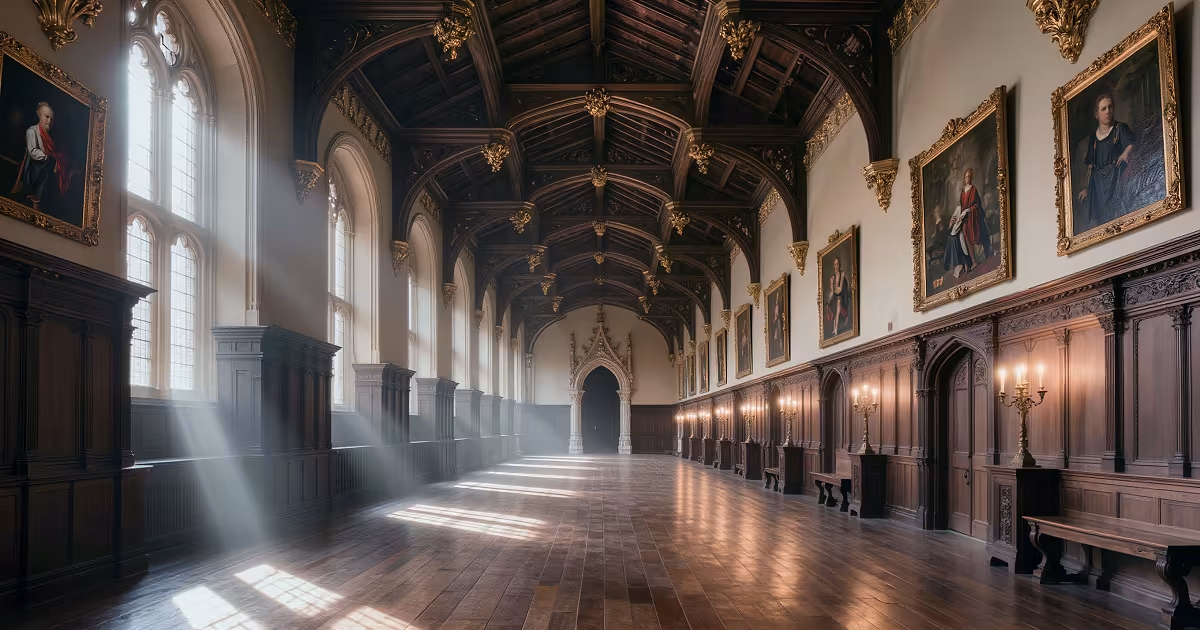
A long gallery with portraits and light from tall windows.
Illustration, not a period photograph.

Archive / Paranormal / BOT313-0241
PAR-1619ParanormalFOLKLORE
ANNE BOLEYN'S ANNIVERSARY COACH
Fig. 01 A long gallery with portraits and light from tall windows. Illustration, not a period photograph.
Opening
Blickling Hall in Norfolk is said to receive a visitor every year on 19 May, the anniversary of Anne Boleyn's execution in 1536. In the usual telling she arrives at midnight in a coach drawn by headless horses and driven by a headless coachman, holding her own head in her lap, and goes into the house. The Boleyns owned an earlier manor on the site, and Anne may have been born there.
The story is older than its star. Historian Alison Weir traced it to a legend about Anne's father, Thomas Boleyn, doomed to drive a phantom coach over the bridges between Wroxham and Blickling, probably current by the 18th century. Anne took the coach in late Victorian retellings. The present house, a Jacobean mansion owned by the National Trust, was begun more than 80 years after she died.
Timeline
1452Geoffrey Boleyn, a London merchant and later Lord Mayor, acquires Blickling, which had earlier belonged to Sir John Fastolf.
1499 to 1505Thomas Boleyn and his wife Elizabeth live at Blickling. Anne is thought by some historians to have been born there around 1501, others prefer a date near 1507, and Hever Castle in Kent is the other main candidate.
1505Blickling passes to Thomas Boleyn; the family's main seat moves to Hever.
19 May 1536Anne Boleyn is executed at the Tower of London and buried in the chapel of St Peter ad Vincula there.
1539Thomas Boleyn dies, in his bed, three years after his daughter.
1616Sir Henry Hobart, Lord Chief Justice of the Common Pleas, buys the estate from the Clere family.
About 1619 to 1627The present house is built to designs by Robert Lyminge, keeping the moat and some Tudor fabric.
18th centuryA legend of Thomas Boleyn's phantom coach is probably established locally.
By 1850The story has Thomas driving over 12 bridges, later 40, between Wroxham and Blickling each year for 1,000 years.
Late 19th centuryRetellings put Anne in the coach.
1940On the death of the 11th Marquess of Lothian, Blickling passes to the National Trust under the Country Houses Scheme.
19 May 1985Administrator Steve Ingram reports hearing footsteps in the house.
Key figures
Anne Boleyn, Henry VIII's second wife, the ghost of the modern story.
Thomas Boleyn, her father, the ghost of the older one.
Sir Henry Hobart, who built the present house.
Christina Hole, the folklorist who recorded the annual coach in 1940.
Alison Weir, whose book The Lady in the Tower (2009) traced how the legend changed.
The National Trust, which looks after the house and tells the ghost story as part of its heritage.
Physical and documentary trail
The ownership record is firm: the Boleyns from 1452, Hobart from 1616, the National Trust from 1940. Anne's birth there is not. A BBC report in 2005 put it plainly: some people believe Blickling was her birthplace, but there is no evidence to support it. A statue and portrait at the house are reported to carry the inscription "Anna Bolena hic nata 1507", Anne Boleyn born here 1507, which is a claim, not a record.
The ghost's paper trail is all folklore. Weir's appendix follows it from Thomas's coach and bridges to Anne's arrival, and records a local man telling the writer Richard Whittington-Egan in 1985 that it was "a load of old squit". The 1940 version treated the visit as routine:
the occupants of the house are so used to this annual appearance that they take no notice of it.
Corrections to the earlier version of this report. The present house was not built from 1616 to 1624. Hobart bought the estate in 1616, and building ran from about 1619 into the later 1620s. The earlier version also dated the stories loosely to the 18th and 19th centuries; Weir's account separates the older Thomas legend from the later Anne one.
Things you might not know
- The punishment was mileage. Thomas Boleyn's sentence was to cross a set number of local bridges, named in some versions as Belaugh, Coltishall, Hautbois, Aylsham and Burgh, every year for a millennium.
- The bridge count grew. The number went from 12 to 40 in retellings.
- Her brother has a ghost too. Norfolk folklore also has George Boleyn, executed two days before Anne, haunting the Blickling area.
- It was Harold's manor. Before the Normans, Blickling belonged to Harold Godwinson, later King Harold.
- The architect had form. Robert Lyminge had already designed Hatfield House before Blickling.
- The RAF moved in. During the Second World War the house served as the officers' mess for nearby RAF Oulton.
Competing explanations
A haunting. In the tradition, Anne's spirit returns on the anniversary to a place tied to her early life. The best-known modern account from staff is the administrator's report of footsteps on the anniversary in 1985.
A legend that changed passengers. The earliest version Weir found is about Thomas, not Anne. A famous executed queen later took over a local story about her father, a common pattern in English ghost lore, where headless coachmen are a stock figure.
A house that she never knew. The building Anne might have been born in was replaced in the 17th century, so the ghost returns to a house built long after her death.
Later life of the case
Blickling is one of several places that claim Anne's ghost, with Hever Castle and the Tower among them. The anniversary brings visitors and press attention each May, and the National Trust includes the legend in how it presents the house.
Finding
Folklore. The coach story began with Thomas Boleyn and passed to his daughter in Victorian retellings, and there is no dated first-hand account of the coach itself. The Boleyn ownership of the site is real; Anne's birth there is possible and unproven.
What still will not resolve: where Anne was born. Blickling and Hever both have a case, no record of her birth survives, and that is a question for historians rather than ghost hunters.
Evidence signature
4/9 Solid
- Witnesses
- several people
- Instruments
- nothing on record
- Paper
- official records at the time
How well documented the case is, not whether it's true. A strong record can still have an ordinary answer, and a thin one can still be real.
You decide · BLICKLING HALL
What do you think happened?
One vote per case, anonymous. You'll see how other readers voted once you've voted.