CALVADOS CASTLE
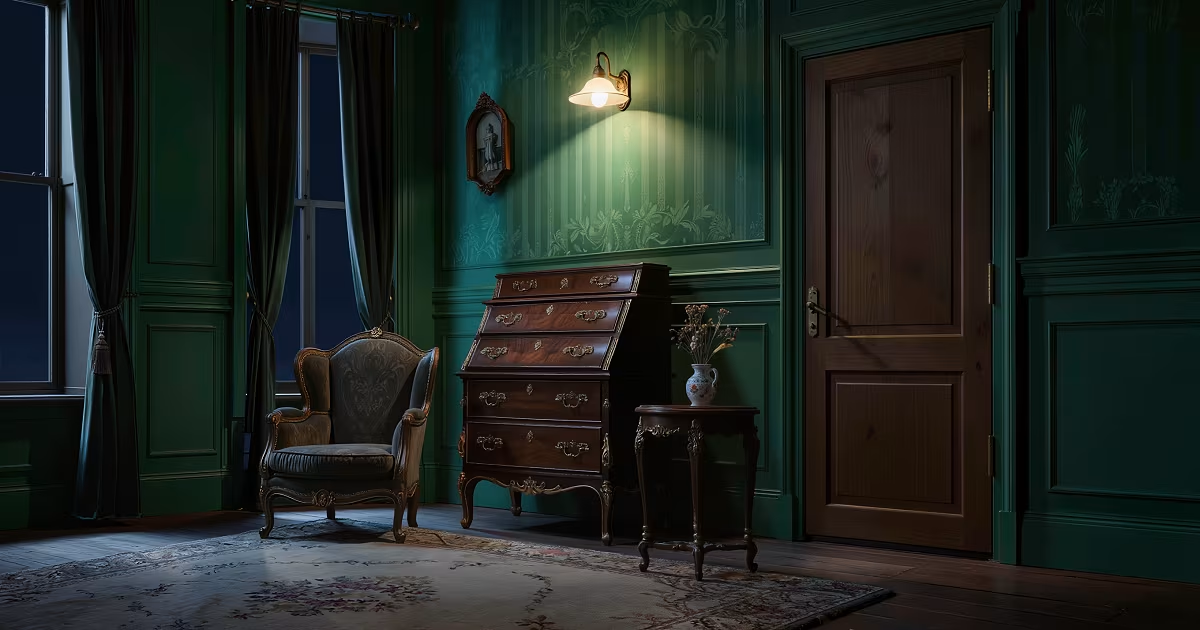
A green-panelled château room with a writing desk and a closed door.
Illustration, not a period photograph.

Archive / Paranormal / BOT313-0232
PAR-187512 OCT 1875ParanormalWITNESS RECORD
THE HAUNTING FLAMMARION RECORDED
Fig. 01 A green-panelled château room with a writing desk and a closed door. Illustration, not a period photograph.
Opening
A tenth-century castle in Calvados, in France's Normandy region, was the site of one of the nineteenth century's most seriously documented poltergeist cases, investigated and preserved for posterity by Camille Flammarion, a working astronomer who devoted part of his career to compiling what he described as scientifically established dossiers on haunted houses.
Over roughly two years, the castle's occupants, including a resident monk, endured nightly banging, furniture hurled by no visible hand, ear-splitting trumpet blasts, a locked organ playing itself, and the recurring sound of a woman sobbing or screaming for help. Exorcism attempts failed. The owners eventually sold the castle and left.
Timeline
Prior to the disturbances. The castle, dating to the tenth century, is inhabited by its owning family, with a resident monk sheltered on the property, a detail suggesting either a private chapel arrangement or a religious tenant common to French landed estates of the period.
October 1873, per one contemporary account of the case's onset. Extraordinary noises begin suddenly, with furniture reported moving about the house and violent blows resounding throughout the building, at times, per witness description, sounding as though a great cannonball were being rolled across the floors above.
1875-1876, per Flammarion's own more detailed documentation and index dating. The disturbances intensify into what one later summary characterizes as serious, sustained poltergeist activity: nighttime banging, the sound of someone running up and down the stairs, ear-splitting trumpet blasts, a woman's screams for help, sobbing, and a locked, unplayed organ nonetheless producing loud musical notes. Furniture and other objects are reported being thrown about the castle by no visible agent. The earlier 1873 date and Flammarion's 1875-76 dating do not agree, and the record does not settle which is right.
During the disturbancesVarious religious ceremonies, including formal exorcism attempts, are performed at the castle specifically to end the activity; per the surviving account, none of these interventions produces any lasting effect.
Following the failed interventionsThe castle's owners, having endured continued sleeplessness and disruption with no successful remedy, sell the property and relocate away from it entirely.
Contemporary interpretation, per the family and local tradition at the time. The disturbing presence is attributed to a previous owner, described as an angry woman, believed to be returning to the property specifically to cause continued disruption for reasons the surviving record does not further specify.
1924Flammarion publishes Haunted Houses, a roughly 410-page compilation drawing on what he described as thousands of dossiers on haunted locations accumulated since 1801, devoting a full dedicated chapter, "Strange Phenomena in a Castle in Calvados," specifically to this case, situating it alongside comparable investigated cases including a haunted house in Corrèze and a separately documented Paris disturbance from 1849 involving an unexplained, sustained stone-throwing attack that continued even after the targeted house was demolished.
Flammarion's broader methodological stance, as expressed in the same work. He explicitly warns readers against making light of or ridiculing reports of haunted locations, framing his compilation project as a serious scientific undertaking rather than mere entertainment, a stance that drew him into contemporary intellectual debate, including a documented disagreement with composer Camille Saint-Saëns over whether such phenomena implied any genuine survival of consciousness after death or were purely explicable through ordinary mental and cerebral processes.
Key figures
The resident monk is the case's specifically named category of witness, sheltered at the castle at the time the disturbances began, though the surviving record does not preserve his individual name or a detailed personal account beyond his presence during the initial 1873-dated onset.
Flammarion is the case's central documentary authority, an astronomer by profession whose parallel, decades-long project compiling and cross-referencing thousands of reported hauntings gives this specific case an unusually serious documentary treatment for its era, situating it within a broader, methodical comparative survey rather than a single, isolated anecdote.
The unnamed castle owners are the case's most directly affected parties, whose ultimate decision to sell a family property with centuries of history rather than continue enduring the disturbances represents a real, consequential outcome regardless of the phenomena's ultimate cause.
The unnamed "angry woman" attributed as the disturbance's source represents the case's own contemporary folkloric explanation, a specific attribution the surviving record offers without further biographical or documentary detail to independently verify.
Physical and documentary trail
The case has Flammarion's own dedicated, published chapter-length treatment, part of a broader, methodologically serious compilation project spanning thousands of comparable cases, and independent secondary retellings in later paranormal compendia that preserve consistent core details, banging, furniture displacement, vocal and musical phenomena, exorcism attempts, and the eventual sale of the property.
What it lacks is any surviving physical evidence beyond witness testimony recorded well after the era's own investigative standards would meet modern forensic or acoustic verification, and a fully reconciled timeline given the specific discrepancy between the 1873 onset date cited in one account and Flammarion's own 1875-76 documentation.
Things you might not know
- The family asked not to be named. The owners requested anonymity when the case was first written up, which is why it is still known only by its department, Calvados.
- It first appeared in a psychical journal. M. J. Morice set out the events in detail for the Annales des Sciences Psychiques in 1892, published in two parts.
- The house had been quiet for five years. Disturbances were reported after the family inherited the château in 1867, stopped in 1870, and did not return until October 1875.
- Some of the noises sounded like animals. The reported sounds included night-time screams, growling and something like a bellowing bull.
- Lourdes was asked to help. Alongside the exorcism in January 1876, the priest arranged a novena of Masses at Lourdes.
- Flammarion gave it a chapter. The 1924 English edition of Camille Flammarion's Haunted Houses carries the case under the title "Strange Phenomena in a Calvados Castle".
Competing explanations
A deliberate hoax, potentially perpetrated by a household member or servant with access to the castle's structure, capable of producing the reported banging, furniture displacement, and organ sounds through mundane if elaborate means, a category of explanation common to many comparable 19th-century poltergeist cases once investigated with modern methodology, though no specific individual is named as a suspect in the surviving account of this particular case.
A genuine haunting connected to the specific, named grievance the family's own contemporary tradition attributed, a deceased former owner's continued attachment to the property, a reading resting entirely on the family's own interpretive framework rather than any independently verifiable biographical connection.
An undiagnosed structural or environmental cause, such as settling foundations, wind-driven acoustic effects through the tenth-century building's aged stonework, or an unidentified wildlife infestation capable of producing sustained banging and movement, a mundane explanation category period investigators, including Flammarion himself in cases where such causes were eventually confirmed, sometimes applied to comparable disturbances after sufficiently thorough on-site investigation.
A genuine, unexplained psychical phenomenon, the reading Flammarion's own broader compiled work generally leaned toward taking seriously as a category worth scientific study, without claiming certainty about the specific underlying mechanism in any individual case.
Later life of the case
The Calvados castle disturbance remains a frequently cited case within serious historical treatments of 19th-century French poltergeist phenomena specifically because of Flammarion's own methodical documentary approach, distinguishing it from more casually reported hauntings of the same general period. Its inclusion alongside comparable cases in his broader compiled work situates it as part of a genuine, if now largely historical, tradition of quasi-scientific paranormal investigation predating modern parapsychology by several decades.
Finding
A real French castle's occupants, including a resident monk, experienced a sustained, multi-sensory disturbance documented seriously enough to draw the attention of a working professional astronomer, who devoted a dedicated chapter to the case within his broader, methodical compilation of comparable reports. The disturbance ended not through any successful exorcism but through the family's own decision to abandon the property entirely, a real and consequential outcome regardless of the phenomena's cause.
What still will not resolve: the specific date discrepancy between the case's reported 1873 onset and Flammarion's own 1875-76 documentation, and any modern forensic or acoustic re-examination of a case whose surviving evidence consists entirely of period testimony. Given how carefully it was recorded at the time, it is best read as a real 19th-century disturbance rather than later folklore.
Evidence signature
3/9 Thin
- Witnesses
- several people
- Instruments
- nothing on record
- Paper
- press and later accounts
How well documented the case is, not whether it's true. A strong record can still have an ordinary answer, and a thin one can still be real.
You decide · CALVADOS CASTLE
What do you think happened?
One vote per case, anonymous. You'll see how other readers voted once you've voted.