BERRY POMEROY
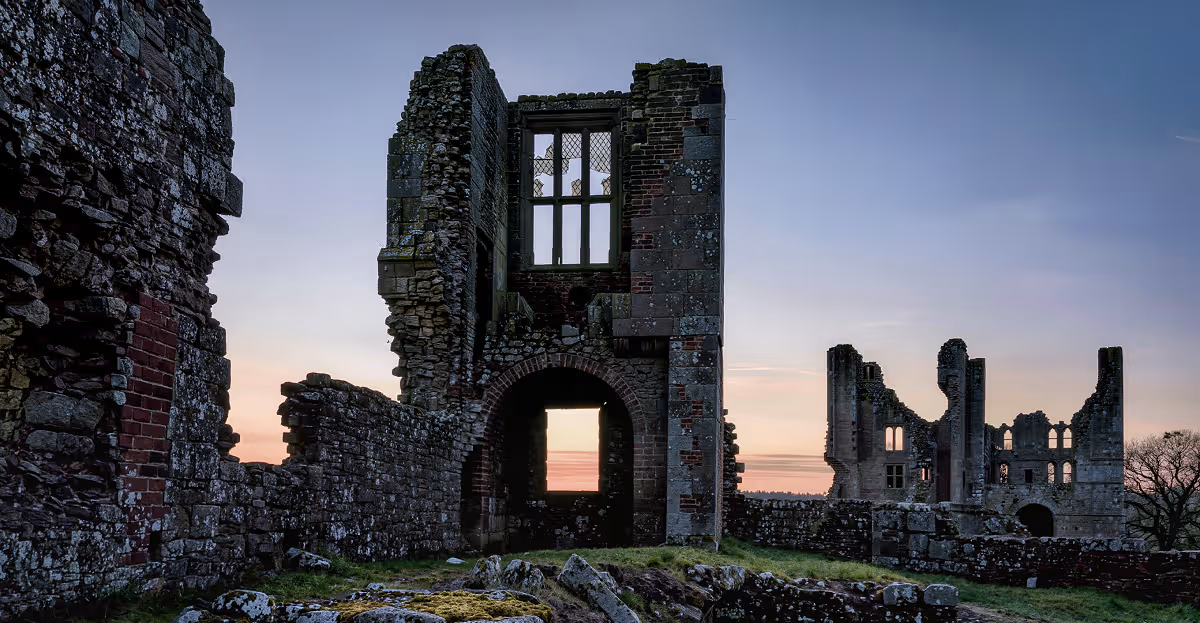
The ruined walls and empty windows of a castle at dusk.
Illustration, not a period photograph.

Archive / Paranormal / BOT313-0202
PAR-1886ParanormalFOLKLORE
THE WHITE LADY AND THE BLUE LADY
Fig. 01 The ruined walls and empty windows of a castle at dusk. Illustration, not a period photograph.
Opening
Berry Pomeroy Castle stands on a limestone outcrop above a wooded valley near Totnes in Devon. It is two buildings in one: a late medieval castle of the Pomeroy family, and inside its walls the shell of a grand Elizabethan mansion built by the Seymours, who bought the estate in 1547. The mansion was abandoned around 1700 and has been a ruin ever since.
It is often called one of the most haunted castles in England. Its two famous ghosts are the White Lady, said to be Margaret Pomeroy, starved in the dungeon by her jealous sister, and the Blue Lady, said to be a daughter of the house who killed the child she bore to her own father.
Timeline
1086The Domesday Book records the de la Pomeroy family holding Berry Pomeroy, shortly after the Norman Conquest.
Late 15th centuryThe castle is built. Its first documented mention is in 1496, and excavations found no buildings older than that period.
1547Edward Seymour, 1st Duke of Somerset and brother of Jane Seymour, buys the castle from Sir Thomas Pomeroy. Somerset is executed in 1552, and his son regains the estate in 1558.
1560 to 1580Lord Edward Seymour clears the Pomeroy buildings in the courtyard and builds a four-storey house. His son adds a north range around 1600.
1694The castle is last recorded in use. The family moves to Wiltshire, and by 1701 the antiquary John Prince describes it as a ruin.
1897John Ingram's The Haunted Homes and Family Traditions of Great Britain prints the Blue Lady story told by the physician Walter Farquhar.
1980 to 1996Excavations find no evidence for the popular stories that the house was destroyed by Civil War cannon or by lightning.
Key figures
The Pomeroy family held the land for nearly five centuries and gave the castle its name and its ghosts.
The Seymours built the mansion and still own the castle. It is held by the Duke of Somerset and managed by English Heritage.
Sir Walter Farquhar, a physician later made a baronet, is named in the best-known ghost account. In it, he is called to treat a steward's wife, sees a richly dressed woman in distress climb a staircase, and is told the next morning that the figure appears before a death in the house. The wife dies that day.
Physical and documentary trail
What survives: the castle's building history, recorded by English Heritage and decades of excavation, and the 19th-century ghost literature. No historical record supports the imprisoned sister or the murdered child, and the Farquhar story was published long after the events it describes, at second hand.
Things you might not know
- It is still a Seymour castle. The family that bought it in 1547 still owns it.
- The ruin hides a painting. In 1978 a wall painting of the Adoration of the Magi, dated to around 1490 to 1500, was found in the gatehouse.
- The cannon story is wrong. Excavations found no sign of Civil War bombardment or a lightning fire, the two most popular explanations for the ruin.
- The two ladies keep merging. Many retellings blend the White Lady and the Blue Lady into one.
- There was a wishing tree. Visitors once whispered wishes against a beech tree and walked backwards around it.
- The Pomeroys never lived in the mansion. The grand house in the ruins is Seymour work. The family in the ghost stories had sold up more than a decade before work began.
Competing explanations
A haunted ruin. Visitors report dread, cold spots and apparitions, especially near St Margaret's Tower and the dungeon, and the White Lady is said to have been seen on the ramparts as recently as 1987.
A romantic ruin with Victorian legends. The stories match the Gothic themes popular in the 19th century: imprisoned sisters, secret births, omens of death. They attach to the most dramatic setting in south Devon and to a family whose real history left few records.
Later life of the case
Berry Pomeroy is a fixture of haunted Britain lists and ghost tourism, and the ruin's atmosphere does much of the work.
Finding
The castle and its long history are real. The ghost stories are Victorian in form and have no support in the historical record, which has no Margaret starved by Eleanor and no murdered child. That doesn't settle what modern visitors feel there, which can't be tested.
What still will not resolve: where the Farquhar story came from before Ingram printed it in 1897.
Evidence signature
3/9 Thin
- Witnesses
- several people
- Instruments
- nothing on record
- Paper
- press and later accounts
How well documented the case is, not whether it's true. A strong record can still have an ordinary answer, and a thin one can still be real.
You decide · BERRY POMEROY
What do you think happened?
One vote per case, anonymous. You'll see how other readers voted once you've voted.