LALAURIE MANSION
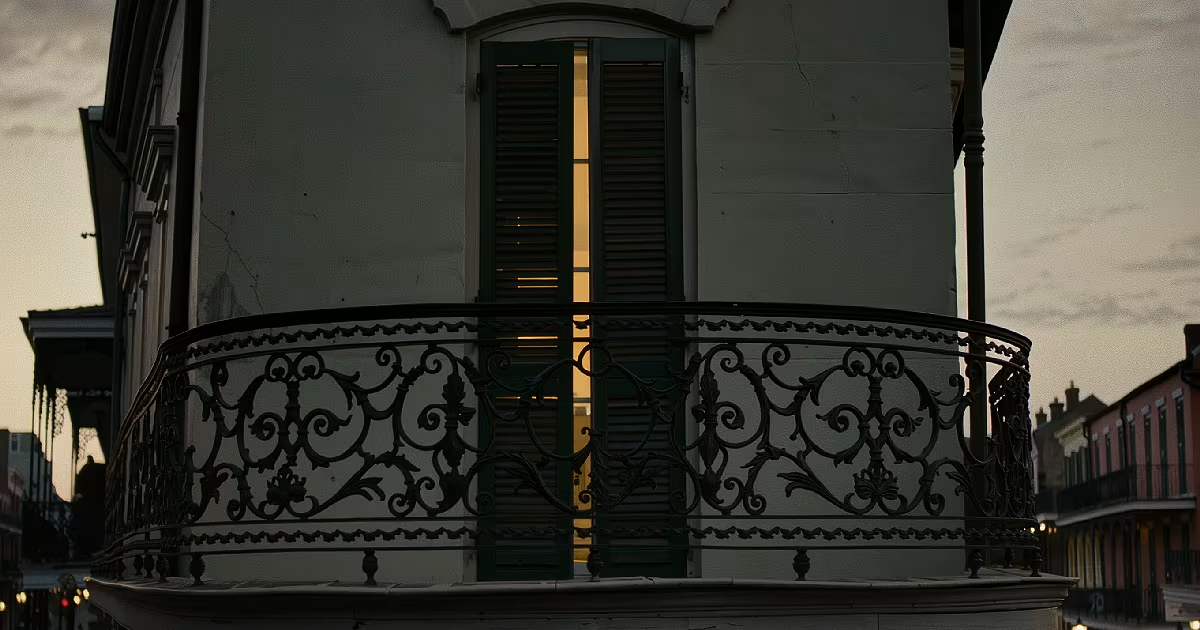
LaLaurie Mansion, 1140 Royal Street, present day.
Illustration, not a period photograph.
Opening
On 10 April 1834, a fire broke out at the Royal Street mansion of Marie Delphine Macarty LaLaurie, a prominent New Orleans Creole socialite, in the city's French Quarter. Neighbors and rescuers who broke into the house to fight the blaze found, in the upper floors, seven enslaved people bound in irons, starved, and bearing evidence of prolonged, deliberate abuse. Word spread within hours. A crowd gathered, turned into a mob, and gutted the house's interior. LaLaurie fled the city before any formal prosecution could occur and died in Paris fifteen years later, having never faced justice for what was found.
That much is documented, cross-referenced across contemporary newspaper accounts, legal records, and family correspondence, and not seriously disputed by any historian who has examined the case closely. What has grown up around that documented core, over nearly two centuries of retelling, is a separate and considerably less reliable body of material: elaborate claims of surgical mutilation, live burial, and grotesque body modification that trace not to 1834 but to a single sensationalized 1946 book, and that the case's most rigorous modern historian treats as embellishment rather than established fact.
Timeline
1787-1825. Delphine Macarty is born in New Orleans during the Spanish colonial period, marries twice, is twice widowed, and in 1825 marries her third husband, physician Louis LaLaurie, moving into what would become the notorious Royal Street mansion.
1833. LaLaurie is reported to have chased a young enslaved girl through the house with a whip; the girl falls from the roof and dies. LaLaurie attempts to conceal the death; police subsequently locate the girl's body hidden in a well on the property. Authorities fine LaLaurie and order the sale of her remaining enslaved people, a legal record independently documented rather than a later embellishment.
Following the forced sale order. LaLaurie arranges, through relatives and friends acting as intermediary purchasers, to have the same enslaved people quietly bought back and returned to her household, circumventing the order's actual intent, a documented legal maneuver reflecting real contemporary awareness that something was seriously wrong in the household even before the 1834 fire.
10 April 1834. A fire breaks out, reportedly in the kitchen; a later account states an elderly enslaved woman chained to the stove had deliberately set the blaze specifically to escape ongoing torture, though the precise contemporaneous sourcing for this specific claim (as opposed to the fire's basic occurrence and the discoveries that followed it) has not been as consistently traceable in later historical review as the discoveries themselves.
Same day. Rescuers, reportedly obstructed by LaLaurie's own initial refusal to hand over keys to the relevant part of the house while she focused on removing furniture, force entry and find seven enslaved people restrained in the upper floors, in a state contemporary accounts describe as severely malnourished and bearing evidence of long-term physical abuse, including reported use of spiked iron collars restricting head movement.
Same day, following the discovery. News spreads rapidly through the city; a crowd gathers at the property, and outrage escalates into a mob that ransacks and severely damages the mansion's interior. LaLaurie and her family flee, reportedly by carriage toward the waterfront, and make their way out of Louisiana; she settles in Paris and does not return.
1836. British writer and social critic Harriet Martineau visits New Orleans and later, in 1838, publishes an account recounting local residents' recollections of the LaLaurie case, including observations that her enslaved people had appeared "singularly haggard and wretched" compared to others in the city, an early secondhand documentary source for the household's general reputation predating the fire itself.
7 December 1849. LaLaurie dies in Paris at age 62, having never returned to Louisiana or faced formal prosecution for the 1834 discoveries.
1946. Jeanne deLavigne publishes The Haunted House of the Rue Royale (sometimes cited as Ghost Stories of Old New Orleans), a book that introduces and popularizes the case's most extreme and specific claims: enslaved people allegedly used in grotesque pseudo-medical experiments, bodies reshaped to resemble animals, forced sex-change procedures, live burial. These details do not appear in the 1834 contemporary press coverage or in the documented legal record, and later historians identify deLavigne's book, along with an earlier, separate 19th-century personal smear campaign by a spurned neighbor, as their most likely actual origin.
2012. Historian Carolyn Morrow Long publishes Madame Lalaurie, Mistress of the Haunted House, the case's most rigorous modern historical treatment, drawing on eyewitness testimony, archival legal documents, and LaLaurie family correspondence specifically to separate the documented 1833-34 record from the accumulated later legend. Long's central finding treats LaLaurie's guilt regarding the seven enslaved people found in 1834 as effectively beyond serious dispute, while explicitly identifying the more extreme surgical-experiment and mutilation stories as later, unsupported embellishment rather than established historical fact.
Present day. The mansion, still standing and privately owned at 1140 Royal Street, is not open for interior tours, but remains a fixture of New Orleans ghost-tour circuits, widely marketed as the city's "most haunted" building, with guides typically narrating the full, embellished legend, experiments included, from the sidewalk outside rather than distinguishing it from the documented historical record.
Key figures
LaLaurie herself is the case's central and, per Long's own carefully sourced conclusion, not seriously disputed perpetrator regarding the seven enslaved people discovered in 1834, a documented finding resting on contemporary eyewitness testimony and legal record rather than only later reputation.
The unnamed enslaved woman said to have set the fire is the case's most consequential and most under-documented figure: her specific act, if accurately reported, directly triggered the discovery that ended LaLaurie's ability to continue the abuse, yet she herself remains unnamed in the surviving record, a telling gap given how much attention the case's perpetrator has received by comparison.
deLavigne is the figure most directly responsible for the case's modern, more sensationalized legend, and her 1946 book's specific, still-uncorroborated claims form the backbone of nearly every "surgical experiment" detail that circulates in popular retellings and ghost tours today.
Long is the case's most significant modern historian, whose explicit methodological project, separating documented fact from accumulated legend using primary archival sources, gives this file a genuinely rare level of scholarly rigor for a story this widely mythologized.
Physical and documentary trail
On the paper, this file has real contemporary 1834 newspaper coverage, a documented 1833 legal record (the whipping death, the forced sale order, and LaLaurie's documented circumvention of it), Martineau's 1838 secondhand account from residents who remembered the case firsthand, French civil death records confirming LaLaurie's 1849 death in Paris, and Long's 2012 archival synthesis directly built from family correspondence and legal documents.
What it conspicuously lacks is any contemporaneous 1834 source for the specific surgical-mutilation and body-modification claims that dominate the case's modern popular retelling; those details' earliest identifiable appearance in the documentary record is deLavigne's 1946 book, well over a century after the events themselves, with no earlier source bridging that gap.
History has just one indisputable truth in this case: cruelty carried out under the color of respectability.
Competing explanations
Documented, sustained, deliberate cruelty toward enslaved people in her household, exactly as the 1834 contemporary record and subsequent legal history establish, without requiring any of the later embellished surgical-experiment claims to be true. This reading, Long's own carefully sourced position, treats the documented core as fully sufficient on its own terms and does not need additional, unsupported horror to establish LaLaurie's guilt or the severity of what was found.
The fully embellished popular legend, including surgical mutilation, forced sex-change procedures, and live burial, as recounted on most modern ghost tours and in deLavigne's 1946 book. This version has no contemporaneous 1834 source and, per Long's explicit historical analysis, appears to have been constructed more than a century after the fact, likely drawing on the general cultural horror of the documented core case and elaborating considerably beyond it.
A press- and reputation-driven exaggeration even of the documented 1834 discoveries themselves, given the era's own sensationalist newspaper culture and the specific personal animus of at least one contemporary who had previously campaigned against LaLaurie. Long's own work takes this possibility seriously without ultimately finding it sufficient to overturn the core, well-corroborated finding of genuine, severe abuse.
Later life of the case
The LaLaurie Mansion's transformation into New Orleans's most marketed "haunted house" runs on the fully embellished version of the story far more often than the documented one, a pattern Long's own book was explicitly written to push back against. The gap between the historically established cruelty toward seven real, named-in-record but individually under-documented enslaved people, and the invented, decontextualized horror-story details that dominate tourist retellings, is itself a useful case study in how a genuinely serious historical atrocity can be simultaneously commercialized and stripped of its actual documented specificity.
Finding
Delphine LaLaurie's guilt regarding the severe, sustained abuse of the seven enslaved people discovered in her home in April 1834 is established by contemporary eyewitness testimony, independent legal record, and rigorous modern archival historical work, and is not seriously disputed by any credible historian. The considerably more extreme surgical-mutilation and body-modification claims that dominate the case's modern popular telling have no contemporaneous source and trace specifically to a single 1946 book published well over a century after the events it describes.
What still will not resolve: the names and full individual fates of the seven enslaved people found in 1834, who remain far less documented in the historical record than their perpetrator, and the precise origin of the specific claim that one of them deliberately set the fire that led to their discovery. This file treats the documented cruelty as fully established and the embellished legend as exactly that, embellishment, following the same distinction Long's own scholarship insists on.