WAVERLY HILLS SANATORIUM
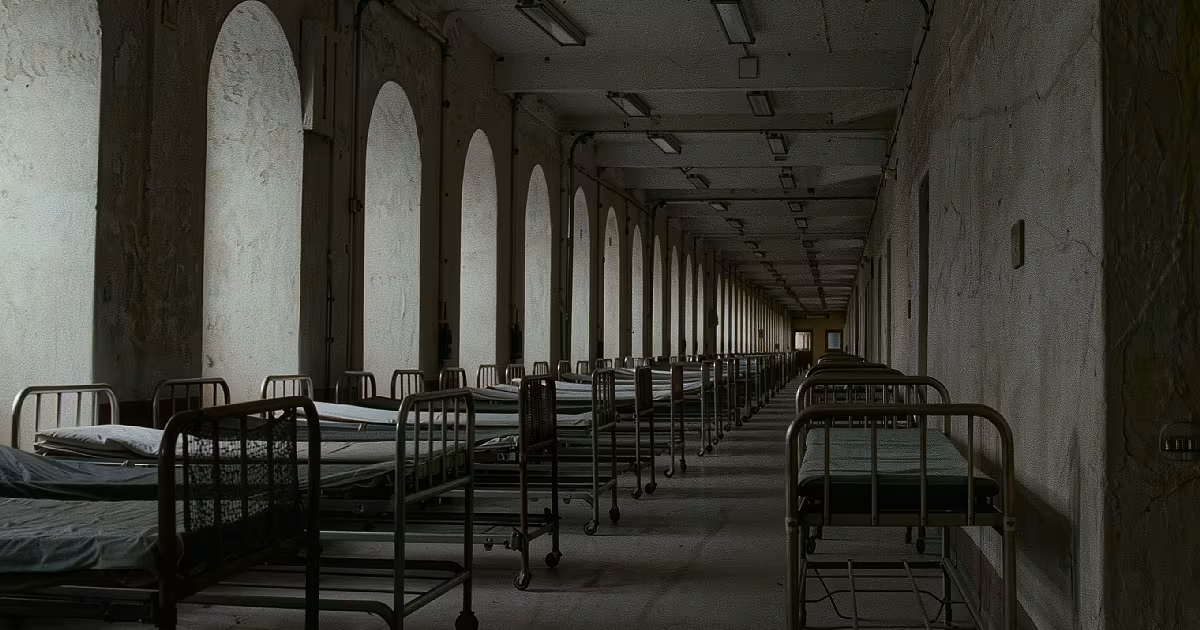
Waverly Hills Sanatorium main building, present day.
Illustration, not a period photograph.
Opening
Waverly Hills Sanatorium opened on 26 July 1910 outside Louisville, Kentucky, built to treat patients suffering from tuberculosis at a moment when the disease, contagious and, before antibiotics, essentially untreatable, was killing Americans in devastating numbers. The five-story Gothic Revival building that stands today, completed in 1926, replaced an earlier, smaller wooden structure that had been overwhelmed within a few years of opening. Every modern ghost tour, cable television special, and paranormal investigation site repeats a specific number for how many people died there: 63,000, sometimes inflated even further to 123,000. Independent historical researchers who have actually gone looking for supporting records have consistently found that number is not just imprecise but off by roughly a factor of eight.
Timeline
1883. Major Thomas H. Hays purchases the land, initially building a family home and, finding no nearby school for his daughters, a one-room schoolhouse he names Waverly School, giving the site its eventual name.
1906. Facing a serious tuberculosis outbreak worsened by the wetlands surrounding the Ohio River, an ideal breeding ground for the disease, the Louisville and Jefferson County Board of Tuberculosis Hospital forms specifically to address the crisis.
1908-1910. Construction begins on a two-story wooden sanatorium at the Waverly Hills site, opening 26 July 1910 with capacity for roughly 40 to 50 patients.
Following years. The tuberculosis epidemic in the region far exceeds the small facility's capacity within just a few years, prompting plans for a much larger replacement.
March 1924. Construction begins on the large brick-and-concrete five-story building that stands today, designed to house up to 400 to 500 patients at capacity.
17 October 1926. The new main building opens, becoming a largely self-contained institutional world, treatment wards, staff quarters, kitchens, and its own on-site infrastructure, reflecting the isolation-based public health strategy standard for tuberculosis care at the time.
Through the 1920s-30s. Waverly Hills becomes a genuine center for period tuberculosis treatment innovation, including extensive use of open-air porches (fresh air exposure was a standard, if only partially effective, contemporary treatment approach) and surgical interventions including thoracoplasty, a procedure involving the removal of ribs to deliberately collapse an infected lung and slow the disease's spread, reflecting real, if today outdated and severe, period medical practice rather than deliberate cruelty.
1937. A major regional flood destroys many of the sanatorium's official medical records predating that year, permanently limiting how precisely later researchers can reconstruct the facility's actual historical death toll, a genuine archival gap that later inflated claims have exploited rather than honestly acknowledged.
Early-to-mid 1940s. Death rates at the facility rise measurably, driven substantially by returning World War II veterans who had contracted tuberculosis overseas, with one documented peak year seeing roughly 152 to 162 deaths, the highest single-year total independently researchers have been able to source to any credible period record.
1943. Streptomycin, the first effective antibiotic treatment for tuberculosis, is discovered, beginning a steady decline in the disease's prevalence and, correspondingly, in the sanatorium's patient population over the following two decades.
1961. With tuberculosis cases having fallen dramatically, Waverly Hills closes as a TB treatment facility.
1962. The building reopens under new purpose as Woodhaven Geriatrics Sanitarium, a nursing and geriatric care facility, a considerably less studied and, per multiple later accounts, considerably darker chapter in the building's history.
Through the 1960s-70s. Conditions at Woodhaven reportedly deteriorate significantly, with later accounts describing patient neglect, overcrowding, understaffing, and unnecessary or improperly administered shock treatments, some resulting in patient deaths, a period of documented institutional failure distinct from and, in terms of actual verified cruelty, arguably worse than the earlier tuberculosis era, despite receiving far less public attention.
1982. The State of Kentucky formally shuts Woodhaven down, citing confirmed patient mistreatment; specific details of the abuse were reportedly never fully disclosed publicly at the time.
2001. Charlie and Tina Mattingly purchase the long-abandoned building, subsequently opening it for historical tours, ghost tours, and paranormal investigations, with proceeds directed toward the property's ongoing restoration and preservation.
Independent historical review, conducted by researchers working from surviving period documentation including a treating physician's own autobiography. This research places the facility's actual documented tuberculosis-era death toll at approximately 5,000 to 8,000 over its full operational history, a figure independently arrived at by more than one researcher working from different surviving sources, standing in stark contrast to the roughly 63,000 figure that dominates popular retellings and, in some more extreme versions, is inflated further still to 123,000.
Key figures
Dr. Dunning S. Wilson, the facility's medical director during its tuberculosis era, oversaw a genuine, if by modern standards severe, period medical operation, and his own later autobiography is cited by independent researchers as one of the more credible surviving primary sources for reconstructing the facility's actual death toll, as distinct from the inflated figures that later commercial retellings adopted.
The Mattinglys are the building's current owners and the primary commercial stewards of its modern ghost-tourism identity, operating historical tours, ghost tours, and a seasonal haunted-house attraction, with a stated goal of using proceeds toward genuine physical restoration of a deteriorating historic structure.
Independent historical researchers, working from period documentation, the physician's autobiography, and the acknowledgment of the 1937 flood's genuine record destruction, represent the case's most careful documented counter to the popular death-toll figure, though their more modest and better-sourced estimate receives far less circulation than the dramatically larger number repeated on television specials and tour narration.
Physical and documentary trail
On the paper, this file has a real, well-documented institutional history: formation records for the county tuberculosis board, construction and capacity documentation for both the original and 1926 buildings, a documented and dated 1937 flood that genuinely destroyed a significant portion of the pre-1937 medical records, a physician's own autobiography providing surviving period mortality detail, and a formal 1982 state closure citing confirmed patient mistreatment during the later Woodhaven era.
What it lacks, and what the frequently repeated 63,000-death figure has never been able to produce, is any surviving primary document, a hospital ledger, a period newspaper report, a state health record, actually supporting a total anywhere near that scale; independent researchers working from the sources that do survive have consistently arrived at figures closer to one-eighth of that number.
The often-cited 63,000 death toll is nearly eight times the documented 8,000 deaths.
Competing explanations
A genuinely tragic but historically modest death toll, roughly 5,000 to 8,000 across the facility's full tuberculosis-era operation, consistent with the surviving physician's autobiography and independent researchers' reconstructions, with the building's reputation for mass death substantially inflated by decades of tourism-driven storytelling rather than reflecting the actual documented historical record.
An unknowable, potentially much higher true figure, given the genuine and specific gap created by the 1937 flood's destruction of pre-1937 records, a real archival limitation that means no fully complete accounting will likely ever be possible in either direction. This reading, while acknowledging real uncertainty, does not itself provide positive evidence for a number anywhere near 63,000, only an honest admission that the true lower-bound figure could theoretically exceed the roughly 8,000 that surviving evidence supports.
Deliberate commercial inflation, given the building's current, ongoing operation as a for-profit ghost-tour and haunted-attraction venue, where a dramatically larger death toll serves an obvious business interest in generating exactly the kind of "most haunted building in America" reputation that draws paying visitors, independent of whether the underlying historical claim can actually be supported.
Later life of the case
Waverly Hills has become one of the most commercially prominent "haunted" locations in the United States, featured on multiple television paranormal investigation programs and marketed heavily around its inflated death-toll figure specifically because a genuinely staggering number of deaths under one roof makes for a considerably more compelling tourism pitch than the real, still-tragic but far more modest historical figure independent research actually supports. Its later Woodhaven-era history of documented, confirmed patient abuse receives comparatively little attention in the building's popular narrative, despite representing a period of verified institutional failure with real, if incompletely disclosed, victims.
Finding
Waverly Hills is a real, historically significant tuberculosis treatment facility whose surviving documentation, a physician's autobiography, formation and construction records, and a well-documented 1937 flood that destroyed earlier records, supports an actual death toll in the range of 5,000 to 8,000 across its operational history, not the 63,000 or 123,000 figures that dominate its modern popular and commercial reputation. Its later Woodhaven Geriatrics era involved confirmed, state-investigated patient mistreatment, a genuinely dark chapter that receives far less attention than the earlier, more heavily mythologized tuberculosis period.
What still will not resolve: a fully complete death toll for the pre-1937 period, given the genuine record destruction from that year's flood, meaning the true lower bound cannot be established with total precision even by careful researchers. What is resolved, and worth stating plainly regardless, is that no surviving source supports anything close to the number most visitors are told before they ever step inside.