ST. LOUIS EXORCISM
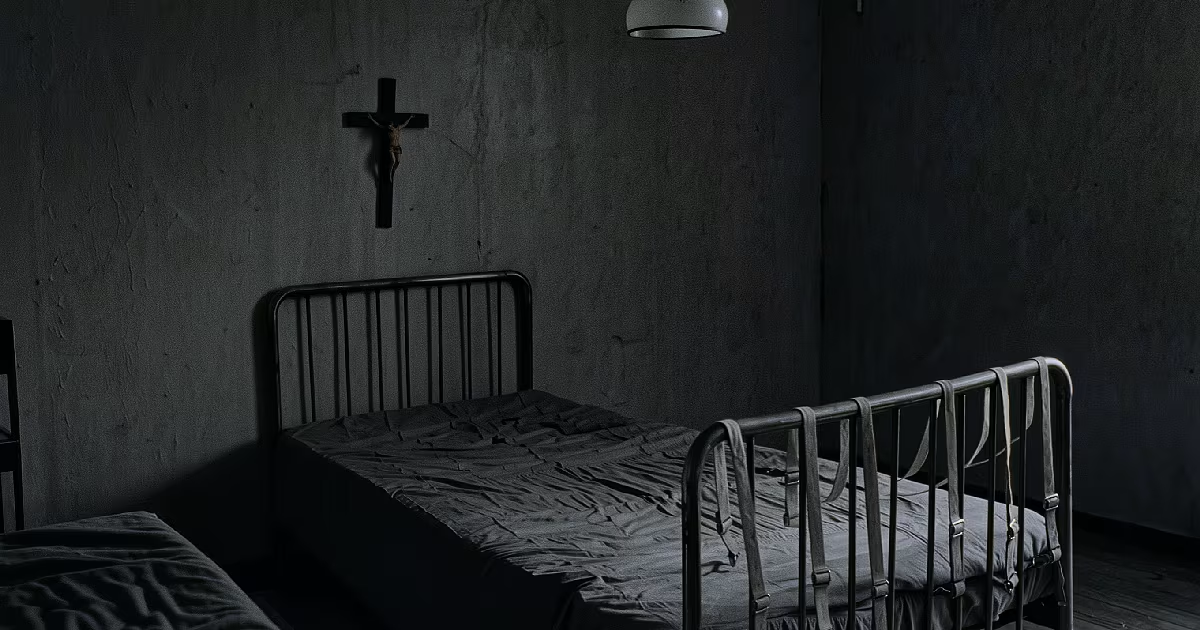
Fr. Raymond J. Bishop diary excerpt, 1949.
Illustration, not a period photograph.
Opening
In January 1949, a fourteen-year-old boy in Cottage City, Maryland, whom the Catholic Church would identify only by the pseudonym "Roland Doe," began experiencing what his family described as unexplained scratching sounds, moving furniture, and shaking religious pictures, following his use of a Ouija board to try to contact a recently deceased aunt who had introduced him to spiritualism. Over the following months, the family sought help first from doctors, then from a Lutheran pastor, then from Catholic priests, culminating in a series of formal exorcism rites, an estimated twenty to thirty performed across multiple locations including Georgetown University Hospital and St. Louis's Alexian Brothers Hospital, that a young Georgetown student named William Peter Blatty would hear about at the time and, more than two decades later, transform into his novel The Exorcist.
This case sits at an unusually well-documented intersection of contemporaneous religious diary-keeping, later investigative journalism that tracked down over a hundred people who actually knew the family, and a formal 2021 identification of the boy himself, whose real life afterward turned out to be almost aggressively ordinary.
Timeline
January 1949. Strange occurrences begin in the boy's Cottage City home, scratching inside the walls that exterminators cannot explain, a shaking picture of Christ, dripping sounds reported by both the boy and his grandmother, beginning shortly after the death of an aunt who had taught him to use a talking board.
Following weeks. Reported phenomena escalate: furniture reportedly moves and topples on its own, fruit and household objects are said to fly across rooms, a Bible allegedly lands at the boy's feet, and, according to the family's account, his school desk moves on the classroom floor in front of other students, leading to his removal from school. A Lutheran pastor witnesses some of these events firsthand and records his own observations in a letter to Duke University's Parapsychology Laboratory, subsequently referring the family to the Catholic Church for help.
Following the referral. The family briefly hospitalizes the boy at Georgetown University Hospital in Washington, D.C., for a roughly three-and-a-half-day observation period, without medical staff identifying a clear physical or psychiatric cause sufficient to explain the reported phenomena to the family's satisfaction.
Early March 1949. The family relocates, first to a relative's home in Normandy, Missouri, then bringing the boy into contact with Jesuit priests associated with St. Louis University, specifically because Father Raymond J. Bishop had learned of the case through a student who was the boy's own cousin.
March-April 1949. Jesuit priests, led by Father William S. Bowdern and assisted by Father Walter Halloran, perform the Roman Ritual of exorcism an estimated twenty to thirty times, split between a relative's St. Louis home and the Alexian Brothers Hospital. Bishop keeps a detailed diary throughout, later cited as the primary contemporaneous documentary record of the ritual's specific content and the boy's reported behavior during it: vomiting, urination, spitting, speaking in what witnesses described as an unfamiliar deep adult voice, and, per some accounts, speaking words in Latin the boy had no known way of having learned.
During one session. The boy reportedly slips a hand free of physical restraints, breaks a bedspring loose from the mattress frame, and uses the resulting metal as an improvised weapon, cutting Halloran's arm and forcing that particular exorcism attempt to be halted. Separately, at another point, Halloran's nose is reportedly broken during the rite.
Following the final session. The priests involved conclude the exorcism was ultimately successful, and the boy is reported to have returned to ordinary life afterward without further incident.
Mid-1949, shortly after the events themselves. Local newspapers print anonymous accounts of the case, the source generally believed to have been the family's own former pastor, Luther Miles Schulze, generating the first public, if pseudonymous, record of the story well before Blatty's later novel.
Early 1970s. Blatty, who had first learned of the case as a Georgetown student in 1949, consults Bishop's diary directly and speaks with Bowdern while writing his novel; the resulting book and its 1973 film adaptation, using a young girl rather than a boy as the possessed character, become one of the most commercially and culturally significant horror works in American film history, drawing ten Academy Award nominations.
1999. Journalist Mark Opsasnick publishes a detailed independent investigation in Strange Magazine, having personally interviewed more than a hundred people who had actually known the real family and the surrounding community. Opsasnick finds that several widely repeated details, including the boy's hometown and whether Georgetown Hospital was really his first stop for treatment, do not match what he was able to independently verify, and that the general local memory of the boy and his behavior at the time differs meaningfully from the more dramatic, spiritually framed version that reached wider circulation through the priests' own accounts and subsequent retellings.
2001. Skeptical Inquirer writer Joe Nickell publishes his own analysis, "Exorcism!: Driving Out the Nonsense," applying a similarly skeptical, psychologically grounded reading to the reported phenomena.
2013. Author Thomas B. Allen, who had written a full book on the case, states publicly that definitive proof the boy was genuinely possessed is "unattainable," and reports that Halloran, one of the last surviving priest-eyewitnesses before his own death, had privately expressed skepticism about the paranormal elements of the case. Directly asked to confirm the boy had been genuinely possessed, Halloran himself responds on record, "No, I can't go on record. I never made an absolute statement about the things because I didn't feel I was qualified."
December 2021. Skeptical Inquirer formally identifies the real boy as Ronald Edwin Hunkeler, born 1 June 1935. Hunkeler had died the previous year, on 10 May 2020, at age 84, in Maryland. His actual adult life, previously unknown to the public, turns out to have been a successful, decades-long career as a NASA engineer, contributing to the Apollo program and later patenting heat-resistant ceramic technology used on space shuttle panels. Acquaintances later report he had been genuinely anxious that colleagues at NASA might discover his connection to the story behind The Exorcist.
Key figures
Hunkeler is the case's central subject, and the specific contrast between the dramatic 1949 events attributed to him and his subsequent, entirely ordinary and professionally accomplished adult life is itself one of the case's more striking documented details, whatever one concludes about what actually happened when he was fourteen.
Bowdern and Bishop are the case's central religious authorities, with Bishop's contemporaneous diary standing as the most detailed surviving primary document of the ritual's specific content, a genuinely unusual level of real-time record-keeping for an event of this kind.
Halloran is the case's most important later skeptical voice from within the original participants themselves, notable specifically for declining, even decades later and under direct questioning, to affirm that what he witnessed was genuine demonic possession, a meaningfully cautious position from a man who was physically present for and injured during the events in question.
Opsasnick is the case's most thorough independent investigator, whose sheer interview volume, over a hundred people who actually knew the family, gives his skeptical findings a documentary weight that later secondhand retellings of the "true story" often lack.
Blatty is the figure responsible for the case's enormous cultural reach, and it is worth noting explicitly that his novel is fiction built from and inspired by the real case's broad outline, not a direct or literal retelling, a distinction popular "the true story behind The Exorcist" coverage sometimes blurs.
Physical and documentary trail
On the paper, this file has genuinely unusual documentation for a case of this kind: a contemporaneous priest's diary, contemporary 1949 newspaper coverage (albeit anonymized), a later formal book-length investigation by Allen drawing on direct interviews with surviving participants, Opsasnick's independent hundred-plus-interview skeptical investigation, and a 2021 confirmed identification of the central figure along with a documented, verifiable account of his subsequent life.
What it lacks is any independent medical or psychiatric record from 1949 itself addressing what specifically happened during the boy's Georgetown Hospital observation period, and any physical evidence beyond witness testimony for the more dramatic reported phenomena, moving furniture, flying objects, spontaneous Latin speech, none of which were captured photographically or through any period recording technology.
No, I can't go on record. I never made an absolute statement about the things because I didn't feel I was qualified.
Competing explanations
A severe psychiatric or emotional crisis in a grieving, troubled adolescent, amplified and given specific religious content by the surrounding adults' own spiritualist and later Catholic interpretive frameworks. This reading is directly supported by Opsasnick's independent community interviews, which found accounts of the boy's behavior and reputation at odds with the more dramatic later retellings, and by Halloran's own persistent, lifelong refusal to affirm genuine possession despite having personally participated in and been injured during the rites.
A hoax or attention-seeking behavior by a boy processing grief and family attention in an unhealthy way, which escalated as adult reactions, first medical, then religious, gave the behavior an increasingly dramatic stage to play out on. This reading is consistent with several period patterns of adolescent behavioral crisis and does not require any of the more supernatural specific claims (Latin speech, levitation-adjacent phenomena) to be literally true.
Genuine demonic possession, exactly as the participating Jesuit priests concluded at the time and as later popular retellings, including Blatty's fictionalized version, have overwhelmingly presented the case. This reading rests on the priests' own contemporaneous diary account and on specific reported details, unlearned foreign language use, extraordinary physical strength or resistance, that are difficult to fully explain through psychiatric illness alone, though none of these specific claims survive in any form beyond witness testimony.
Later life of the case
The case's cultural footprint through The Exorcist vastly exceeds public knowledge of its actual, more mundane documented details, a gap Opsasnick's 1999 investigation and the 2021 identification of Hunkeler have both worked to narrow without fully closing. Hunkeler's own successful, ordinary NASA career, kept carefully separate from his connection to the story for his entire adult life, stands as one of the more genuinely poignant footnotes in modern paranormal case history: a man who spent decades contributing to actual American spaceflight technology while privately dreading that his colleagues might learn what he was, as a frightened fourteen-year-old, believed to have been.
Finding
A real family underwent a real, extensively documented religious crisis response in 1949, involving genuine hospitalization, a genuine and unusually detailed contemporaneous priest's diary, and a formally performed series of Catholic exorcism rites. What is not independently verifiable is any of the case's most dramatic specific claims, levitation, spontaneous foreign-language fluency, superhuman strength, none of which exist in any record beyond participant testimony, and what later, thorough independent investigation by Opsasnick found was a local community memory of events considerably less sensational than the version that eventually reached wider circulation.
What still will not resolve: any medical or psychiatric record from the boy's actual 1949 hospital observation, and any confirmation, from Halloran or anyone else directly present, of the case's most extraordinary specific claims beyond what survives in participant recollection and Bishop's own diary. Even the priests closest to the events, by their own final, careful words, stopped short of claiming certainty about what they had actually witnessed.